Memorandum by Minnie Perry FitzSimons (handwritten draft), page 2 — rat birthmark, removal to Charleston, third marriage of grandmother
Book 1, Page 634 ·1830–1900
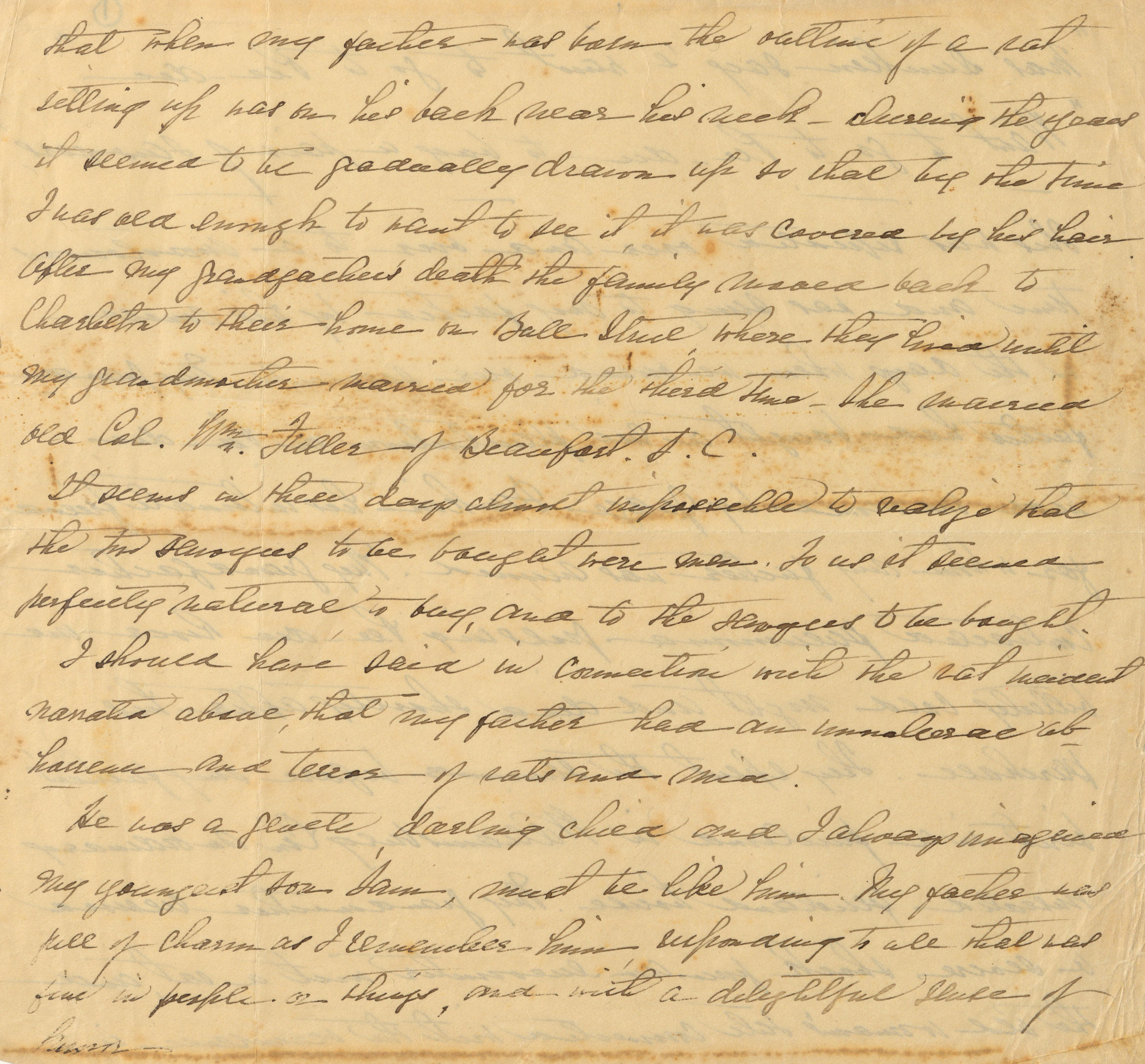
Transcription
[Continuation from page 633. Top of leaf reads:]
…that when my father was born the outline of a rat sitting up was on his back near his neck — during the years it seemed to be gradually drawn up so that by the time I was old enough to want to see it it was covered by his hair.
After my grandfather’s death the family moved back to Charleston to their home on Bull Street where they lived until my grandmother married for the third time. She married old Col. Wm. Fuller of Beaufort, S.C.
It seems in these days almost impossible to realize that the two strangers to be bought were men. To us it seemed perfectly natural to buy, and to the strangers to be bought.
I should have said in connection with the rat incident narrated above, that my father had an unnatural abhorrence and terror of rats and mice.
He was a gentle darling child and I always imagined my youngest son, Sam, must be like him. My father was full of charm as I remember him — responding to all that was fine in people or things, and with a delightful sense of humor.
AI Notes
Second sheet of the handwritten draft of Minnie Perry FitzSimons’s Perry-family memorandum, continuing the narrative begun on p633. The text is essentially identical to the typed fair copy at Book 2, p032, which that page’s header explicitly attributes to “Minnie Perry FitzSimons” — i.e., the handwritten leaves on Book 1, pp633–634 are the source draft from which that typescript was made. The writer is the compiler Amy’s mother Mary Anne Perry FitzSimons (1859–1934).
Page content: the closing of the rat-birthmark anecdote (the “outline of a rat sitting up… on his back near his neck” gradually moving up under the hair); the family’s removal to Charleston to a Bull Street house after Edward Perry’s death; the grandmother Maria Ann (Hedley) Mauger Perry Fuller’s third marriage to old Col. Wm. Fuller of Beaufort, S.C.; a one-paragraph reflection on the moral impossibility, in 1900-vintage memory, of recognising “that the two strangers to be bought were men”; an addendum about the father’s lifelong “unnatural abhorrence and terror of rats and mice”; and the closing portrait — “He was a gentle darling child and I always imagined my youngest son, Sam, must be like him” — in which Minnie likens her own father to her youngest son Samuel Cashel FitzSimons, who had died in early childhood (per the p629 FitzSimons pedigree). The “rat-birthmark child” is Benjamin Faneuil Dunkin Perry (B. F. D. Perry, b. 18 Aug 1834), named for his father’s intimate friend Judge Dunkin and orphaned before his birth by his father Edward Perry’s Pee-Dee pneumonia death (see p633). The grandmother’s three marriages were: 1st a Mr. Mauger, 2nd Edward Perry, 3rd Col. Wm. Fuller — see the family-tree page Book 1, p624.
Two small divergences between this handwritten draft and the typed fair copy at Book 2, p032 are preserved as Minnie wrote them: “the two strangers” (the typed copy reads simply “the strangers”); and “He was a gentle darling child” (no comma — the typed copy reads “a gentle, darling child”). The “strangers” euphemism appears repeatedly across both versions and across the lullaby quoted on p633 and Book 2, pp031–032 — it is the period household word for enslaved people to be bought at auction.