Memorandum by Minnie Perry FitzSimons — page 2 of 2: Mas' Dunkin anecdote and reflections on her father
Book 2, Page 32 ·1830–1900
Transcription
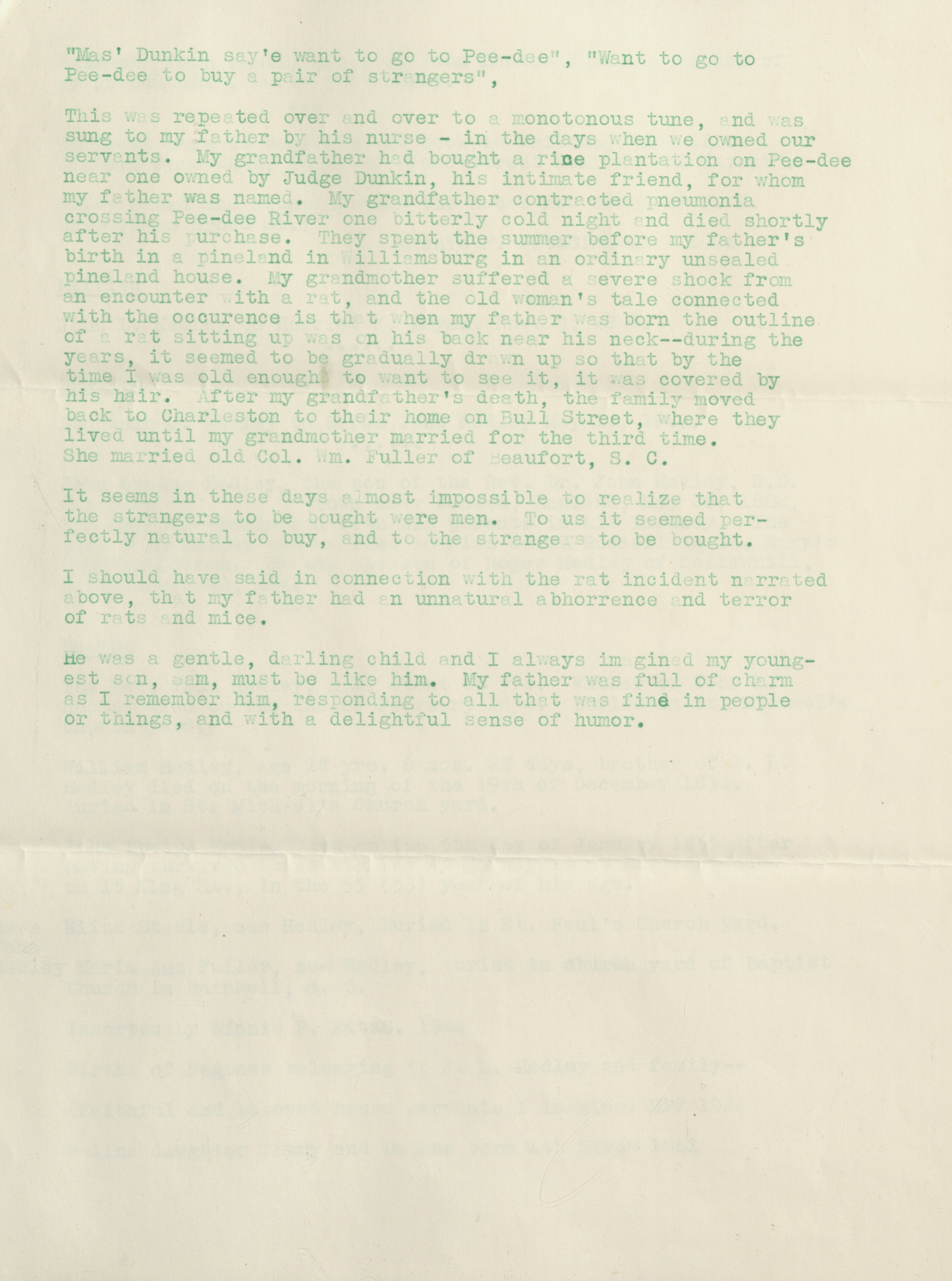
“Mas’ Dunkin says want to go to Pee-dee”, “Want to go to Pee-dee to buy a pair of strangers”.
This was repeated over and over again to a monotonous tune, and was sung to my father by his nurse — in the days when we owned our servants. My grandfather had bought a rice plantation on Pee-dee near one owned by Judge Dunkin, his intimate friend, for whom my father was named. My grandfather contracted pneumonia crossing Pee-dee River one bitterly cold night and died shortly after his purchase. They spent the summer before my father’s birth in a pineland in Williamsburg in an ordinary unceiled pineland house. My grandmother suffered a severe shock from an encounter with a rat, and the old woman’s tale connected with the occurrence is that when my father was born the outline of a rat sitting up was on his back near his neck — during the years, it seemed to be gradually drawn up so that by the time I was old enough to want to see it, it was covered by his hair. After my grandfather’s death, the family moved back to Charleston to their home on Bull Street, where they lived until my grandmother married for the third time. She married old Col. Wm. Fuller of Beaufort, S. C.
It seems in these days almost impossible to realize that the strangers to be bought were men. To us it seemed perfectly natural to buy, and to the strangers to be bought.
I should have said in connection with the rat incident narrated above, that my father had an unnatural abhorrence and terror of rats and mice.
He was a gentle, darling child and I always imagined my youngest son, Sam, must be like him. My father was full of charm as I remember him, responding to all that was fine in people or things, and with a delightful sense of humor.
AI Notes
Second sheet of the typed Minnie Perry FitzSimons memorandum begun on page 031. The page recounts a slave-nurse’s plantation song about going to the Pee-Dee ‘to buy a pair of strangers’ (i.e., to buy enslaved people at auction), the writer’s reflection on slavery and what it meant in her childhood, an addendum about her father’s lifelong terror of rats, and a closing personal portrait of her father — a man she likens to her own youngest son ‘Sam’ (Samuel Cashel FitzSimons, who died in early childhood per the p629 pedigree). The page is typed in black ribbon ink with characteristic overstrikes; the lower third is blank apart from faint show-through. The closing line reads ‘I always imagined my youngest son, Sam, must be like him.’ — putting a name to the youngest son and explaining the elegiac tone: Minnie is writing after Sam’s death in childhood, projecting her own father’s qualities onto the lost child. The ‘Mas’ Dunkin’ song is the household lullaby version of an actual rice-plantation business trip her grandfather Edward Perry undertook to buy enslaved laborers (‘strangers’) on the Pee-Dee — a transaction during which he contracted the pneumonia that killed him. Her father, the orphan born after that trip, was named Edward Dunkin Perry for Judge Benjamin Faneuil Dunkin (Chief Justice of the SC Court of Appeals), Edward Perry’s intimate friend and the owner of a neighboring Pee-Dee plantation.
End of memorandum. “Sam” in the closing line is Samuel Cashel FitzSimons, the youngest son of Minnie Perry FitzSimons and her husband Samuel Gaillard FitzSimons Sr.; per the enhanced p629 pedigree chart, Sam was one of three FitzSimons children who died in early childhood. The memorandum is therefore both a Perry-side family history (continuing the genealogy of pp031) and an elegy in which Minnie projects onto her lost child the qualities of her own beloved father, Edward Dunkin Perry.