Memoir of Mary Anne Perry FitzSimons, page 1 — 'Mas' Dunkin' lullaby and her grandfather Edward Perry's Pee-Dee purchase
Book 1, Page 633 ·1830–1900
Transcription
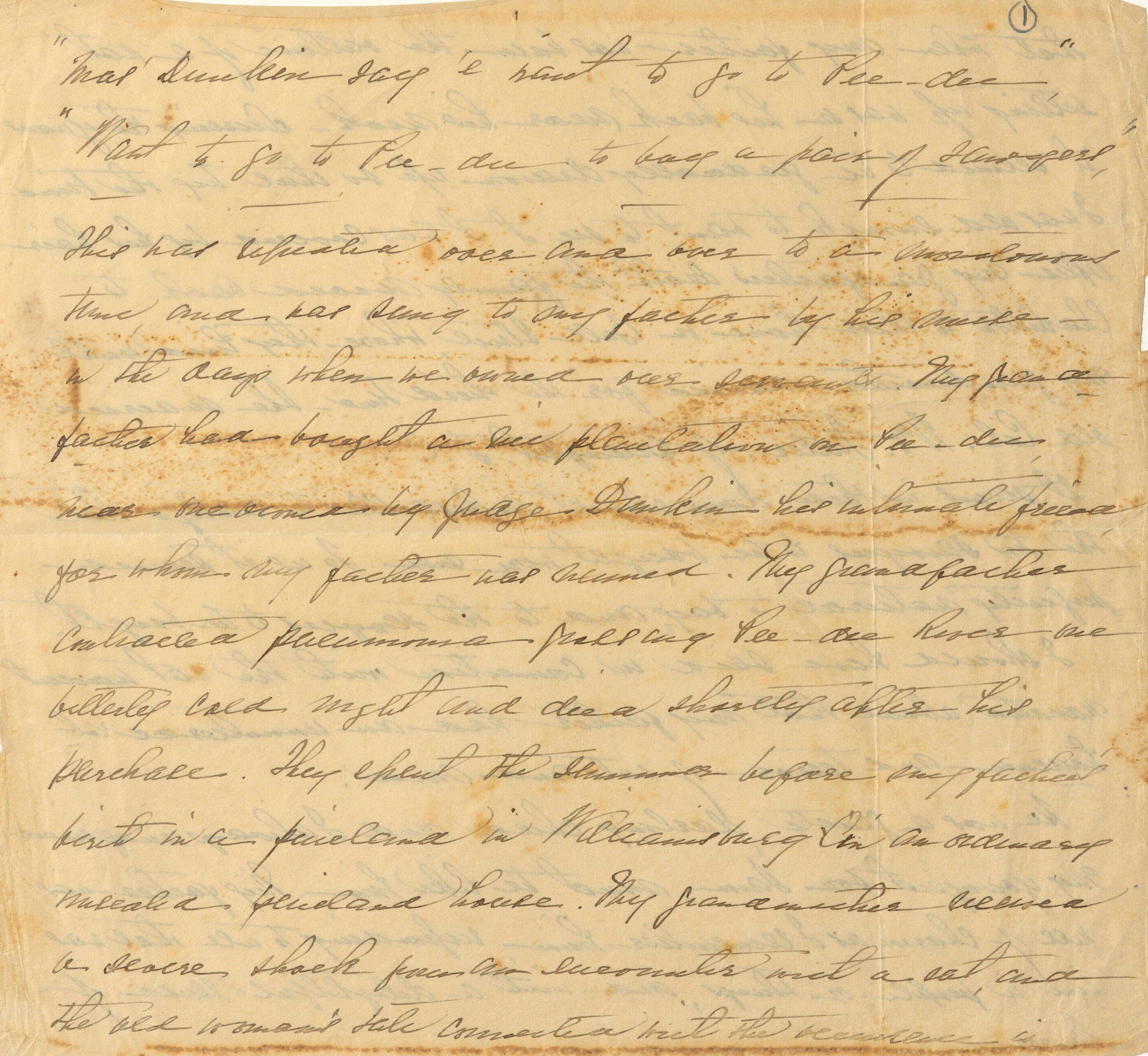
A page of close-set handwriting in faded brown ink, numbered “1” within a small circle at the upper right. Heavy foxing and bleed-through from the verso obscure several passages; a horizontal crease bisects the page mid-height.
“Mas’ Dunkin say ‘I want to go to Pee-dee —’”
“Want to go to Pee-dee — to buy a pair of strangers”
This was repeated over and over to a monotonous tune and was sung to my father by his nurse — in the days when we owned our servants. My poor father had bought a rice plantation on Pee-dee, near one owned by Judge Dunkin, his intimate friend, for whom my father was named. My grandfather contracted pneumonia crossing Pee-dee river one bitterly cold night and died shortly after his purchase. They spent the summer before my father’s birth in a pineland in Williamsburg in an ordinary unceiled pineland house. My grandmother received a severe shock from an encounter with a rat and the old woman’s tale connected with the occurrence —
AI Notes
First sheet of the handwritten draft of Minnie Perry FitzSimons’s memorandum about her father Benjamin Faneuil Dunkin Perry and the family lore surrounding his birth — the source draft from which the typed fair copy at book-002/p032 was made. Numbered ‘1’ within a small circle at the upper right; continues on p634. The script is close-set, the ink heavily foxed and showing through from the verso, and a horizontal crease bisects the page.
The page tells a tightly compressed back-story for Minnie’s father, Benjamin Faneuil Dunkin Perry (1834–1874), who was born after his own father’s death: Minnie’s grandfather Edward Perry had bought a rice plantation on the Pee-Dee near one owned by his intimate friend Judge Benjamin Faneuil Dunkin (later Chief Justice of the S.C. Court of Appeals); shortly after the purchase Edward Perry contracted pneumonia crossing the Pee-Dee river on a bitterly cold night and died; the orphan-to-be was carried by his pregnant mother in a pineland house in Williamsburg County over that summer, and was named for Judge Dunkin in honor of the friendship. The household lullaby preserved in the opening lines — “Mas’ Dunkin say ‘I want to go to Pee-dee, to buy a pair of strangers’” — is the nurse’s song-version of that ill-fated plantation trip; “strangers” is the period euphemism for enslaved people to be bought at auction, and is the reading carried forward in the typed fair copy.
Two readings in the handwritten draft differ from the typed fair copy and are preserved here as Minnie wrote them: “My poor father had bought a rice plantation” (the typed copy corrects this to “My grandfather had bought” — internally the draft is inconsistent, since the next clause speaks of “my grandfather” contracting pneumonia; the typed version regularises the slip), and “received a severe shock” (the typed copy reads “suffered a severe shock”). The mid-page passage reads “…his intimate friend, for whom my father was named” — matching the typed copy exactly. The bottom of the page ends mid-sentence; the closing thought continues on p634.