'Woods and Waters' hunting reminiscence at Willtown Bluff — The State, 10 December 1930
Book 4, Page 20 ·1930
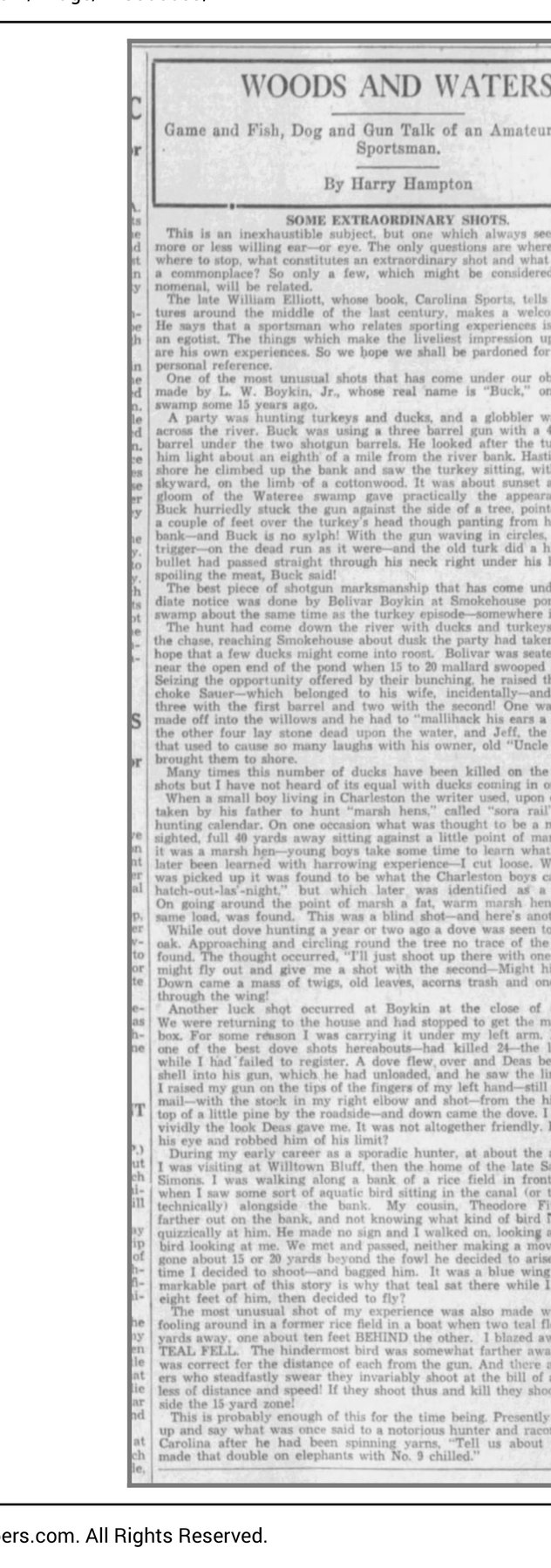
Transcription
[The article is a long hunting column with multiple anecdotes. The full text is preserved in the source PDF; this transcription reproduces only the paragraph containing the family reference.]
Woods and Waters
Game and Fish, Dog and Gun Talk of an Amateur, Sporadic Sportsman.
By Harry Hampton
Some Extraordinary Shots.
[Earlier paragraphs about an extraordinary turkey shot by L. W. Boykin, Jr. on the Wateree, and a double duck shot at Smokehouse pond by Bolivar Boykin, are not transcribed here. The article continues:]
During my early career as a sporadic hunter, at about the age of 12 or 14, I was visiting at Willtown Bluff, then the home of the late Samuel G. FitzSimons. I was walking along a bank of a rice field in front of the house when I saw some sort of aquatic bird sitting in the canal (or trunk, to speak technically) alongside the bank. My cousin, Theodore FitzSimons, was farther out on the bank, and not knowing what kind of bird it was I looked quizzically at him. He made no sign and I walked on, looking at the bird, the bird looking at me. We met and passed, neither making a move. When I had gone about 15 or 20 yards beyond the fowl he decided to arise. At the same time I decided to shoot—and bagged him. It was a blue wing teal. The remarkable part of this story is why that teal sat there while I passed within eight feet of him, then decided to fly?
Source: The State (Columbia, S.C.), Wednesday 10 December 1930, page 8. Image from newspapers.com, image 748506689. Public-domain newspaper.
AI Notes
Harry Hampton’s ‘Woods and Waters’ hunting column in The State, 10 December 1930 — a long folksy compendium of extraordinary-shot anecdotes. The piece is included in the appendix not for its overall content but for a single FitzSimons-relevant paragraph in which Hampton recalls a hunting visit to Willtown Bluff plantation, ‘the home of the late Samuel G. FitzSimons’ — i.e., the compiler Amy’s father SGFS Sr. (1856–1930), who had died seven weeks earlier on 18 October 1930. Hampton was ‘at about the age of 12 or 14’ — placing the anecdote c. 1910–1912 — and was accompanied by his ‘cousin, Theodore FitzSimons’ on the bank of a rice field. Harry Hampton (1898–1980) was a great-grandson of Gen. Wade Hampton II and a noted SC conservationist; the cousin relationship implied here is through the broader Hampton/FitzSimons/Barker network rather than a documented direct line. The piece confirms Willtown Bluff as the SGFS Sr. family seat in the 1910s and the close hunting-companion relationship between the Hampton and FitzSimons families in that decade. The ‘Theodore FitzSimons’ cousin is most plausibly Theodore Stoney FitzSimons (Gen-4, Amy’s paternal uncle) or a son of his — the album record is not yet definitive on Theodore’s children, and Hampton’s loose use of ‘cousin’ is consistent with extended-family Southern usage.
Willtown Bluff — the plantation on the South Edisto River in Colleton County, c. 12 miles south of Adams Run — is the family seat where Samuel G. FitzSimons Sr. lived from his 1887 marriage to Mary Anne Perry until his death there 18 October 1930 (the elder Sam Sr. is named in Book 1, p339’s family pedigree as having died at Willtown Bluff on the Edisto). This 1930 column confirms the property was still the family seat as late as the 1910s and that hunting visits from neighboring lowcountry families (the Hamptons foremost among them) were routine.
Identifying “cousin Theodore FitzSimons”: in Harry Hampton’s circle this is most plausibly Theodore Stoney FitzSimons — Amy’s uncle, a son of Dr. Christopher 3rd and Susan Milliken Barker, who lived in Hope, Arkansas by 1925 (Book 4, p021) but had grown up in the SC lowcountry and would have been in his 50s during a c.1910-1912 hunting visit; or possibly a son of Theodore not yet documented in the album. The “cousin” usage is Southern-loose and need not imply first-degree kinship.