'Maj. Theodore G. Barker' — editorial appreciation, The State, 2 June 1917 (p.4)
Book 4, Page 19 ·1917
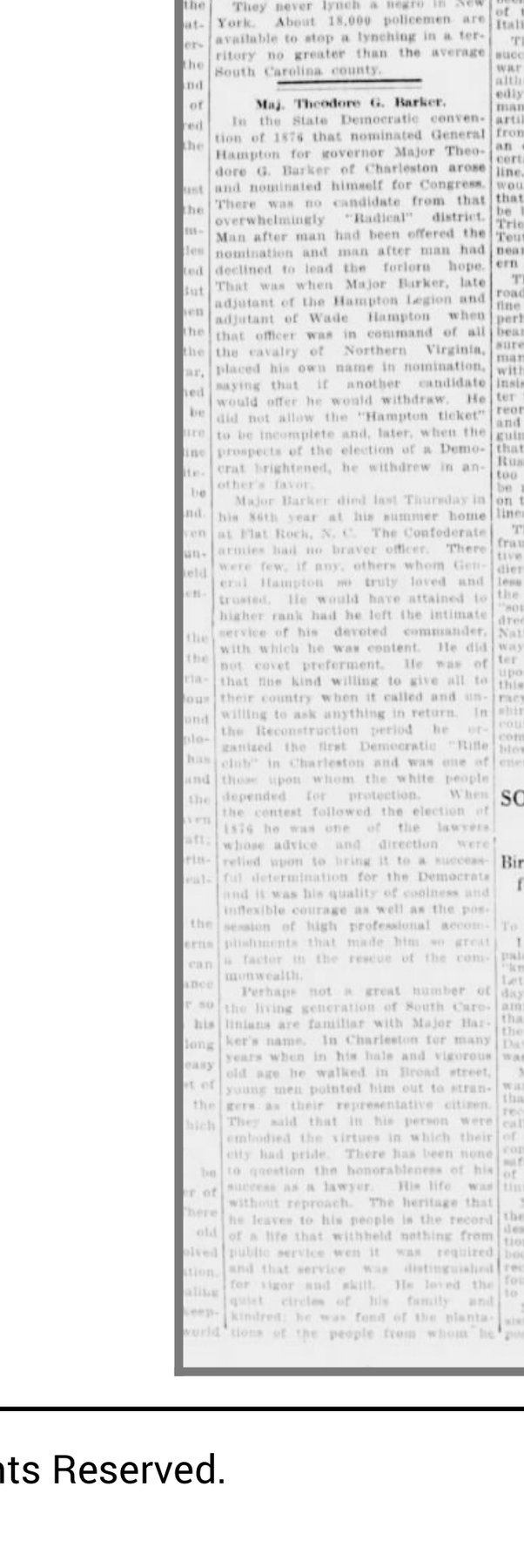
Transcription
Maj. Theodore G. Barker.
In the State Democratic convention of 1876 that nominated General Hampton for governor Major Theodore G. Barker of Charleston arose and nominated himself for Congress. There was no candidate from that overwhelmingly “Radical” district. Man after man had been offered the nomination and man after man had declined to lead the forlorn hope. That was when Major Barker, late adjutant of the Hampton Legion and adjutant of Wade Hampton when that officer was in command of all the cavalry of Northern Virginia, placed his own name in nomination, saying that if another candidate would offer he would withdraw. He did not allow the “Hampton ticket” to be incomplete and, later, when the prospects of the election of a Democrat brightened, he withdrew in another’s favor.
Major Barker died last Thursday in his 86th year at his summer home at Flat Rock, N. C. The Confederate armies had no braver officer. There were few, if any, others whom General Hampton so truly loved and trusted. He would have attained to higher rank had he left the intimate service of his devoted commander, with which he was content. He did not covet preferment. He was of that fine kind willing to give all to their country when it called and unwilling to ask anything in return. In the Reconstruction period he organized the first Democratic “Rifle club” in Charleston and was one of those upon whom the white people depended for protection. When the contest followed the election of 1876 he was one of the lawyers whose advice and direction were relied upon to bring it to a successful determination for the Democrats and it was his quality of coolness and inflexible courage as well as the possession of high professional accomplishments that made him so great a factor in the rescue of the commonwealth.
Perhaps not a great number of the living generation of South Carolinians are familiar with Major Barker’s name. In Charleston for many years when in his hale and vigorous old age he walked in Broad street, young men pointed him out to strangers as their representative citizen. They said that in his person were embodied the virtues in which their city had pride. There has been none to question the honorableness of his success as a lawyer. His life was without reproach. The heritage that he leaves to his people is the record of a life that withheld nothing from public service when it was required and that service was distinguished for vigor and skill. He loved the quiet circles of his family and kindred; he was fond of the plantations of the people from whom he…
Source: The State (Columbia, S.C.), Saturday, 2 June 1917, page 4. Image from newspapers.com, image 747401213. Public-domain newspaper.
AI Notes
The State (Columbia, S.C.), Saturday 2 June 1917, page 4 — the editorial-page appreciation of Maj. Theodore Gaillard Barker, distinct from the page-3 news obituary at Book 4, p018. Where page 3 is biographical-of-record, this page-4 piece is political-of-memory: it focuses on Barker’s 1876 self-nomination for Congress (an ‘overwhelmingly Radical district’ where no other Democrat would run), his Confederate-cavalry service with the Hampton Legion, his founding of the Carolina Rifle club, and his decisive role as one of the lawyers whose ‘coolness and inflexible courage’ brought the contested 1876 election to a Democratic conclusion in South Carolina. Note: this editorial gives Barker’s age at death as the ‘86th year’ where the page-3 news obit says ‘85th year’ — page 3 is correct against the confirmed birth date of 24 August 1832 (he was 84 at the May 1917 death, hence in his 85th year). The discrepancy is a typesetter’s slip in the editorial. The article ends mid-sentence at the bottom of the visible column; the very last words (‘the plantations of the people from whom he…’) likely conclude on the next page of the same issue, not preserved in the source clipping.
The article ends with “the plantations of the people from whom he…” — a column-foot cut where the continuation either runs to another column of the same page or wraps to a subsequent page. The clipping as preserved does not include the conclusion.
Political register. The editorial’s framing of the 1876 election as “the rescue of the commonwealth” and the Rifle Club as protection “for the white people” against the “Radical” party reflects the State’s editorial position in 1917 — at the height of the Lost Cause narrative — and the same Reconstruction-era vocabulary the page-3 news obit reproduces. The historical reality of the 1876 election in South Carolina is that the Democratic victory was secured by widespread voter intimidation and electoral fraud by Red Shirt paramilitaries (of which the Carolina Rifle Club was an early progenitor). The State’s 1917 editorial obscures this history; preserving the obit’s framing intact (rather than editorializing it) keeps the document a genuine historical source.