'Maj. Barker Dead at Hendersonville' — The State, 2 June 1917 (news obit, p.3)
Book 4, Page 18 ·1917
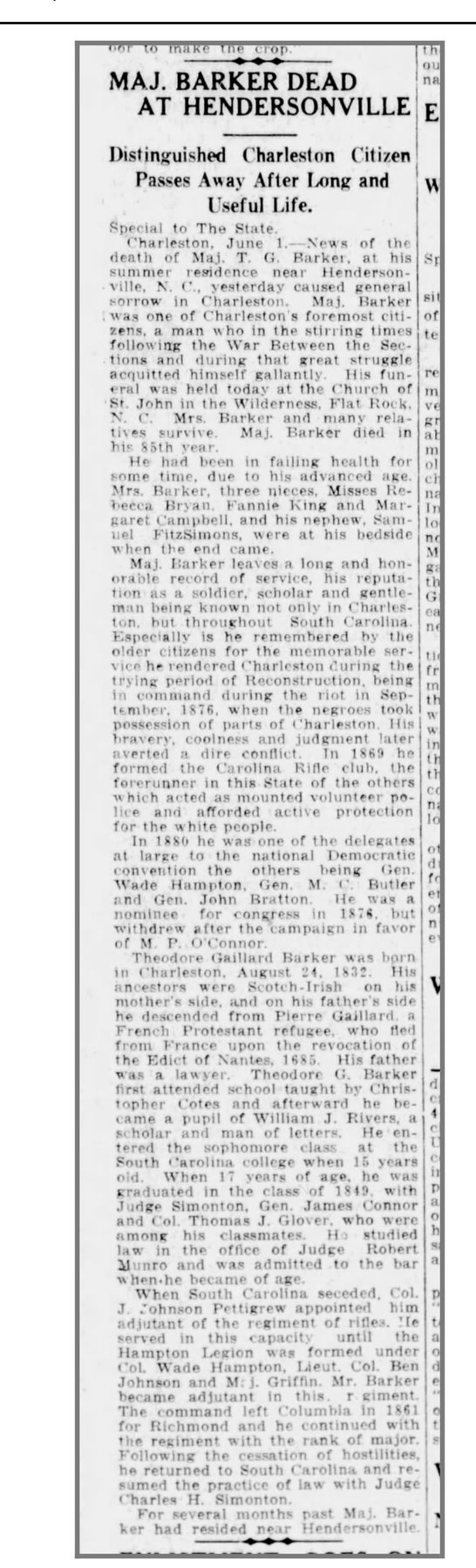
Transcription
MAJ. BARKER DEAD AT HENDERSONVILLE
Distinguished Charleston Citizen Passes Away After Long and Useful Life.
Special to The State.
Charleston, June 1.—News of the death of Maj. T. G. Barker, at his summer residence near Hendersonville, N. C., yesterday caused general sorrow in Charleston. Maj. Barker was one of Charleston’s foremost citizens, a man who in the stirring times following the War Between the Sections and during that great struggle acquitted himself gallantly. His funeral was held today at the Church of St. John in the Wilderness, Flat Rock, N. C. Mrs. Barker and many relatives survive. Maj. Barker died in his 85th year.
He had been in failing health for some time, due to his advanced age. Mrs. Barker, three nieces, Misses Rebecca Bryan, Fannie King and Margaret Campbell, and his nephew, Samuel FitzSimons, were at his bedside when the end came.
Maj. Barker leaves a long and honorable record of service, his reputation as a soldier, scholar and gentleman being known not only in Charleston, but throughout South Carolina. Especially is he remembered by the older citizens for the memorable service he rendered Charleston during the trying period of Reconstruction, being in command during the riot in September, 1876, when the negroes took possession of parts of Charleston. His bravery, coolness and judgment later averted a dire conflict. In 1869 he formed the Carolina Rifle club, the forerunner in this State of the others which acted as mounted volunteer police and afforded active protection for the white people.
In 1880 he was one of the delegates at large to the national Democratic convention the others being Gen. Wade Hampton, Gen. M. C. Butler and Gen. John Bratton. He was a nominee for congress in 1876, but withdrew after the campaign in favor of M. P. O’Connor.
Theodore Gaillard Barker was born in Charleston, August 24, 1832. His ancestors were Scotch-Irish on his mother’s side, and on his father’s side he descended from Pierre Gaillard, a French Protestant refugee, who fled from France upon the revocation of the Edict of Nantes, 1685. His father was a lawyer. Theodore G. Barker first attended school taught by Christopher Cotes and afterward he became a pupil of William J. Rivers, a scholar and man of letters. He entered the sophomore class at the South Carolina college when 15 years old. When 17 years of age, he was graduated in the class of 1849, with Judge Simonton, Gen. James Connor and Col. Thomas J. Glover, who were among his classmates. He studied law in the office of Judge Robert Munro and was admitted to the bar when he became of age.
When South Carolina seceded, Col. J. Johnson Pettigrew appointed him adjutant of the regiment of rifles. He served in this capacity until the Hampton Legion was formed under Col. Wade Hampton, Lieut. Col. Ben Johnson and Maj. Griffin. Mr. Barker became adjutant in this regiment. The command left Columbia in 1861 for Richmond and he continued with the regiment with the rank of major. Following the cessation of hostilities, he returned to South Carolina and resumed the practice of law with Judge Charles H. Simonton.
For several months past Maj. Barker had resided near Hendersonville.
Source: The State (Columbia, S.C.), Saturday, 2 June 1917, page 3, column 1. Image from newspapers.com, image 747401204. Public-domain newspaper.
AI Notes
The State (Columbia, S.C.), Saturday 2 June 1917, page 3, column 1 — the headline news obituary of Maj. Theodore Gaillard Barker (Charleston attorney, Confederate cavalry officer, brother of Susan Milliken Barker FitzSimons). The State carried a separate editorial appreciation of Barker on page 4 of the same issue — see Book 4, p019. Several substantive new facts the family record had not preserved: (1) Exact death: Thursday 31 May 1917 (‘yesterday’ relative to the June 1 dateline), in his 85th year, at his summer residence near Hendersonville, N.C.; funeral held Friday 1 June at the Church of St. John in the Wilderness, Flat Rock. (2) Family present at bedside: Mrs. Barker; three nieces (Rebecca Bryan, Fannie King, Margaret Campbell); and a nephew, Samuel FitzSimons — that is Samuel Gaillard FitzSimons Sr. (1856–1930), the compiler Amy’s father. The nephew identity confirms that Amy’s father made the trip from his SC plantation to be with his Charleston uncle at the end. (3) Pierre Gaillard, the paternal-line Huguenot ancestor — Theodore’s father’s side descended from a Pierre Gaillard, French Protestant refugee who fled France upon the 1685 revocation of the Edict of Nantes; mother’s side Scotch-Irish. (4) The 1876 Charleston riot command: Theodore was ‘in command during the riot in September, 1876, when the negroes took possession of parts of Charleston’ (in the obit’s language) — bravery, coolness, and judgment averted ‘a dire conflict.’ He had founded the Carolina Rifle Club in 1869, forerunner of the rifle clubs that ‘acted as mounted volunteer police and afforded active protection for the white people’ during Reconstruction. (5) 1880 delegate-at-large to the national Democratic convention with Wade Hampton, M. C. Butler, and John Bratton; 1876 nominee for Congress (withdrew for M. P. O’Connor). (6) Education: Christopher Cotes; William J. Rivers; SC College (entered sophomore at 15, graduated 1849 at 17 with classmates including Judge Simonton, Gen. James Connor, Col. Thomas J. Glover). The Reconstruction-era framing — and the obit’s casual reproduction of period racial language — is itself a historical artifact and is preserved verbatim below for the integrity of the source.
The “nephew, Samuel FitzSimons” at Theodore’s bedside is Samuel Gaillard FitzSimons Sr. (1856–1930), the compiler Amy FitzSimons Walker’s father — Theodore was his maternal uncle (mother Susan Milliken Barker, Theodore’s sister). The three nieces (Bryan, King, Campbell) are daughters of Theodore’s sisters Susan, Ellen, and a third sister identified only by the daughters’ married surnames — this is the first time the album record names them. The piece’s casual reproduction of 1876-era racial framing (“the negroes took possession of parts of Charleston”) and the Reconstruction-era Rifle Clubs as “active protection for the white people” reflects the obit-writer’s 1917 perspective; for context, the Reconstruction-era Carolina Rifle Club was part of the paramilitary Red Shirt apparatus that, working alongside the regular Democratic party, ended Reconstruction in South Carolina through a combination of voter intimidation and electoral fraud. Preserving the obit’s framing intact (rather than editing it) keeps the document a genuine historical source.
Pierre Gaillard the Huguenot ancestor. The obit gives Theodore’s paternal-line Huguenot ancestor as Pierre Gaillard, fled France 1685 upon the revocation of the Edict of Nantes. This is consistent with the broader Charleston-Gaillard pattern: multiple Huguenot families named Gaillard settled the SC lowcountry in the late 17th century, and the connection to the Barker family is via Theodore’s father’s Gaillard middle name (rather than via marriage). See also Book 1, p027 for the broader Gaillard-Porcher-Cordes-Gendron Huguenot synthesis transcribed there.