Obituary of Catherine Pritchard FitzSimons — Charleston Mercury, 21 December 1841
Book 4, Page 17 ·1841
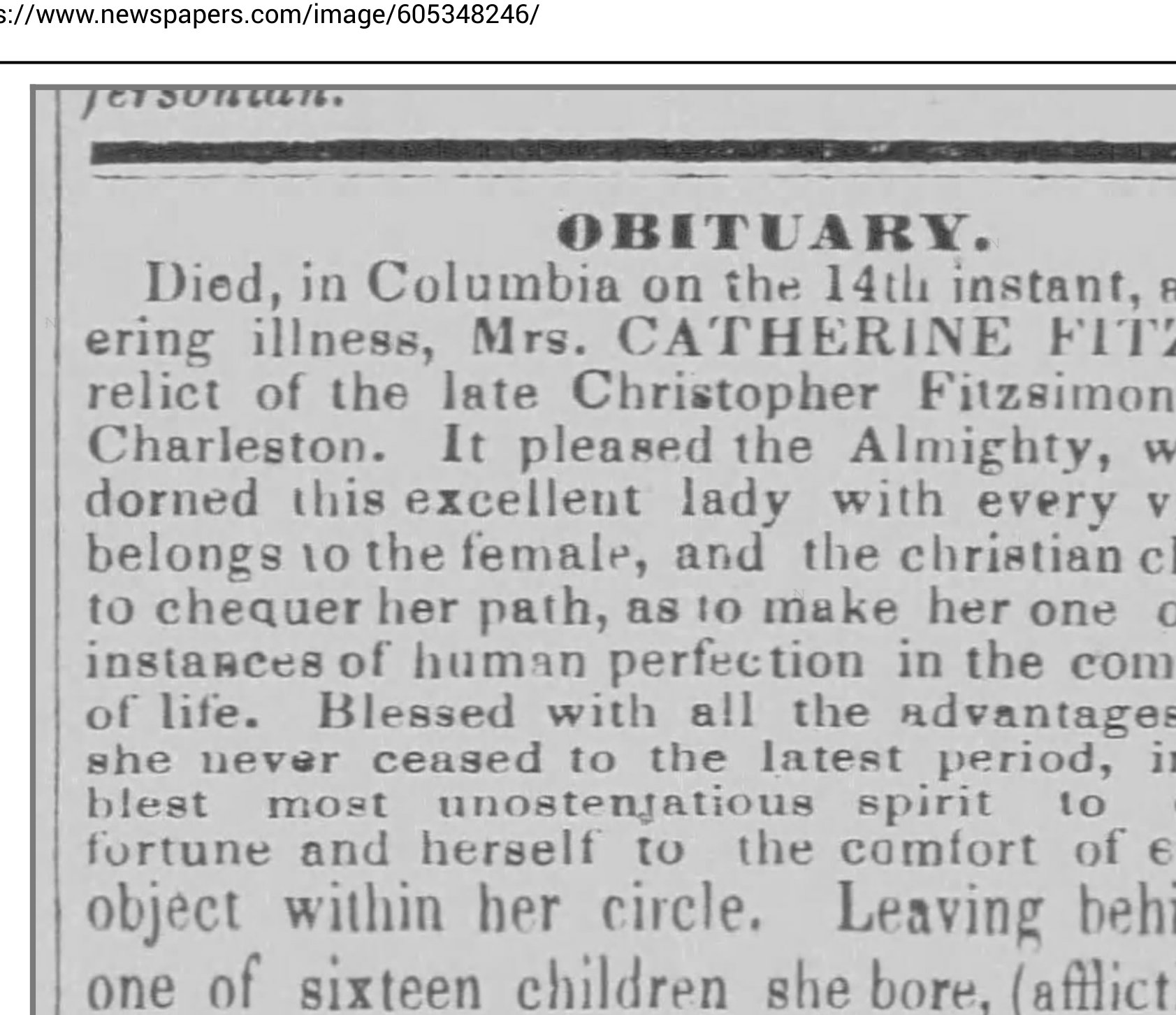
Transcription
OBITUARY.
Died, in Columbia on the 14th instant, after a lingering illness, Mrs. Catherine Fitzsimons, relict of the late Christopher Fitzsimons, Senr., of Charleston. It pleased the Almighty, who had addorned this excellent lady with every virtue which belongs to the female, and the christian character, so to chequer her path, as to make her one of the rarest instances of human perfection in the common walks of life. Blessed with all the advantages of wealth, she never ceased to the latest period, in the humblest [and] most unostentatious spirit to devote her fortune and herself to the comfort of every living object within her circle. Leaving behind her but one of sixteen children she bore, (afflictions) which to a heart like hers, were uncommonly severe, with the firmness and resignation worthy of a follower of Him who suffered voluntarily upon the Cross. Length of days were given her to prolong a bright example, and when at length she was taken to that rich inheritance above, which was the only thing she ever coveted; every one who knew her felt that they had lost a friend—many, one that can never be replaced.
“Blessed are they who put their trust in God.”
Source: The Charleston Mercury (Charleston, S.C.), Tuesday, 21 December 1841, page 2. Image from newspapers.com, image 605348246. Public-domain newspaper.
AI Notes
The Charleston Mercury’s setting of Catherine Pritchard FitzSimons’s death notice — the same Tuesday 21 December 1841 publication date as the Charleston Daily Courier version at Book 4, p016, but a different paper. Both papers received the obituary from the same source (probably a Columbia correspondent or the family) but set the text independently, producing several telling typographic and textual divergences: Mercury renders the husband’s rank as ‘Senr.’ (correct — he is the senior Christopher Fitzsimons in distinction to his son Christopher 2nd, d. 1832) where the Courier prints ‘Esq.’; Mercury has ‘addorned’ (typo, double d) for the Courier’s ‘adorned’; Mercury omits ‘and’ in ‘the humblest [and] most unostentatious’; Mercury frames the children-survivorship clause as ‘Leaving behind her but one of sixteen children she bore, (afflictions) which to a heart like hers, were uncommonly severe’ where the Courier reads ‘unspeakably severe’; and most theologically striking, Mercury has ‘Him who suffered voluntarily upon the Cross’ where the Courier has ‘Him, who suffered reluctantly upon the cross’ — the Mercury’s ‘voluntarily’ is the orthodox theological framing of the Atonement and is almost certainly the intended word; the Courier’s ‘reluctantly’ may be a typesetter’s misreading. The Mercury also boxes the obit between thick rules at top and bottom, presenting it as a self-contained advertisement-style notice; the Courier ran it as a flowing news item across a column break.
Two papers, one obit, several textual variants. Compare verbatim with the Charleston Daily Courier setting at Book 4, p016 (same day, same death, same body text). The two settings preserve a small but real difference in editorial choice — the Mercury identifies the husband by patriarchal rank (‘Senr.’), the Courier by social title (‘Esq.’). And the theological variant (‘voluntarily’ vs ‘reluctantly’ upon the Cross) is striking enough that it cannot be a simple substitution: one is the orthodox formula and the other reverses the implied Christology. The Mercury’s reading is the more orthodox; the Courier’s may be a typesetter’s misreading of ‘voluntarily’ (the words are visually similar in 1840s cursive copy). The ‘addorned’ typo and the missing ‘and’ in ‘humblest [and] most’ are evidence that the Mercury’s typesetter worked from a handwritten copy at speed and did not closely proof.
The ‘sixteen children’ fact is shared between both versions and is therefore a hard primary-source datum: Catherine bore sixteen children. The obit’s accompanying claim that only one survived her at her death in December 1841 is, however, eulogistic flourish rather than literal fact — documented record shows at least Col. Paul FitzSimons of Augusta and Catherine Elizabeth FitzSimons Hammond (b. 1814, d. 1896; m. Gov. James Henry Hammond in 1831) both alive in late 1841. See the editorial bracket on Book 4, p016 for the lineage analysis.