Obituary of Catherine Pritchard FitzSimons — Charleston Daily Courier, 21 December 1841
Book 4, Page 16 ·1841
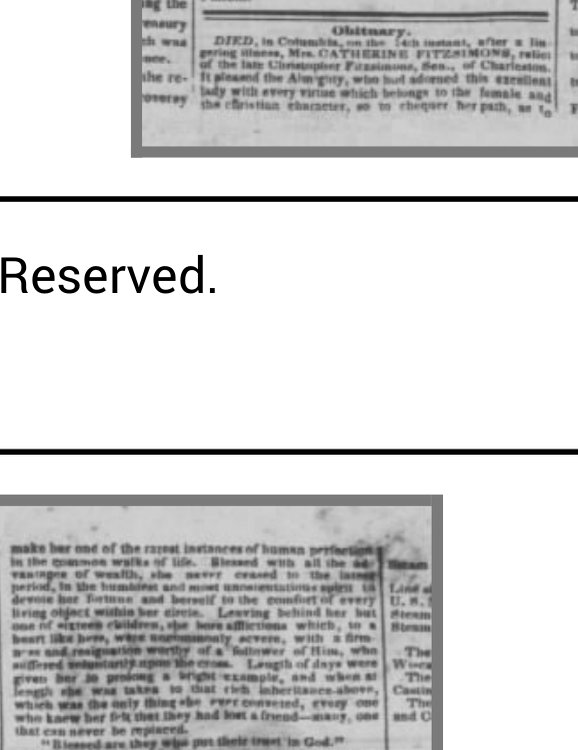
Transcription
Obituary.
DIED, in Columbia, on the 14th instant, after a lingering illness, Mrs. Catherine Fitzsimons, relict of the late Christopher Fitzsimons, Esq., of Charleston. It pleased the Almighty, who had adorned this excellent lady with every virtue which belongs to the female and the christian character, so to chequer her path, as to make her one of the rarest instances of human perfection in the common walks of life. Blessed with all the advantages of wealth, she never ceased to the latest period, in the humblest and most unostentatious spirit to devote her fortune and herself to the comfort of every living object within her circle. Leaving behind her but one of sixteen children, she bore afflictions which, to a heart like hers, were unspeakably severe, with a firmness and resignation worthy of a follower of Him, who suffered reluctantly upon the cross. Length of days were given her to prolong a bright example, and when at length she was taken to that rich inheritance above, which was the only thing she ever coveted, every one who knew her felt that they had lost a friend—many, one that can never be replaced.
“Blessed are they who put their trust in God.”
Source: The Charleston Daily Courier (Charleston, S.C.), Tuesday, 21 December 1841, page 2, columns 4–5 (column-break composite). Image from newspapers.com, image 604515012. Public-domain newspaper.
AI Notes
Charleston Daily Courier, Tuesday 21 December 1841, page 2 — the death notice of Catherine Pritchard FitzSimons (b. 19 Aug 1772, d. 14 Dec 1841), widow of Christopher Fitzsimons the emigrant. The piece is a contemporary primary source confirming Catherine’s death date and giving substantive biographical detail. Three findings of immediate importance: (1) Exact death date: 14 December 1841 (‘the 14th instant’) in Columbia; (2) cause: a lingering illness rather than a sudden death; (3) the headline genealogical fact that Catherine and Christopher had sixteen children, of whom the obit says only one survived her — a striking eulogistic framing that helps explain the concentration of memorial / family-tree material in the family record and the heavy reliance on collateral relatives’ descendants for the surviving lineage. The obit’s prose is the period’s high-eulogy style, and the ‘one of sixteen’ survivorship statement should be read as eulogistic flourish rather than literal genealogical fact: documented record shows at least two of Catherine’s children alive in late 1841 — Col. Paul FitzSimons of Augusta (known alive from Christopher 2nd’s 1831 will at Book 4, p007, which names ‘beloved Mother and brother Paul’) and Catherine Elizabeth FitzSimons Hammond (b. 8 June 1814, d. 25 March 1896 at Redcliffe Plantation, Beech Island, S.C.; m. 23 June 1831 to James Henry Hammond, later Governor of South Carolina and U.S. Senator). A third surviving daughter, Maria Adams FitzSimons, is also plausible though less certain. The ‘one of sixteen’ figure is best read as the obit-writer’s grief-stricken approximation — emphasizing how many of Catherine’s children she had buried, not asserting that only one remained.
Sixteen children, multiple survivors. The album’s Gen-2 family memorandum at Book 1, p003 (compiled by W. Huger FitzSimons) lists only six children for Christopher + Catherine — Christopher 2nd, Peter Gaillard, Catherine Ann, Paul, plus two who appear in later sources (Ann, John Stoney FitzSimons). This Courier notice establishes that the actual count was sixteen, of whom many died in infancy or childhood and were never carried forward in the family record. Documented survivors past 1841 include Col. Paul FitzSimons of Augusta and Catherine Elizabeth FitzSimons Hammond (wife of Gov. James Henry Hammond); Christopher 2nd had died Dec 1832 per Book 4, p007, and Ann FitzSimons Hampton (Wade Hampton II’s wife, b. 1 January 1794) had also predeceased her mother, leaving the famous Wade Hampton II as her surviving son. The Hammond marriage is a major connection of the FitzSimons line into South Carolina’s antebellum political elite, paralleling the Hampton connection through Ann. This fundamentally reframes the family’s early history: rather than a comfortably-sized Charleston gentry household, Catherine and Christopher lived a life of repeated mortal grief, made bearable (in the obit-writer’s framing) by religious conviction and philanthropic discipline.
The Columbia residence. Catherine died “in Columbia” — establishing that she had moved (permanently? seasonally?) from Charleston to Columbia by the time of her final illness. Christopher 2nd’s 1831 will at Book 4, p007 describes his “beloved Mother” without giving a residence; his own residence at the date of that will was Charleston. By 1841 the Columbia move had occurred — possibly to be near surviving Pritchard or Eve relatives, or to the same Columbia household where Kit FitzSimmons would live four generations later (Columbia is also where Christopher 2nd died, in Lexington S.C., in 1832 — see the appendix note at Book 4, p007).
Column-break note. The obituary begins at the foot of the left-hand news column (“Obituary. / DIED, in Columbia, on the 14th instant, after a lingering illness, Mrs. CATHERINE FITZSIMONS, relict of the late Christopher Fitzsimons, Esq., of Charleston. It pleased the Almighty, who had adorned this excellent lady with every virtue which belongs to the female and the christian character, so to chequer her path, as to…”) and continues at the top of the right-hand news column (“make her one of the rarest instances of human perfection in the common walks of life…”). The appendix image is a composite of those two regions; the unrelated content between them (Texan-frontier news at the foot of column 1, holiday-presents notice at the head of column 2, and a separate “DIED, at New-Orleans” notice for Gunnox Alfred Vail of Newport R.I. immediately after Catherine’s notice in column 2) has been cropped out. The full source PDF preserves the original page layout.