Typewritten gardening essay, page 4 — annual bed designs, German Iris and tulips, Southern annual border
Book 2, Page 161 ·1930–1950
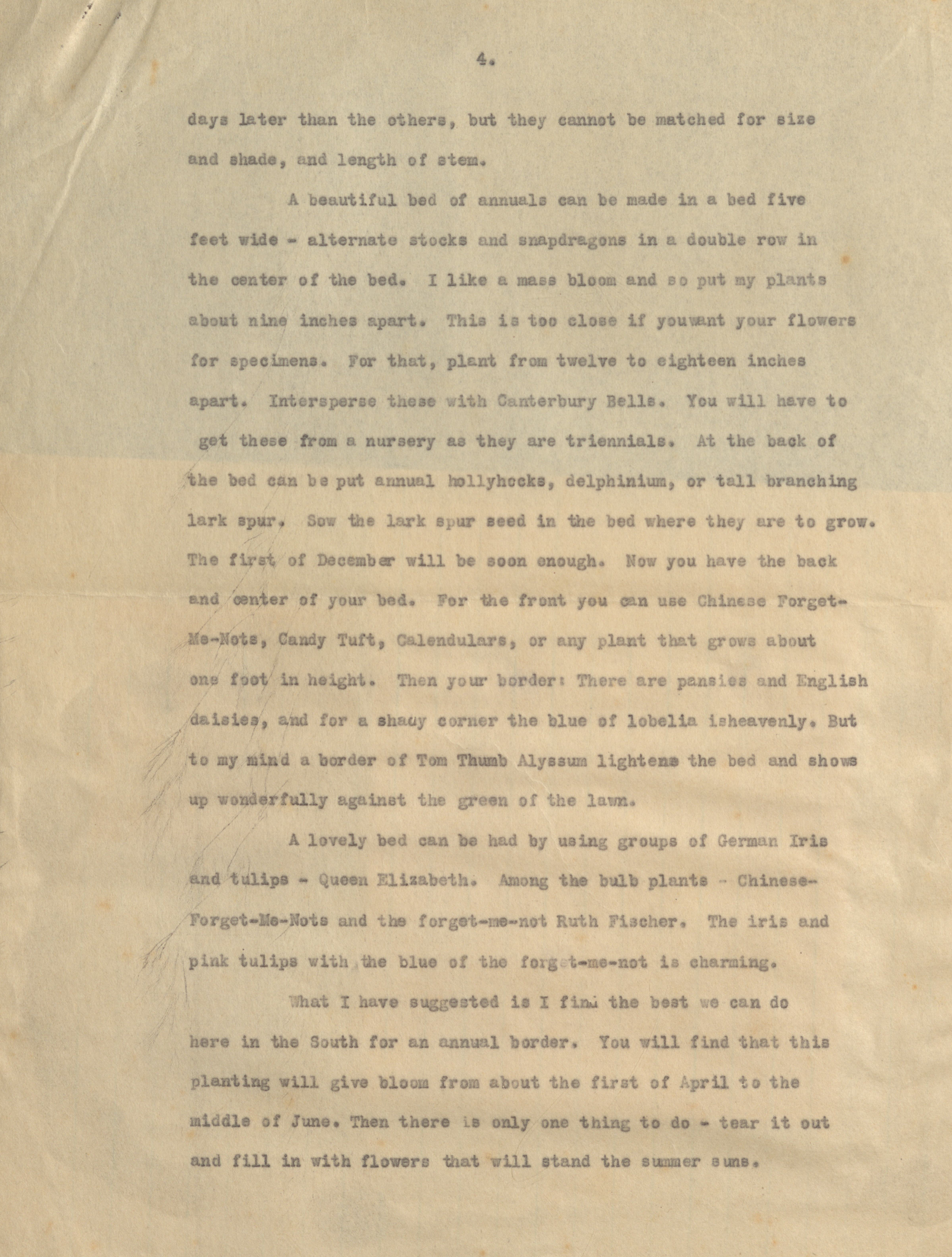
Transcription
days later than the others, but they cannot be matched for size and shade, and length of stem.
A beautiful bed of annuals can be made in a bed five feet wide — alternate stocks and snapdragons in a double row in the center of the bed. I like a mass bloom and so put my plants about nine inches apart. This is too close if you want your flowers for specimens. For that, plant from twelve to eighteen inches apart. Intersperse these with Canterbury Bells. You will have to get these from a nursery as they are triennials. At the back of the bed can be put annual hollyhocks, delphinium, or tall branching lark spur. Sow the lark spur seed in the bed where they are to grow. The first of December will be soon enough. Now you have the back end wonder of your bed. For the front you can use Chinese Forget-Me-Nots, Candy Tuft, Calendulars, or any plant that grows about one foot in height. Then your border: There are pansies and English daisies, and for a shady corner the blue of lobelia isheavenly. But to my mind a border of Tom Thumb Alyssum lightens the bed and shows up wonderfully against the green of the lawn.
A lovely bed can be had by using groups of German Iris and tulips — Queen Elizabeth. Among the bulb plants — Chinese-Forget-Me-Nots and the forget-me-not Ruth Fischer. The iris and pink tulips with the blue of the forget-me-not is charming.
What I have suggested is I find the best we can do here in the South for an annual border. You will find that this planting will give bloom from about the first of April to the middle of June. Then there is only one thing to do — tear it out and fill in with flowers that will stand the summer suns.
AI Notes
A single typewritten sheet, numbered ‘4.’ at the upper right, continuing the gardening/horticultural essay that runs from page 158 (or earlier) through page 161. Discusses ornamental bed design with stocks, snapdragons, Canterbury Bells, hollyhocks, delphinium, lark spur, Chinese Forget-Me-Nots, Candy Tuft, Calendulars, pansies, English daisies, Tom Thumb Alyssum, German Iris, Queen Elizabeth tulips, and the Ruth Fischer forget-me-not. The author offers regional planting advice for the South, recommending an April through mid-June bloom cycle. The unsigned typescript is the 4th and final sheet of the gardening essay companion to the book-001 pp456–461 cluster.
The essay continues from page 160 — which is numbered “3.” at the upper right — and breaks off at the foot of this sheet. No further numbered pages of this typescript are pasted in the immediately following spreads. The author is unsigned, but the regional reference (“here in the South”) and the earlier page’s mention of obtaining tobacco dust “from the cigar factory in Charleston for $1.00 a hundred pounds” places the writer in or near Charleston, S.C.