Typed garden essay, page 3 of 4 — tobacco dust, Paris green, fertilizer, stocks
Book 2, Page 160 ·1930–1950
Transcription
Page numbered 3. at the upper right:
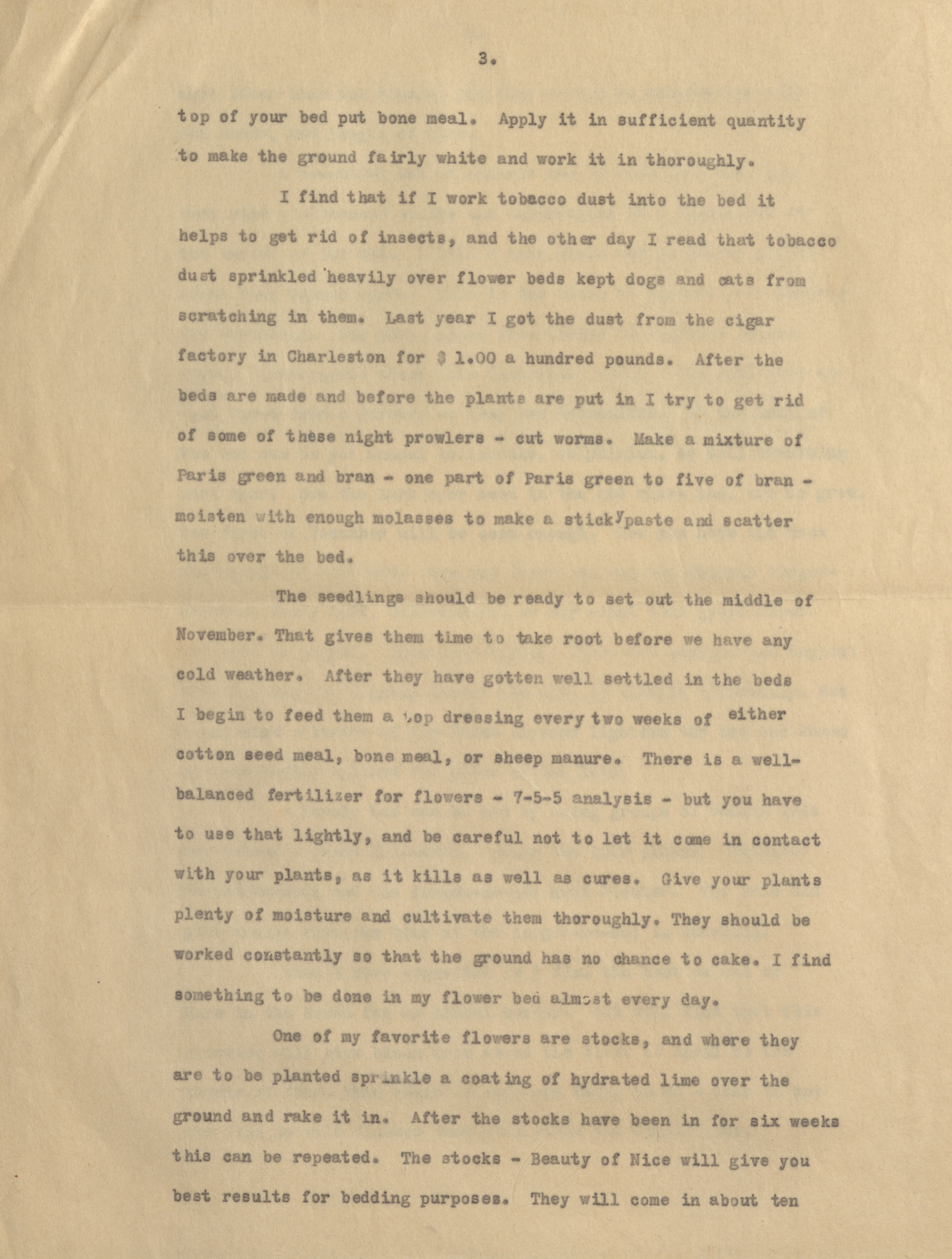
top of your bed put bone meal. Apply it in sufficient quantity to make the ground fairly white and work it in thoroughly.
I find that if I work tobacco dust into the bed it helps to get rid of insects, and the other day I read that tobacco dust sprinkled heavily over flower beds kept dogs and cats from scratching in them. Last year I got the dust from the cigar factory in Charleston for $ 1.00 a hundred pounds. After the beds are made and before the plants are put in I try to get rid of some of these night prowlers — cut worms. Make a mixture of Paris green and bran — one part of Paris green to five of bran — moisten with enough molasses to make a stick[y] paste and scatter this over the bed.
The seedlings should be ready to set out the middle of November. That gives them time to take root before we have any cold weather. After they have gotten well settled in the beds I begin to feed them a top dressing every two weeks of either cotton seed meal, bone meal, or sheep manure. There is a well-balanced fertilizer for flowers — 7-5-5 analysis — but you have to use that lightly, and be careful not to let it come in contact with your plants, as it kills as well as cures. Give your plants plenty of moisture and cultivate them thoroughly. They should be worked constantly so that the ground has no chance to cake. I find something to be done in my flower bed almost every day.
One of my favorite flowers are stocks, and where they are to be planted sprinkle a coating of hydrated lime over the ground and rake it in. After the stocks have been in for six weeks this can be repeated. The stocks — Beauty of Nice will give you best results for bedding purposes. They will come in about ten
AI Notes
Third numbered sheet of the typed garden essay (page ‘3.’ at upper right). Advice on top-dressing beds with bone meal; using tobacco dust against insects (a hundred pounds bought from the cigar factory in Charleston for $1.00); spraying with Paris green and molasses against cutworms; sowing seedlings in mid-November; feeding with a 7-5-5 cottonseed-meal / bone-meal / sheep-manure dressing; cultivating frequently; and recommending the Beauty of Nice variety of stock as the author’s favorite bedding flower. The typist’s ‘stick/paste’ is a typewriter overstrike; the intended word is ‘sticky paste’ (a Paris green / bran / molasses cutworm bait).