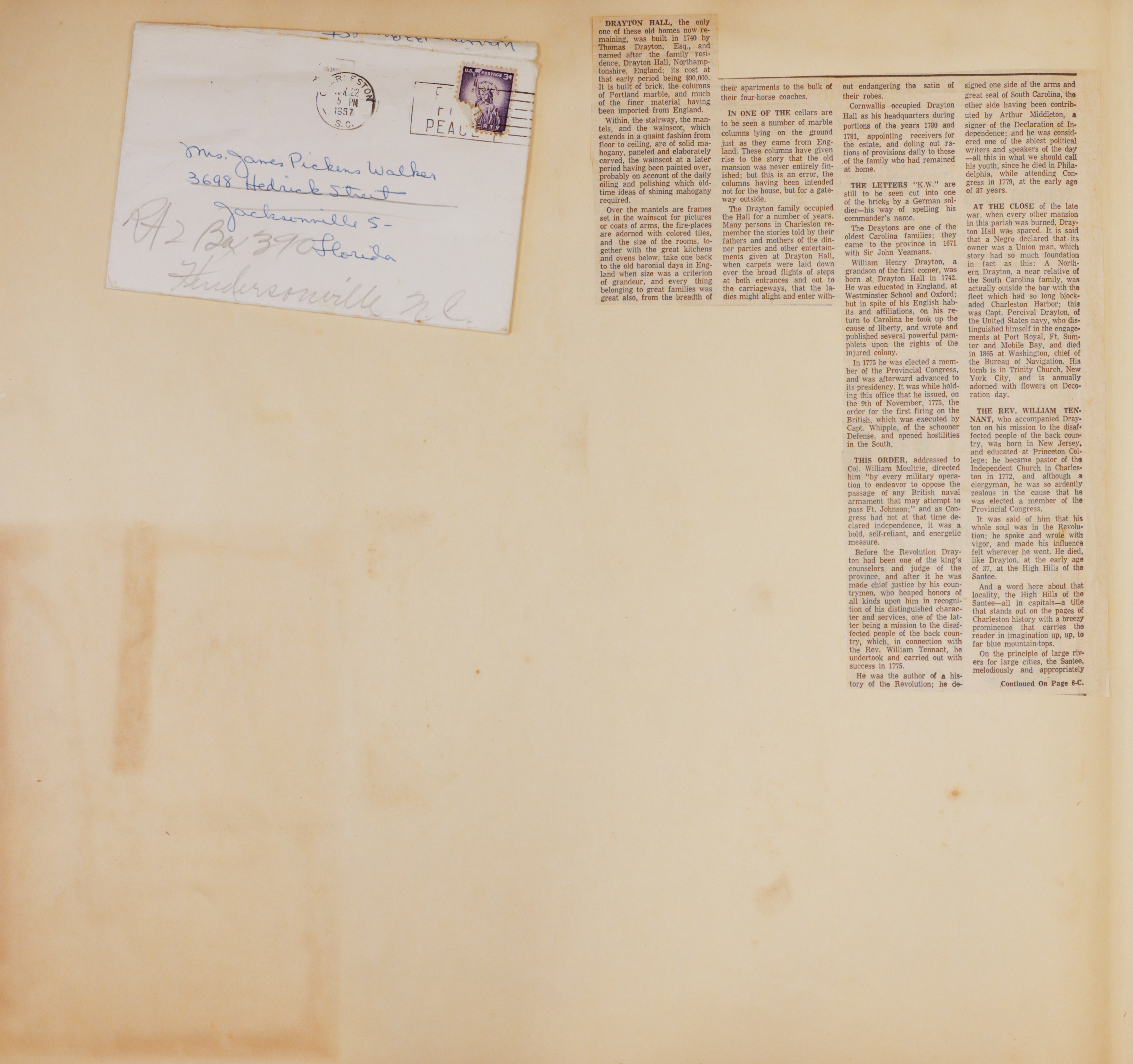
Envelope to Mrs. James Pickens Walker (1957) with newspaper article on Drayton Hall and the Drayton family
Book 1, Page 606 ·1957
Transcription
Envelope (upper left):
Addressed in blue fountain-pen ink, with a Charleston, S.C. postmark reading “MAR 22 / 5 PM / 1957” and a 3-cent purple Statue of Liberty stamp (“IN GOD WE TRUST”). A slogan-cancel block at the right reads “PRAY FOR PEACE.” A faint pencilled line along the top edge of the envelope appears to begin “Dr.” but is largely illegible.
Mrs. James Pickens Walker 3698 Hedrick Street Jacksonville 5 — Florida
[Forwarding address added below in pencil:]
R/2 Box 39 Hendersonville N.C.
Newspaper clipping (upper right), two narrow columns:
DRAYTON HALL, the only one of these old homes now remaining, was built in 1740 by Thomas Drayton, Esq., and named after the family residence, Drayton Hall, Northamptonshire, England; its cost at that early period being $90,000. It is built of brick, the columns of Portland marble, and much of the finer material having been imported from England.
Within, the stairway, the mantels, and the wainscot, which extends in a quaint fashion from floor to ceiling, are of solid mahogany, paneled and elaborately carved; the wainscot at a later period having been painted over, probably on account of the daily oiling and polishing which old-time ideas of shining mahogany required.
Over the mantels are frames set in the wainscot for pictures or coats of arms, the fire-places are adorned with colored tiles, and the size of the rooms, together with the great kitchens and ovens below, take one back to the old baronial days in England when size was a criterion of grandeur, and every thing belonging to great families was great also, from the breadth of their apartments to the bulk of their four-horse coaches.
IN ONE OF THE cellars are to be seen a number of marble columns lying on the ground just as they came from England. These columns have given rise to the story that the old mansion was never entirely finished; but this is an error, the columns having been intended not for the house, but for a gateway outside.
The Drayton family occupied the Hall for a number of years. Many persons in Charleston remember the stories told by their fathers and mothers of the dinner parties and other entertainments given at Drayton Hall, when carpets were laid down over the broad flights of steps at both entrances and out to the carriageways, that the ladies might alight and enter without endangering the satin of their robes.
Cornwallis occupied Drayton Hall as his headquarters during portions of the years 1780 and 1781, appointing receivers for the estate, and doling out rations of provisions daily to those of the family who had remained at home.
THE LETTERS “K.W.” are still to be seen cut into one of the bricks by a German soldier — his way of spelling his commander’s name.
The Draytons are one of the oldest Carolina families; they came to the province in 1671 with Sir John Yeamans.
William Henry Drayton, a grandson of the first comer, was born at Drayton Hall in 1742. He was educated in England, at Westminster School and Oxford; but in spite of his English habits and affiliations, on his return to Carolina he took up the cause of liberty, and wrote and published several powerful pamphlets upon the rights of the injured colony.
In 1775 he was elected a member of the Provincial Congress, and was afterward advanced to its presidency. It was while holding this office that he issued, on the 9th of November, 1775, the order for the first firing on the British, which has executed by Capt. Whipple, of the schooner Defense, and opened hostilities in the South.
THIS ORDER, addressed to Col. William Moultrie, directed him “by every military operation to endeavor to oppose the passage of any British naval armament that may attempt to pass Ft. Johnson,” and as Congress had not at that time declared independence, it was a bold, self-reliant, and energetic measure.
Before the Revolution Drayton had been one of the king’s counselors and judge of the province, and after it he was made chief justice by his countrymen, who heaped honors of all kinds upon him in recognition of his distinguished character and services, one of the latter being a mission to the disaffected people of the back country, which, in connection with the Rev. William Tennant, he undertook and carried out with success in 1775.
He was the author of a history of the Revolution; he de[…] signed one side of the arms and great seal of South Carolina, the other side having been contributed by Arthur Middleton, a signer of the Declaration of Independence; and he was considered one of the ablest political writers and speakers of the day — all this in what we should call his youth, since he died in Philadelphia, while attending Congress in 1779, at the early age of 37 years.
AT THE CLOSE of the late war, when every other mansion in this parish was burned, Drayton Hall was spared. It is said that a Negro declared that its owner was a Union man, which story had so much foundation in fact as this: A Northern Drayton, a near relative of the South Carolina family, was actually outside the bar with the fleet which had so long blockaded Charleston Harbor; this was Capt. Percival Drayton, of the United States navy, who distinguished himself in the engagements at Port Royal, Ft. Sumter and Mobile Bay, and died in 1865 at Washington, chief of the Bureau of Navigation. His tomb is in Trinity Church, New York City, and is annually adorned with flowers on Decoration day.
THE REV. WILLIAM TENNANT, who accompanied Drayton on his mission to the disaffected people of the back country, was born in New Jersey, and educated at Princeton College; he became pastor of the Independent Church in Charleston in 1772, and although a clergyman, he was so ardently zealous in the cause that he was elected a member of the Provincial Congress.
It was said of him that his whole soul was in the Revolution; he spoke and wrote with vigor, and made his influence felt wherever he went. He died, like Drayton, at the early age of 37, at the High Hills of the Santee.
And a word here about that locality, the High Hills of the Santee — all in capitals — a title that stands out on the pages of Charleston history with a breezy prominence that carries the reader in imagination up, up, to far blue mountain-tops.
On the principle of large rivers for large cities, the Santee, melodiously and appropriately
Continued On Page 6-C
AI Notes
An album page with a small white envelope mounted at the upper left and a tall three-column newspaper clipping pasted at the upper right. The envelope bears a 3-cent purple Statue of Liberty ‘IN GOD WE TRUST’ stamp, a Charleston, S.C. postmark reading ‘MAR 22 / 5 PM / 1957’ with a slogan cancel (‘PRAY FOR PEACE’), and is addressed in blue fountain-pen ink to Mrs. James Pickens Walker at 3698 Hedrick Street, Jacksonville 5, Florida, with a forwarding address added in pencil: ‘R/2 Box 39 / Hendersonville N.C.’ A faint pencil note runs along the top edge of the envelope, partly trimmed and largely illegible. The clipping is a three-column feature article on Drayton Hall and the Drayton family of South Carolina, beginning ‘DRAYTON HALL, the only one of these old homes now remaining, was built in 1740 by Thomas Drayton, Esq.’ and continuing through William Henry Drayton (1742–1779), the Rev. William Tennant, Capt. Percival Drayton USN, and the High Hills of Santee, then breaking with ‘Continued On Page 6-C’ (continuation not preserved on this album page). The lower two-thirds of the album sheet is blank. Of family interest because the Draytons connect to the Perry/Drayton material at the top of the FitzSimons pedigree.
The lower two-thirds of the album sheet is blank.
Drayton Hall, on the Ashley River, is the oldest surviving plantation house in South Carolina and one of the finest examples of Georgian-Palladian domestic architecture in North America. The article’s William Henry Drayton (1742–1779) was a delegate to the Continental Congress and chief justice of South Carolina. The “Northern Drayton” praised at the close is Capt. Percival Drayton (1812–1865), USN — fleet captain to Admiral Farragut at the Battle of Mobile Bay (Aug 1864); his elder brother Thomas F. Drayton commanded the Confederate forts Percival’s gunboats destroyed at the November 1861 Battle of Port Royal — one of the war’s starkest brother-against-brother engagements.