Typescript essay on Charleston gardens, page (cont.): Middleton Place and the Carolina Gazette
Book 1, Page 459 ·1920–1940
Transcription
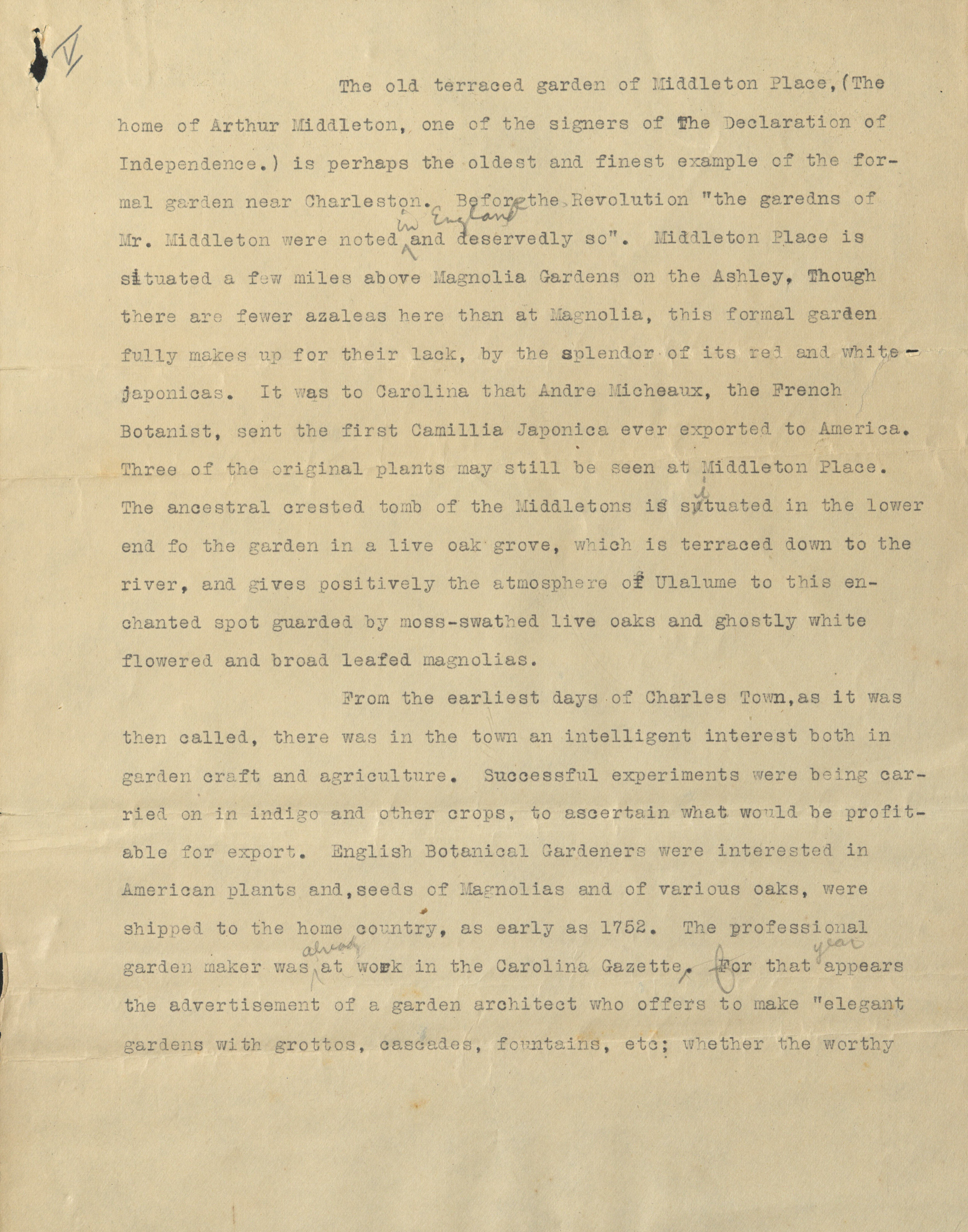
The old terraced garden of Middleton Place, (The home of Arthur Middleton, one of the Signers of The Declaration of Independence), is perhaps the oldest and finest example of the formal garden near Charleston. Before the Revolution “the garedns of Mr. Middleton were noted [pencil insert above:] in England [/insert] and deservedly so”. Middleton Place is situated a few miles above Magnolia Gardens on the Ashley. Though there are fewer azaleas here than at Magnolia, this formal garden fully makes up for their lack, by the splendor of its red and white japonicas. It was to Carolina that Andre Michaux, the French Botanist, sent the first Camillia Japonica ever exported to America. Three of the original plants may still be seen at Middleton Place. The ancestral crested tomb of the Middletons is situated in the lower end of the garden in a live oak grove, which is terraced down to the river, and gives positively the atmosphere of Ulalume to this enchanted spot guarded by moss-swathed live oaks and ghostly white flowered and broad leafed magnolias.
From the earliest days of Charles Town, as it was then called, there was in the town an intelligent interest both in garden craft and agriculture. Successful experiments were being carried on in indigo and other crops, to ascertain what would be profitable for export. English Botanical Gardeners were interested in American plants and seeds of Magnolias and of various oaks, were shipped to the home country, as early as 1752. The professional garden maker was [pencil insert above:] always [/insert] at work in the Carolina Gazette. For that appears the advertisement of a garden architect who offers to make "elegant gardens with grottos, cascades, fountains, etc; whether the worthy
AI Notes
Continuation of the typescript essay on Charleston gardens (the page numbered ‘VII’ is page 461 of this archive). Covers Middleton Place — described as ‘perhaps the oldest and finest example of the formal garden near Charleston’ — recalls that the French botanist André Michaux sent the first Camillia Japonica ever exported to America to Carolina (three of the originals still standing at Middleton Place), and turns to early advertisements in the Carolina Gazette. Original typescript typos preserved (‘garedns’ for ‘gardens’); two pencil insertions present — ‘in England’ above ‘noted’, and ‘always’ between ‘was’ and ‘at work’; an additional pencil mark above ‘appears’ is illegible. Reference to ‘Ulalume’ is to Edgar Allan Poe’s 1847 poem of misty graveyard atmosphere.