Typescript essay on Charleston gardens, page VI (cont.): Washington Plantation, the English garden tradition, and the bricks of a Charleston byway
Book 1, Page 460 ·1920–1940
Transcription
[Page numbered ‘VI’ in pencil at top-left.]
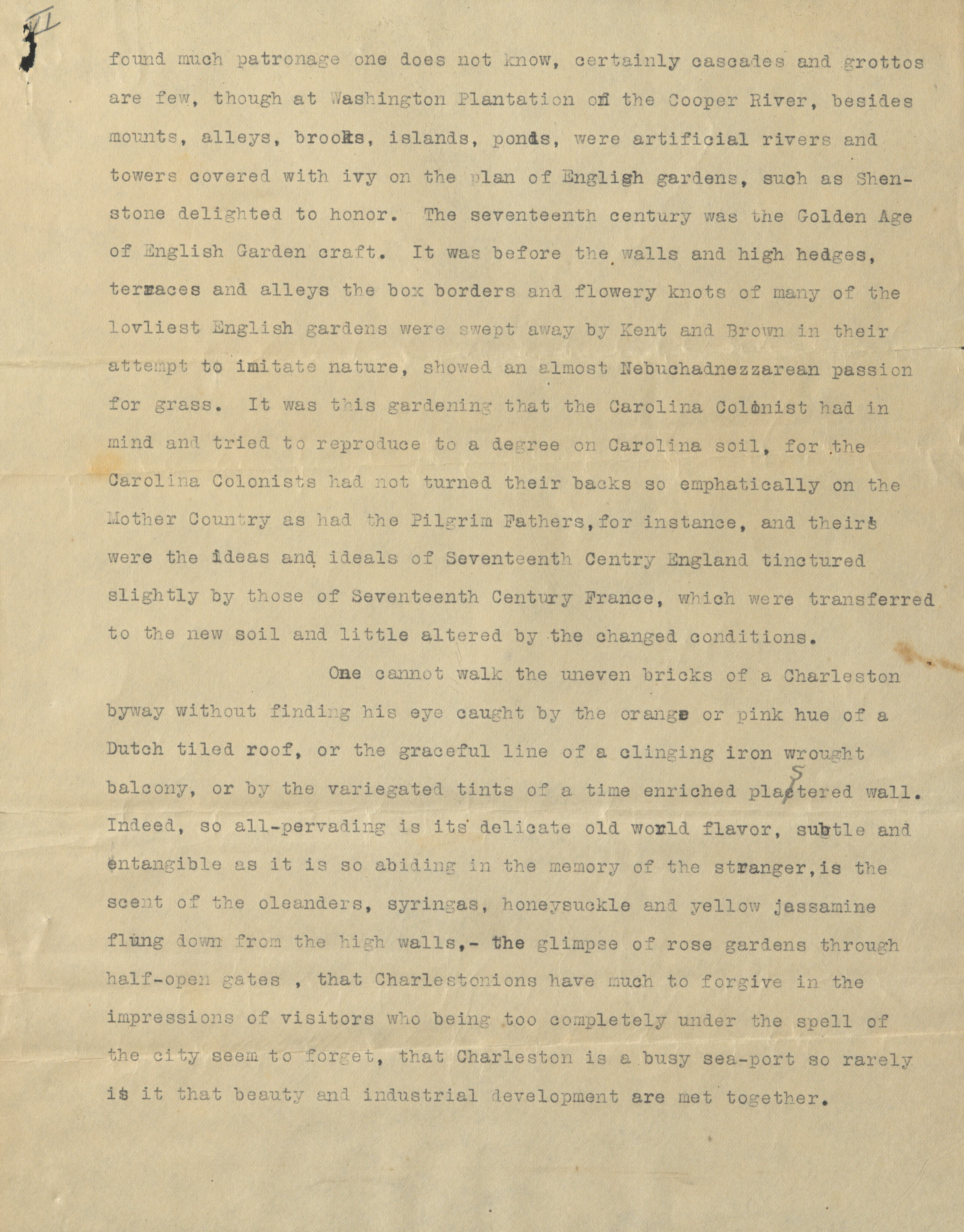
…found much patronage one does not know, certainly cascades and grottos are few, though at Washington Plantation on the Cooper River, besides mounts, alleys, brooks, islands, ponds, were artificial rivers and towers covered with ivy on the plan of English gardens, such as Shenstone delighted to honor. The seventeenth century was the Golden Age of English Garden craft. It was before the walls and high hedges, terraces and alleys the box borders and the flowery knots of many of the loveliest English gardens were swept away by Kent and Brown in their attempt to imitate nature, showed an almost Nebuchadnezzarean passion for grass. It was this gardening that the Carolina Colonist had in mind and tried to reproduce to a degree on Carolina soil, for the Carolina Colonists had not turned their backs so emphatically on the Mother Country as had the Pilgrim Fathers, for instance, and their’s were the ideas and ideals of Seventeenth Centry England tinctured slightly by those of Seventeenth Centry France, which were transferred to the new soil and little altered by the changed conditions.
One cannot walk the uneven bricks of a Charleston byway without finding his eye caught by the orange or pink hue of a Dutch tiled roof, or the graceful line of a clinging iron wrought balcony, or by the variegated tints of a time enriched plastered wall. Indeed, so all-pervading is its delicate old world flavor, subtle and entangible as it is so abiding in the memory of the stranger, is the scent of the oleanders, syringas, honeysuckle and yellow jessamine flung down from the high walls,— the glimpse of rose gardens through half-open gates, that Charlestonions have much to forgive in the impressions of visitors who being too completely under the spell of the city seem to forget, that Charleston is a busy sea-port so rarely is it that beauty and industrial development are met together.
AI Notes
Continuation of the typescript essay on Charleston gardens; page is numbered ‘VI’ in pencil at the top-left. Notes Washington Plantation on the Cooper River as an example of the elaborate seventeenth-century English garden idiom — mounts, alleys, brooks, islands, ponds — that the Carolina colonist transplanted; concludes with a paragraph on walking through Charleston byways and glimpses of rose gardens through half-open gates. The poet referenced is William Shenstone (1714–1763), whose Leasowes ferme ornée was a touchstone of mid-18th-century English garden taste. A small pencil ‘5’ appears between ‘time enriched’ and ‘plastered’. Original typewriter misspellings preserved (‘entangible’ for intangible; ‘Charlestonions’ for Charlestonians; ‘Centry’ for Century).