Typescript essay on Charleston gardens, page (cont.): the elusive charm of Charleston and the mockingbird
Book 1, Page 458 ·1920–1940
Transcription
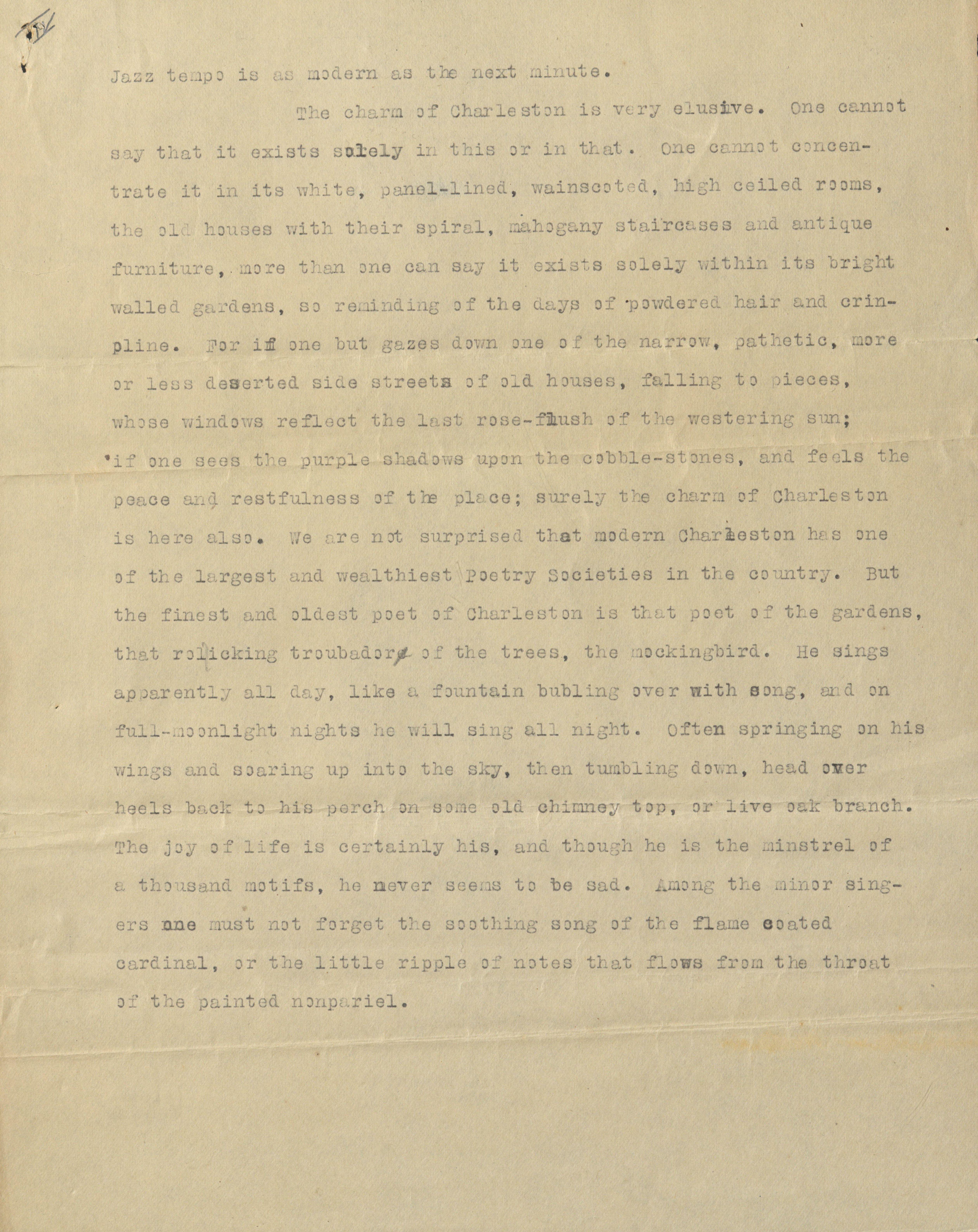
Jazz tempo is as modern as the next minute.
The charm of Charleston is very elusive. One cannot say that it exists solely in this or in that. One cannot concentrate it in its white, panel-lined, wainscoted, high-ceiled rooms, the old houses with their spiral, mahogany staircases and antique furniture, more than one can say it exists solely within its bright walled gardens, so reminding of the days of powdered hair and crinoline. For if one but gazes down one of the narrow, pathetic, more or less deserted side streets of old houses, falling to pieces, whose windows reflect the last rose-flush of the westering sun; if one sees the purple shadows upon the cobble-stones, and feels the peace and restfulness of the place; surely the charm of Charleston is here also. We are not surprised that modern Charleston has one of the largest and wealthiest Poetry Societies in the country. But the finest and oldest poet of Charleston is that poet of the gardens, that rollicking troubadors of the trees, the mockingbird. He sings apparently all day, like a fountain bubling over with song, and on full-moonlight nights he will sing all night. Often springing on his wings and soaring up into the sky, then tumbling down, head over heels back to his perch on some old chimney top, or live oak branch. The joy of life is certainly his, and though he is the minstrel of a thousand motifs, he never seems to be mad. Among the minor singers one must not forget the soothing song of the flame coated cardinal, or the little ripple of notes that flows from the throat of the painted nonpariel.
AI Notes
Continuation of the typescript essay on Charleston gardens. Reflects on the elusive charm of the city — its panel-lined houses, antique furniture, walled gardens, side streets — closing with a lyrical passage on Charleston as ‘the finest and oldest poet of Charleston’ being the city’s gardens and the mockingbird. Typewriter underlines preserved as italics on ‘solely’, ‘the’ (twice in ‘the finest and oldest poet’); original typescript misspellings preserved (‘troubadors’, ‘bubling’, ‘minstrel’, ‘nonpariel’). Note ‘in its white’; ‘minor singers’; ‘so reminding’ (the typist’s awkward construction).