Typescript essay on Charleston gardens, page III: Goose Creek Church (near Otranto) and Charleston hotels
Book 1, Page 457 ·1924–1940
Transcription
[Pencilled upper-left page numeral:] III
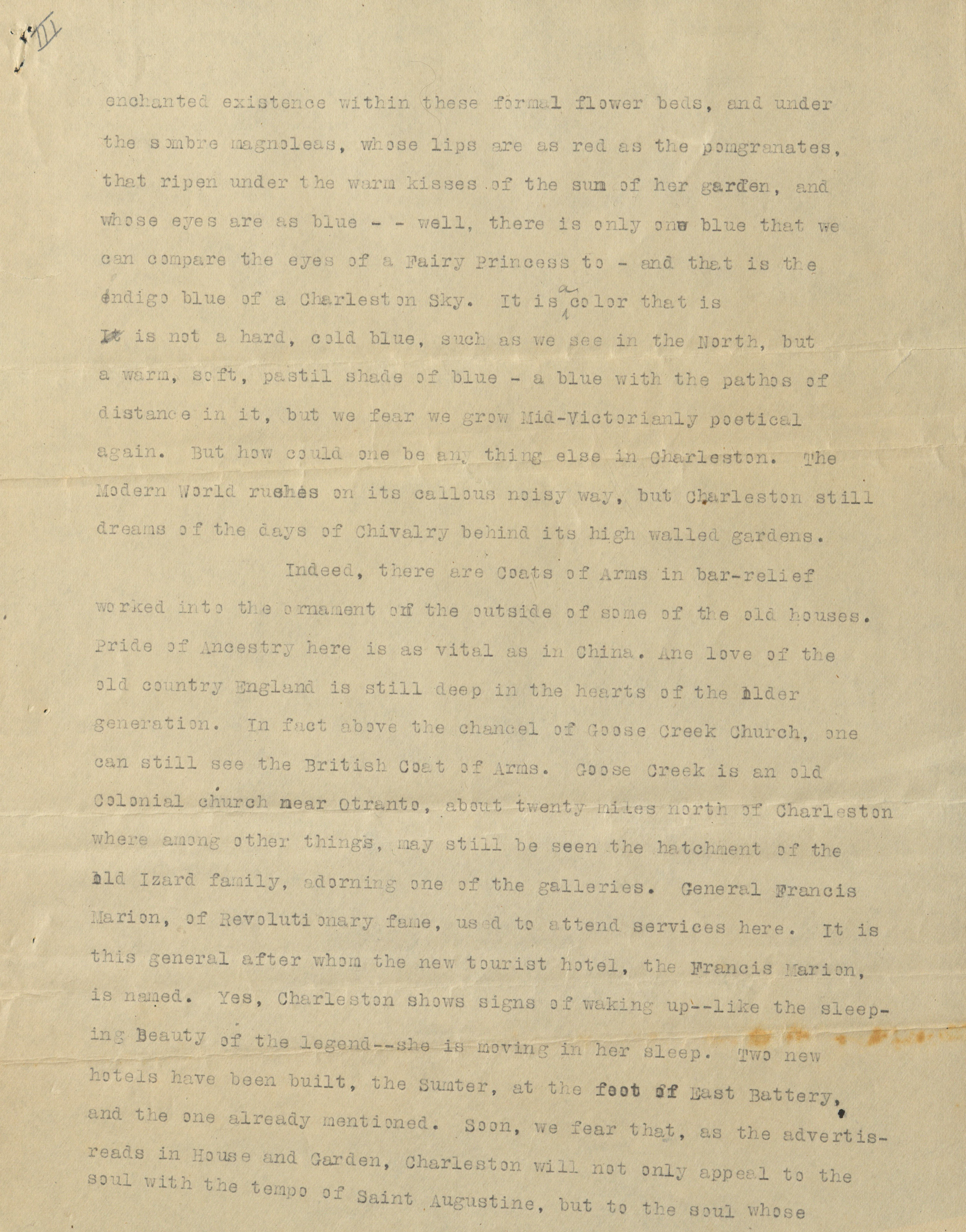
…enchanted existence within these formal flower beds, and under the umbra-magnoleas, whose lips are as red as the pomegranates, that ripen under the warm kisses of the sun of her garden, and whose eyes are as blue — — well, there is only one blue that we can compare the eyes of a Fairy Princess to — and that is the indigo blue of a Charleston Sky. It is a color that is not a hard, cold blue, such as we see in the North, but a warm, soft, pastil shade of blue — a blue with the pathos of distance in it, but we fear we grow Mid-Victorianly poetical again. But how could one be any thing else in Charleston? The Modern World rushes on its callous noisy way, but Charleston still dreams of the days of Chivalry behind its high walled gardens.
Indeed, there are Coats of Arms in bas-relief worked into the ornament of the outside of some of the old houses. Pride of Ancestry here is as vital as in China. One love of the old country England is still deep in the hearts of the older generation. In fact above the chancel of Goose Creek Church, one can still see the British Coat of Arms. Goose Creek is an old Colonial church near Otranto, about twenty miles north of Charleston, where among other things, may still be seen the hatchment of the old Izard family, adorning one of the galleries. General Francis Marion, of Revolutionary fame, used to attend services here. It is this general after whom the new tourist hotel, the Francis Marion, is named. Yes, Charleston shows signs of waking up — like the sleeping Beauty of the legend — she is moving in her sleep. Two new hotels have been built, the Sumter, at the foot of East Battery, and the one already mentioned. Soon, we fear that, as the advertising reads in House and Garden, Charleston will not only appeal to the soul with the tempo of Saint Augustine, but to the soul whose…
AI Notes
Continuation of a typescript essay on Charleston gardens. Page number ‘III’ pencilled at upper left. The Francis Marion Hotel opened in 1924 and the Fort Sumter Hotel in 1923, so this essay dates after 1924; the ‘Mid-Victorianly poetical’ frame suggests 1924–c.1940. Notable readings: ‘umbra-magnoleas’ (the writer’s coinage for the Magnolia grandiflora’s deep shade); ‘Coats of Arms’; ‘near Otranto’ (Otranto Plantation, the historic Goose Creek estate); ‘callous noisy way’; ‘tempo of Saint Augustine’; the ‘sleeping Beauty of the legend — she is moving in her sleep’ clause is in dashes.