Newspaper feature: 'Apostolic Succession' by Jack Leland
Book 1, Page 327 ·1980–1985
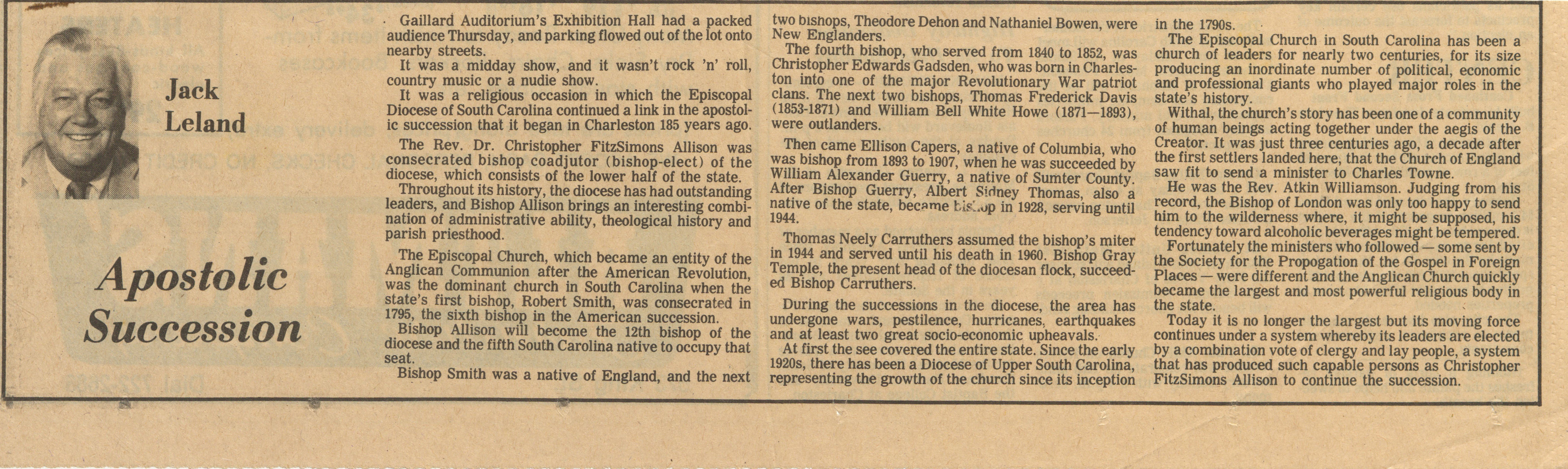
Transcription
A long, narrow newspaper feature pasted horizontally across the album page. The byline block at the upper left:
Jack Leland
Apostolic Succession
The body of the feature, set in three columns, is partly cropped at the inner gutter where it was trimmed for the album. Selected passages:
Gaillard Anderson’s Exhibition Hall had a packed audience Thursday, and parting flowed out of the lot onto nearby streets.
It was a midday show, and it wasn’t rock ‘n’ roll, country music or a radio show.
It was a religious occasion in which the Episcopal Diocese of South Carolina continued in front of its packed audience to celebrate the line of succession that it began in Charleston 196 years ago.
The Rev. Dr. Christopher FitzSimons Allison was consecrated bishop coadjutor (bishop-elect) of the diocese, which consists of the lower half of the state.
Throughout its history, the diocese has had outstanding leaders, and Bishop Allison brings an interesting combination of administrative ability, theological history and parish priesthood.
The Episcopal Church, which became an entity of the Anglican Communion after the American Revolution, was the diocesan church in South Carolina when the state’s first bishop, Robert Smith, was consecrated in 1795, the sixth bishop in the American succession.
Bishop Allison will become the 12th bishop of the diocese and the fifth South Carolina native to occupy the post…
Bishop Smith was a native of England, and the next two bishops, Theodore Dehon and Nathaniel Bowen, were New Englanders.
The fourth bishop, who served from 1840 to 1853, was Christopher Edwards Gadsden, who was born in Charleston into one of the major Revolutionary War patriot clans. The next two bishops, Thomas Frederick Davis (1853-1871) and William Bell White Howe (1871-1893), were outlanders.
Then came Ellison Capers, a native of Columbia, who was bishop from 1893 to 1907, when he was succeeded by William Alexander Guerry, a native of Sumter County. After Bishop Guerry, Albert Sidney Thomas, also a native of the state, became bishop and served from 1928 to 1944.
Thomas Neely Carruthers assumed the bishop’s mitre in 1944 and served until his death in 1960. Bishop Gray Temple, the present head of the diocesan flock, succeeded Bishop Carruthers.
During the successions in the diocese, the area has undergone wars, pestilence, hurricanes, earthquakes and at least two great socio-economic upheavals.
At first the sea covered the entire state. Since the early 1800s, there has been a Diocese of Upper South Carolina, representing the growth of the church since its beginnings in the 1700s.
The Episcopal Church in South Carolina has been a church of leaders for nearly two centuries, for its size produces and that of its sister diocese, an impressive and predominant plants who played major roles in the state’s history.
Withal, the church’s story has been one of a community of human beings acting together under the aegis of the Creator and of human beings — and many decades after the first settlers landed here, that the Church of England saw fit to send a minister to Charles Towne.
He was the Rev. Atkin Williamson. Judging from his record, the Bishop of London was only too happy to send Williamson far away, as it might happen, perhaps. He tendered toward alcoholic beverages might be tempered.
Fortunately the ministers who followed — particularly the Society for the Propagation of the Gospel in Foreign Places — were of higher quality and the Anglican Church quickly began to thrive both in size and in ability throughout the state.
The duty is, no longer the largest but its moving force continues under a system whereby its leaders are elected by a continuative vote of clergy and lay people, a system that has produced such capable persons as Christopher FitzSimons Allison to continue the succession.
AI Notes
A long horizontal newspaper clipping pasted across the page. At the upper left the byline panel reads ‘Jack Leland’ over the headline ‘Apostolic Succession.’ The article is a feature on the unbroken episcopal succession of the Diocese of South Carolina, prompted by the impending consecration of Dr. C. FitzSimons Allison as bishop coadjutor.
The article continues in small print and the column gutter is partly trimmed; transcription above is selective for legibility.
The new bishop’s middle name — FitzSimons — is the reason the album preserves the cluster of clippings (pp. 327–337) on his 1980 consecration. Allison, a Columbia native, is believed to be a kinsman through the Allston/FitzSimons branch (his exact descent has not been pinned in this archive). His consecration on 25 September 1980 at the Gaillard Auditorium made him the 12th Bishop of South Carolina; he later succeeded the Rt. Rev. Gray Temple. The diocese’s first bishop, Robert Smith, was consecrated in 1795 — the sixth bishop in the American Episcopal succession.