Magazine article: 'Christopher Fitzsimmons, Sr. — Man Of Vision' by Louise Jones DuBose (South Carolina Magazine)
Book 1, Page 326 ·1879–1948
Transcription
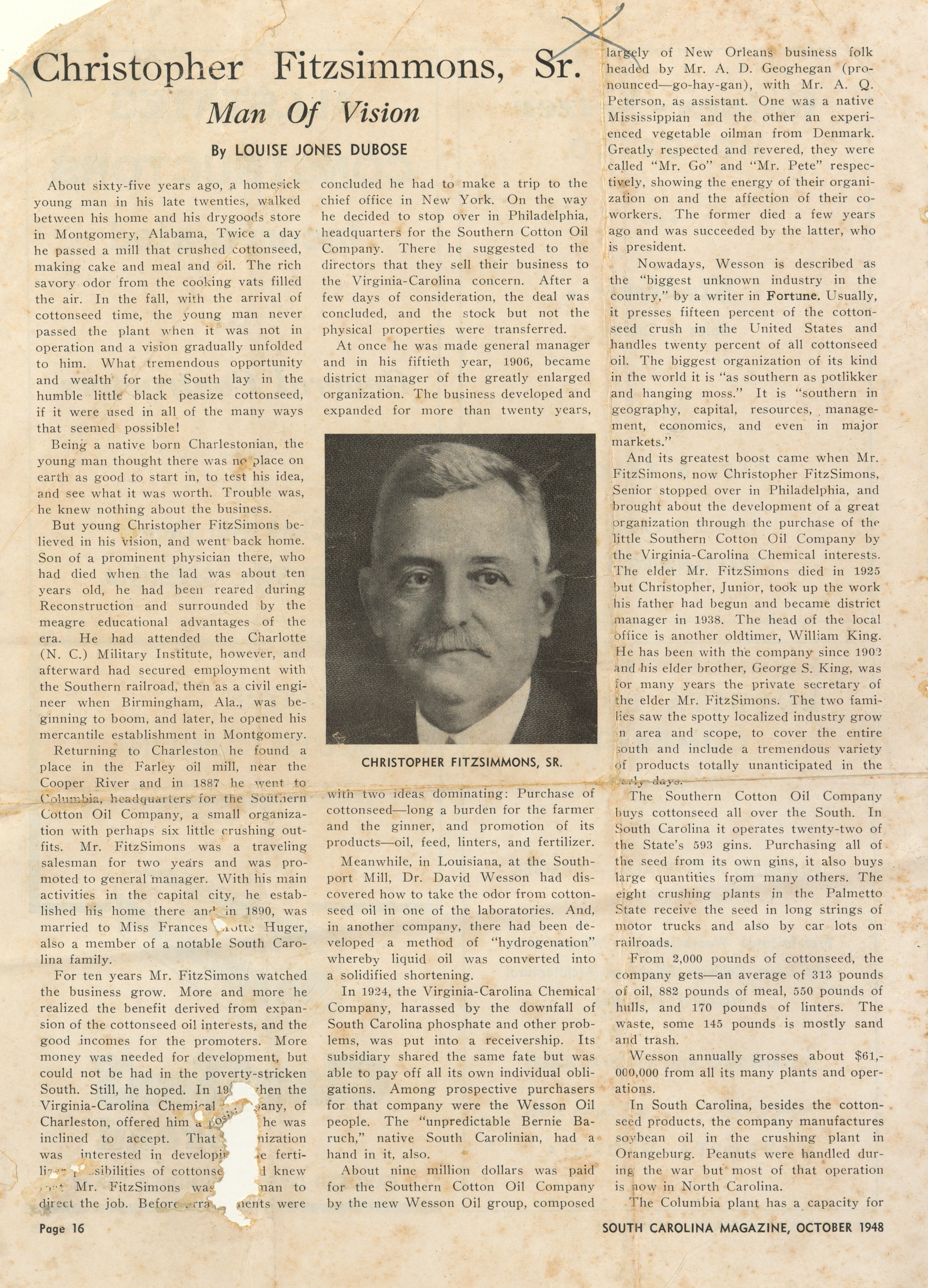
A full-page magazine article cut from South Carolina Magazine, October 1948, mounted to the album sheet. The page carries an engraved head-and-shoulders portrait of the subject roughly mid-page; the text wraps around it in four narrow columns.
Title block:
Christopher Fitzsimmons, Sr.
Man Of Vision
By LOUISE JONES DUBOSE
Engraved portrait, captioned beneath:
CHRISTOPHER FITZSIMONS, SR.
Article body — column one:
About sixty-five years ago, a homesick young man in his late twenties, walked between his home and his drygoods store in Montgomery, Alabama. Twice a day he passed a mill that crushed cottonseed, making cake and meal and oil. The rich savory odor from the cooking vats filled the air. In the fall, with the arrival of cottonseed time, the young man never passed the plant when it was not in operation and a vision gradually unfolded to him. What tremendous opportunity and wealth for the South lay in the humble little black peasize cottonseed, if it were used in all of the many ways that seemed possible!
Being a native born Charlestonian, the young man thought there was no place on earth as good to start in, to test his idea, and see what it was worth. Trouble was, he knew nothing about the business.
But young Christopher FitzSimons believed in his vision, and went back home. Son of a prominent physician there, who had died when the lad was about ten years old, he had been reared during Reconstruction and surrounded by the meagre educational advantages of the era. He had attended the Charlotte (N. C.) Military Institute, however, and afterward had secured employment with the Southern railroad, then as a civil engineer when Birmingham, Ala., was beginning to boom, and later, he opened his mercantile establishment in Montgomery.
Returning to Charleston he found a place in the Farley oil mill, near the Cooper River and in 1887 he went to Columbia, headquarters for the Southern Cotton Oil Company, a small organization with perhaps six little crushing outfits. Mr. FitzSimons was a traveling salesman for two years and was promoted to general manager. With his main activities in the capital city, he established his home there and in 1890, was married to Miss Frances [Huger?] Huger, also a member of a notable South Carolina family.
For ten years Mr. FitzSimons watched the business grow. More and more he realized the benefit derived from expansion of the cottonseed oil interests, and the good incomes for the promoters. More money was needed for development, but could not be had in the poverty-stricken South. Still, he hoped. In 19[XX] then the Virginia-Carolina Chemical [Comp]any, of Charleston, offered him a [posi]tion he was inclined to accept. That [organ]ization was interested in develop[ing] fertili[zer p]ossibilities of cottonse[ed, a]nd [tha]t Mr. FitzSimons was [the] man to direct the job. Before [arra]n[gem]ents were …
[A small irregular hole in the paper toward the foot of the column has destroyed about a dozen words across several lines; bracketed reconstructions above are conjectural.]
Article body — column two (continuing, beside and below the portrait):
concluded he had to make a trip to the chief office in New York. On the way he decided to stop over in Philadelphia, headquarters for the Southern Cotton Oil Company. There he suggested to the directors that they sell their business to the Virginia-Carolina concern. After a few days of consideration, the deal was concluded, and the stock but not the physical properties were transferred.
At once he was made general manager and in his fiftieth year, 1906, became district manager of the greatly enlarged organization. The business developed and expanded for more than twenty years, with two ideas dominating: Purchase of cottonseed — long a burden for the farmer and the ginner, and promotion of its products — oil, feed, linters, and fertilizer.
Meanwhile, in Louisiana, at the Southport Mill, Dr. David Wesson had discovered how to take the odor from cottonseed oil in one of the laboratories. And, in another company, there had been developed a method of “hydrogenation” whereby liquid oil was converted into a solidified shortening.
In 1924, the Virginia-Carolina Chemical Company, harassed by the downfall of South Carolina phosphate and other problems, was put into a receivership. Its subsidiary shared the same fate but was able to pay off all its own individual obligations. Among prospective purchasers for that company were the Wesson Oil people. The “unpredictable Bernie Baruch,” native South Carolinian, had a hand in it, also.
About nine million dollars was paid for the Southern Cotton Oil Company by the new Wesson Oil group, composed
Article body — column three (right of portrait):
largely of New Orleans business folk headed by Mr. A. D. Geoghegan (pronounced — go-hay-gan), with Mr. A. Q. Peterson, as assistant. One was a native Mississippian and the other an experienced vegetable oilman from Denmark. Greatly respected and revered, they were called “Mr. Geo” and “Mr. Pete” respectively, showing the energy of their organization and the affection of their co-workers. The former died a few years ago and was succeeded by the latter, who is president.
Nowadays, Wesson is described as the “biggest unknown industry in the country,” by a writer in Fortune. Usually, it presses fifteen percent of the cottonseed crush in the United States and handles twenty percent of all cottonseed oil. The biggest organization of its kind in the world it is “as southern as potlikker and hanging moss.” It is “southern in geography, capital, resources, management, economics, and even in major markets.”
And its greatest boost came when Mr. FitzSimons, now Christopher FitzSimons, Senior stopped over in Philadelphia, and brought about the development of a great organization through the purchase of a little Southern Cotton Oil Company by the Virginia-Carolina Chemical interests. The elder Mr. FitzSimons died in 1925 but Christopher, Junior, took up the work his father had begun and became district manager in 1938. The head of the local office is another oldtimer, William King. He has been with the company since 1902 and his elder brother, George S. King, was for many years the private secretary of the elder Mr. FitzSimons. The two families saw the spotty localized industry grow in area and scope, to cover the entire south and include a tremendous variety of products totally unanticipated in the early days.
Article body — column four (continuing across the foot of the page):
The Southern Cotton Oil Company buys cottonseed all over the South. In South Carolina it operates twenty-two of the State’s 593 gins. Purchasing all of the seed from its own gins, it also buys large quantities from many others. The eight crushing plants in the Palmetto State receive the seed in long strings of motor trucks and also by car lots on railroads.
From 2,000 pounds of cottonseed, the company gets — an average of 313 pounds of oil, 882 pounds of meal, 550 pounds of hulls, and 170 pounds of linters. The waste, some 145 pounds is mostly sand and trash.
Wesson annually grosses about $61,000,000 from all its many plants and operations.
In South Carolina, besides the cottonseed products, the company manufactures soybean oil in the crushing plant in Orangeburg. Peanuts were handled during the war but most of that operation is now in North Carolina.
The Columbia plant has a capacity for
[Article continues on the following magazine page, off the album leaf.]
Page footers:
Page 16 SOUTH CAROLINA MAGAZINE, OCTOBER 1948
AI Notes
Full-page article mounted on the album leaf, cut from South Carolina Magazine, October 1948, titled ‘Christopher Fitzsimmons, Sr. — Man Of Vision’ by Louise Jones DuBose. The article occupies four columns around a head-and-shoulders engraved portrait captioned ‘CHRISTOPHER FITZSIMONS, SR.’; the magazine renders the surname ‘Fitzsimmons’ (double-m) in title and prose throughout, but the engraving caption uses ‘FITZSIMONS.’ The subject is NOT Christopher FitzSimons the emigrant (1762–1825) — internal evidence (a young man in his late twenties in Montgomery, Alabama c. 1879; son of a prominent Charleston physician who died when the lad was about ten; attended Charlotte (N.C.) Military Institute) places him as ‘Kit’ Christopher FitzSimons Jr., eldest son of Dr. Christopher FitzSimons (3rd) and Susan Milliken Barker. Dr. Christopher 3rd died May 1866, fitting a c. 1856 birth year for Kit. The 1925 death of ‘the elder Mr. FitzSimons’ refers to this same Kit, with his own son Christopher Jr. succeeding him at the head of the Southern Cotton Oil Company. The Charleston cotton-oil dynasty is therefore three generations of Christophers: the doctor’s son Kit (the subject) → Christopher Jr. (the successor) → the family business. The bottom of column 1 has insect damage (a hole obscuring fragments of the 1914 Virginia-Carolina Chemical Company paragraph).
The subject is Christopher FitzSimons “Kit” (b. 26 January 1856, Charleston; d. 8 October 1925, Columbia) — the compiler’s paternal uncle, eldest brother of her father Samuel Gaillard FitzSimons Sr. The Charleston cotton-oil dynasty named in the piece runs three Christophers: Kit (Gen-4) → his son Christopher Jr. (Gen-5, district manager from 1938) → the firm itself. The Southern Cotton Oil Company that Kit joined in 1887 was eventually absorbed by the Wesson Oil interests profiled here and survives today as the Wesson cooking-oil brand.