Letter from Rev. James Warley Miles to Samuel Gaillard Barker on Shelley's Prometheus Unbound (page 2 of 4)
Book 1, Page 79 ·1850–1860
Transcription
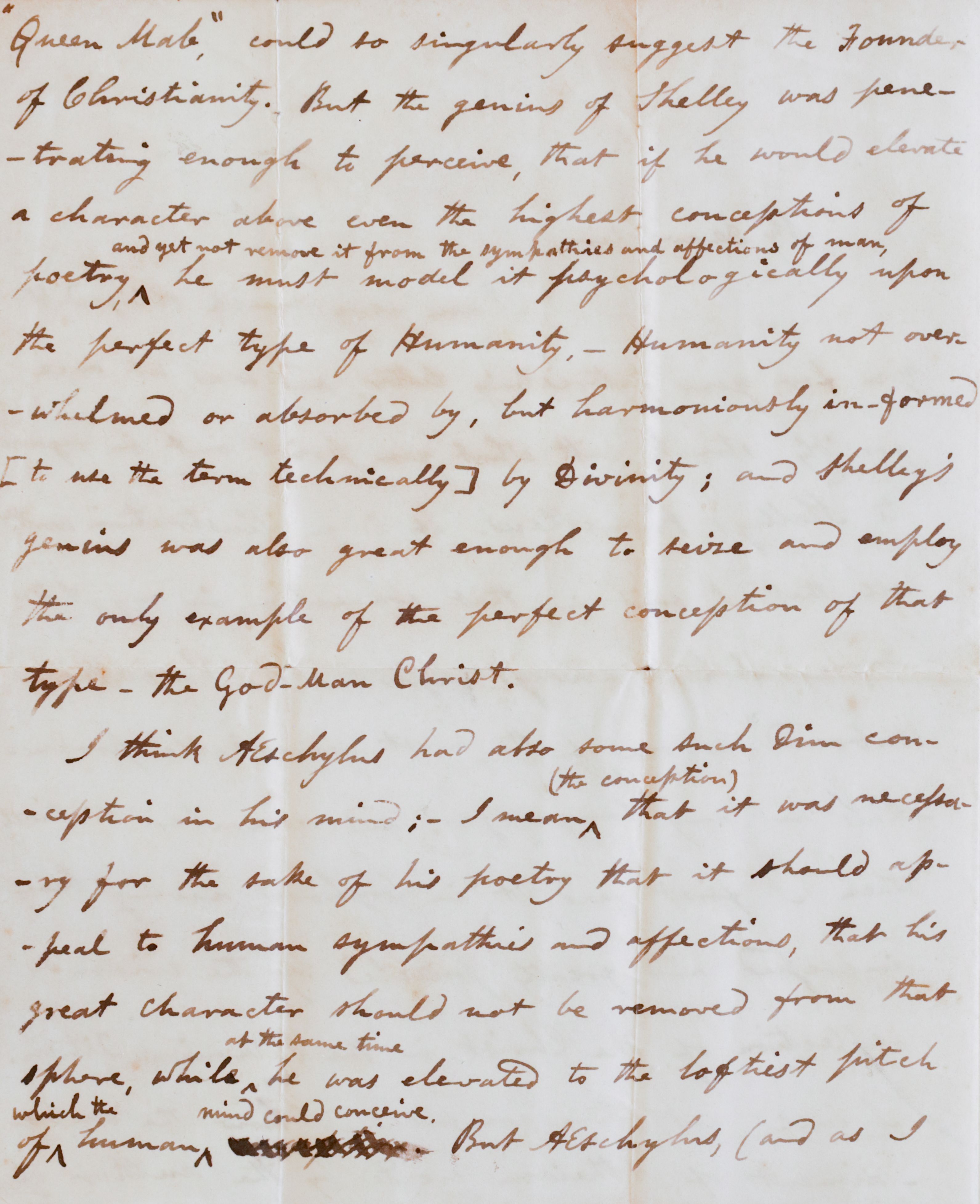
A handwritten letter, page 2 of four, on plain paper in brown ink. The same neat sloping cursive as page 078. Several short caret-inserted interlinear insertions are written above the lines, and one phrase is cancelled and replaced near the bottom of the page.
“Queen Mab” could so singularly suggest the Founder of Christianity. But the genius of Shelley was pene-trating enough to perceive, that if he would elevate a character above even the highest conceptions of poetry, ^and yet not remove it from the sympathies and affections of men, he must model it psychologically upon the perfect type of Humanity, — Humanity not over-whelmed or absorbed by, but harmoniously in-formed [to use the term technically] by Divinity; and Shelley’s genius was also great enough to seize and employ the only example of the perfect conception of that type — the God-Man Christ.
I think Aeschylus had also some such dim con-ception in his mind; — I mean ^(the conception) that it was necessa-ry for the sake of his poetry that it should ap-peal to human sympathies and affections, that his great character should not be removed from that sphere, while, ^at the same time, he was elevated to the loftiest pitch
of human conception.^which the mind could conceive. But Aeschylus, (and as I
AI Notes
Page 2 of the four-page handwritten letter from Rev. James Warley Miles to Samuel Gaillard Barker, in the same brown ink and sloping hand as page 078. The writer continues his analysis of Shelley’s debt to the figure of Christ and turns to Aeschylus. Several short caret-inserted interlinear additions appear, and one cancelled phrase near the foot of the page; the final two lines were heavily revised by the writer with the original phrase ‘of human conception’ cancelled and replaced interlinearly with ‘which the mind could conceive.’ Letter continues onto page 080.
Letter continues on page 080. The caret marks (^) reproduce the writer’s own interlinear inserts. The cancellation “of human conception.” is struck through in the original and replaced above the line with “which the mind could conceive.”