Letter from Rev. James Warley Miles to Samuel Gaillard Barker on Shelley's Prometheus Unbound (page 3 of 4)
Book 1, Page 80 ·1850–1860
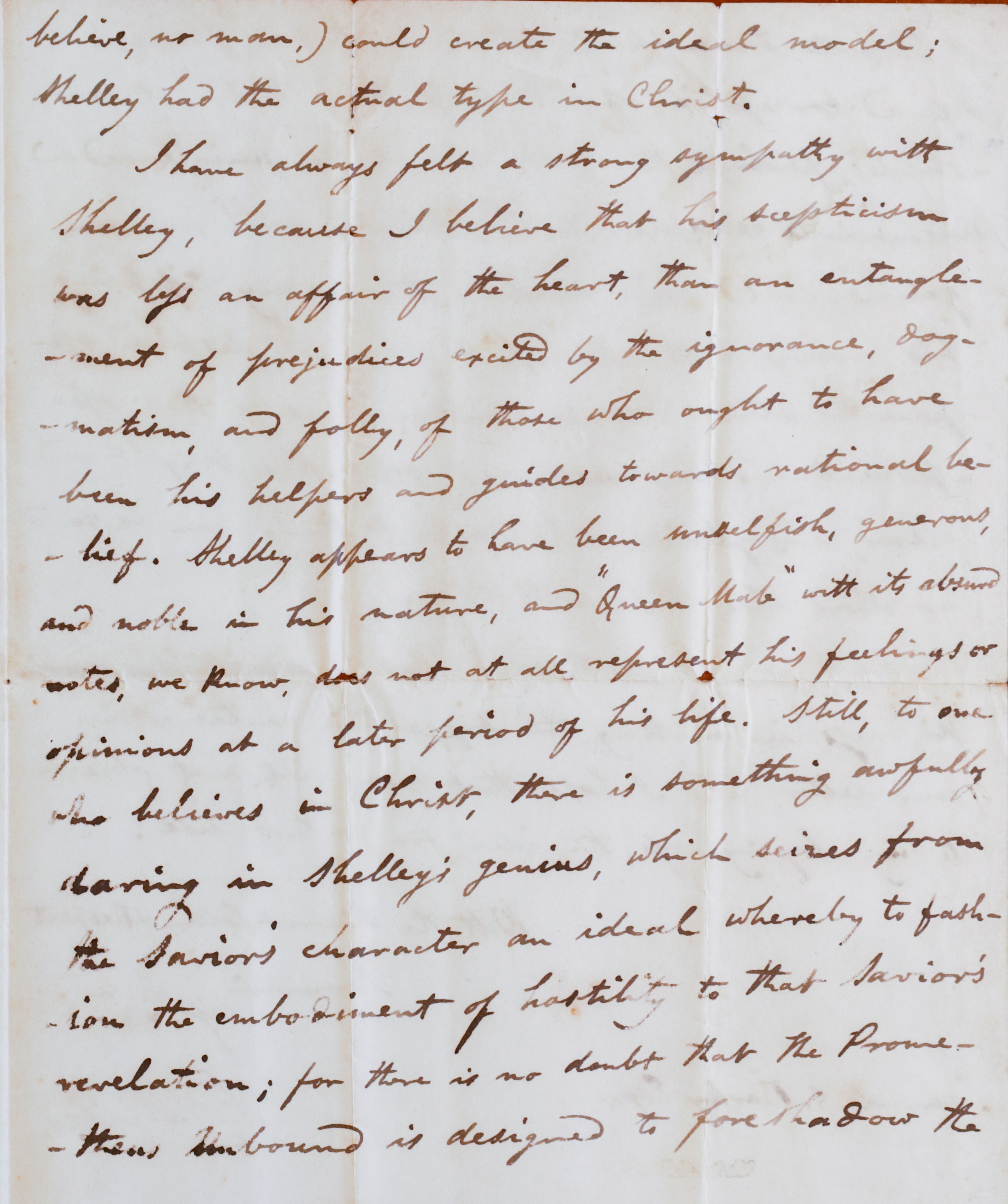
Transcription
A handwritten letter, page 3 of four, on plain paper in brown ink. A vertical fold runs down the centre. Same hand as the preceding pages.
believe, no man,) could create the ideal model; Shelley had the actual type in Christ.
I have always felt a strong sympathy with Shelley, because I believe that his scepticism was less an affair of the heart, than an entangle-ment of prejudices excited by the ignorance, dog-matism, and folly, of those who ought to have been his helpers and guides towards rational be-lief. Shelley appears to have been unselfish, generous, and noble in his nature, and “Queen Mab” with its absurd
notes,we know, does not at all represent his feelings or opinions at a later period of his life. Still, to one who believes in Christ, there is something awfully daring in Shelley’s genius, which seizes fromthethe Saviour’s character an ideal whereby to fash-ion the embodiment of hostility to that Saviour’s revelation; for there is no doubt that the Prome-theus Unbound is designed to foreshadow the
AI Notes
Page 3 of the four-page handwritten letter from Rev. James Warley Miles to Samuel Gaillard Barker. Same brown ink and sloping hand as the preceding pages; a vertical fold runs down the centre of the sheet. The writer rounds off his comparison of Shelley with Aeschylus, then turns to a sympathetic appraisal of Shelley as a man whose scepticism was ‘less an affair of the heart, than an entanglement of prejudices excited by the ignorance, dogmatism, and folly, of those who ought to have been his helpers,’ and characterises Prometheus Unbound as designed ‘to foreshadow’ the ultimate triumph of his (Shelley’s) refined conception of atheism — set up for the closing paragraph on page 081. Letter continues onto page 081.
Letter continues on page 081.