Letter from Rev. James Warley Miles to Samuel Gaillard Barker on Shelley's Prometheus Unbound (page 1 of 4)
Book 1, Page 78 ·1850–1860
Transcription
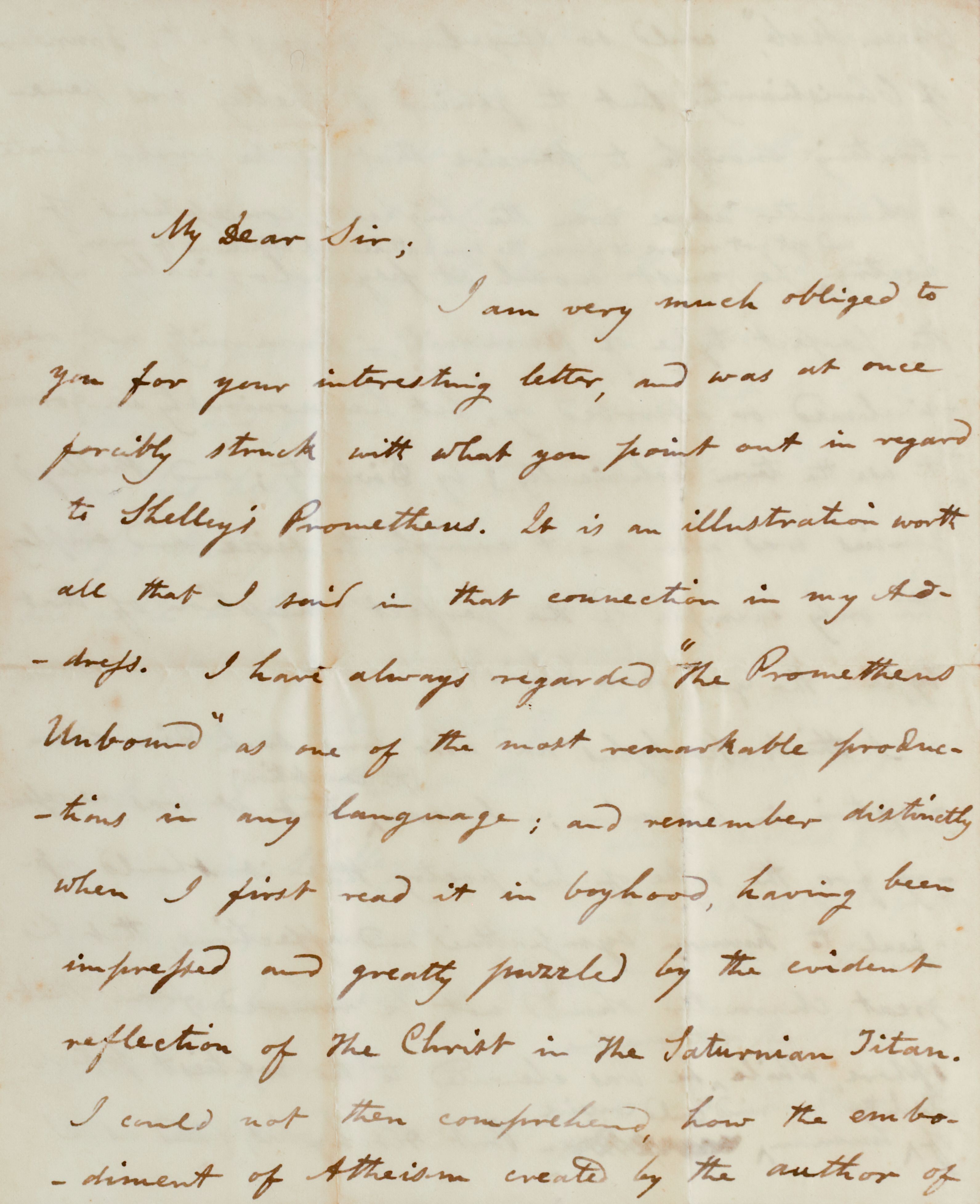
A handwritten letter, page 1 of four, on plain paper in brown ink. A neat sloping cursive in the hand of Rev. James Warley Miles.
My Dear Sir;
I am very much obliged to you for your interesting letter, and was at once forcibly struck with what you point out in regard to Shelley’s Prometheus. It is an illustration worth all that I said in that connection in my Ad-dress. I have always regarded “The Prometheus Unbound” as one of the most remarkable produc-tions in any language; and remember distinctly when I first read it in boyhood, having been impressed and greatly puzzled by the evident reflection of The Christ in The Saturnian Titan. I could not then comprehend how the embo-diment of Atheism created by the author of
AI Notes
Page 1 of a four-page handwritten letter on plain laid paper in brown ink, in the neat sloping cursive of Rev. James Warley Miles (1818–1875), the Charleston Episcopal priest, philologist, and Charleston Library Society Librarian. The letter is addressed to Samuel Gaillard Barker (1799–1863) — see the signed concluding page 081 and the folded-sheet address panel on page 082 (preserved together as a single packet). The writer thanks Barker for an observation about Shelley’s Prometheus Unbound that confirms a point made in ‘my Ad-dress’ (almost certainly one of Miles’s published Charleston addresses of the 1850s), praises Prometheus Unbound as ‘one of the most remarkable productions in any language,’ and recalls being puzzled in boyhood by ‘the evident reflection of The Christ in The Saturnian Titan.’ Letter continues onto page 079.
Letter continues on page 079.
Rev. James Warley Miles (1818–1875) was a Charleston Episcopal priest, philologist, and Librarian of the Charleston Library Society (1854–1858); his addressee Samuel Gaillard Barker (1799–1863) is the compiler Amy FitzSimons Walker’s paternal great-grandfather. Percy Bysshe Shelley’s Prometheus Unbound (1820) was widely regarded by mid-nineteenth-century clergymen as the most theologically provocative of his works — the “atheism” Miles refers to is the openly anti-Christian stance Shelley had taken in the earlier Queen Mab (1813).