Will of Paul Pritchard of Charleston, ship builder — body opens, 10 November 1791 (page 1 of 4)
Book 4, Page 3 ·1791
Transcription
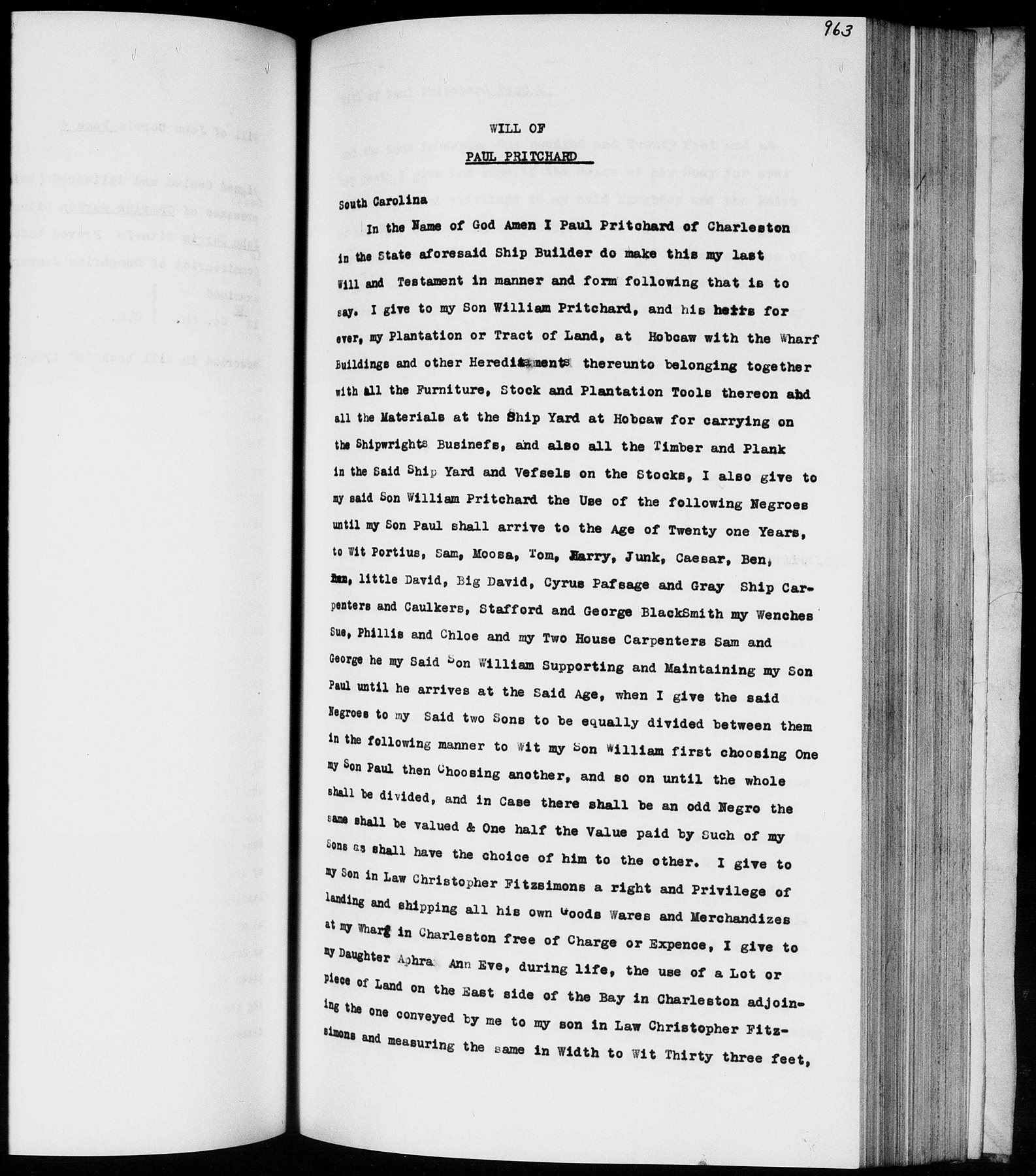
The typewritten transcript is paginated as p. 963 of the source volume. The page bears the header WILL OF PAUL PRITCHARD at top center.
South Carolina.
In the Name of God Amen I Paul Pritchard of Charleston in the State aforesaid Ship Builder do make this my last Will and Testament in manner and form following that is to say. I give to my Son William Pritchard, and his heirs for ever, my Plantation or Tract of Land, at Hobcaw with the Wharf Buildings and other Hereditaments thereunto belonging together with all the Furniture, Stock and Plantation Tools thereon and all the Materials at the Ship Yard at Hobcaw for carrying on the Shipwrights Businefs, and also all the Timber and Plank in the Said Ship Yard and Vefsels on the Stocks, I also give to my said Son William Pritchard the Use of the following Negroes until my Son Paul shall arrive to the Age of Twenty one Years, to Wit Portius, Sam, Moosa, Tom, Harry, Junk, Caesar, Ben, [Ben? — typist’s letter unclear], little David, Big David, Cyrus Pafsage and Gray Ship Carpenters and Caulkers, Stafford and George BlackSmith my Wenches Sue, Phillis and Chloe and my Two House Carpenters Sam and George he my Said Son William Supporting and Maintaining my Son Paul until he arrives at the Said Age, when I give the said Negroes to my Said two Sons to be equally divided between them in the following manner to Wit my Son William first choosing One my Son Paul then Choosing another, and so on until the whole shall be divided, and in Case there shall be an odd Negro the same shall be valued & One half the Value paid by Such of my Sons as shall have the choice of him to the other. I give to my Son in Law Christopher Fitzsimons a right and Privilege of landing and shipping all his own Goods Wares and Merchandizes at my Wharf in Charleston free of Charge or Expence, I give to my Daughter Aphra Ann Eve, during life, the use of a Lot or piece of Land on the East side of the Bay in Charleston adjoining the one conveyed by me to my son in Law Christopher Fitzsimons and measuring the same in Width to Wit Thirty three feet,
Source: Charleston, South Carolina probate Will Book B, 1786-1793, page 613. Typewritten transcription reproduced from FamilySearch image 939L-J49B-9M, in the public domain.
AI Notes
Opening of the November 10, 1791 will of Paul Pritchard of Charleston, the shipbuilder father-in-law of Christopher FitzSimons the emigrant. The will is referenced multiple times in Book 1 (pp 003, 007, 011, 024) and definitively answers the long-running confusion between Paul Pritchard Sr. (the testator here, Catharine’s father) and his sons Paul Jr. and William, who succeeded him in the shipyard. The typewritten transcription preserves several 18th-century long-s forms (‘Pafsage’, ‘Businefs’, ‘pofsefs’) that the original handwritten will used. The will is recorded in Charleston probate Will Book B, 1786-93, page 613 (not Will Book A, which held the 1782 will of Christopher FitzSimons the uncle).
Will continues onto document 4.
This is the Paul Pritchard the family memoranda repeatedly identify as Catharine Pritchard’s father — in his own words. The opening bequest gives the Hobcaw shipyard and its working complement to his son William, with the labour of eighteen named enslaved people, “until my Son Paul shall arrive to the Age of Twenty one Years.” Paul Jr. was born 13 April 1779 (per Book 1, p024), so his 21st birthday would have fallen in April 1800 — by which time his father was dead and the inherited workforce had been split. The “Son in Law Christopher Fitzsimons” granted free wharfage is the future emigrant founder of the Charleston FitzSimons line, who had married Catharine Pritchard on 3 August 1788; the wharf privilege passes to his heirs in perpetuity at the end of document 4’s preceding clause (continued on document 4). The list of named enslaved workers — the people whose labour sustained the Hobcaw yard’s Revolutionary-era and post-war shipbuilding output under Pritchard’s ownership (he acquired the yard in 1778) — is the most concrete record in the archive of the human labour underpinning the family’s antebellum wealth.