Typed garden essay, page 1 of 4 — beginning a Southern garden in October
Book 2, Page 158 ·1930–1950
Transcription
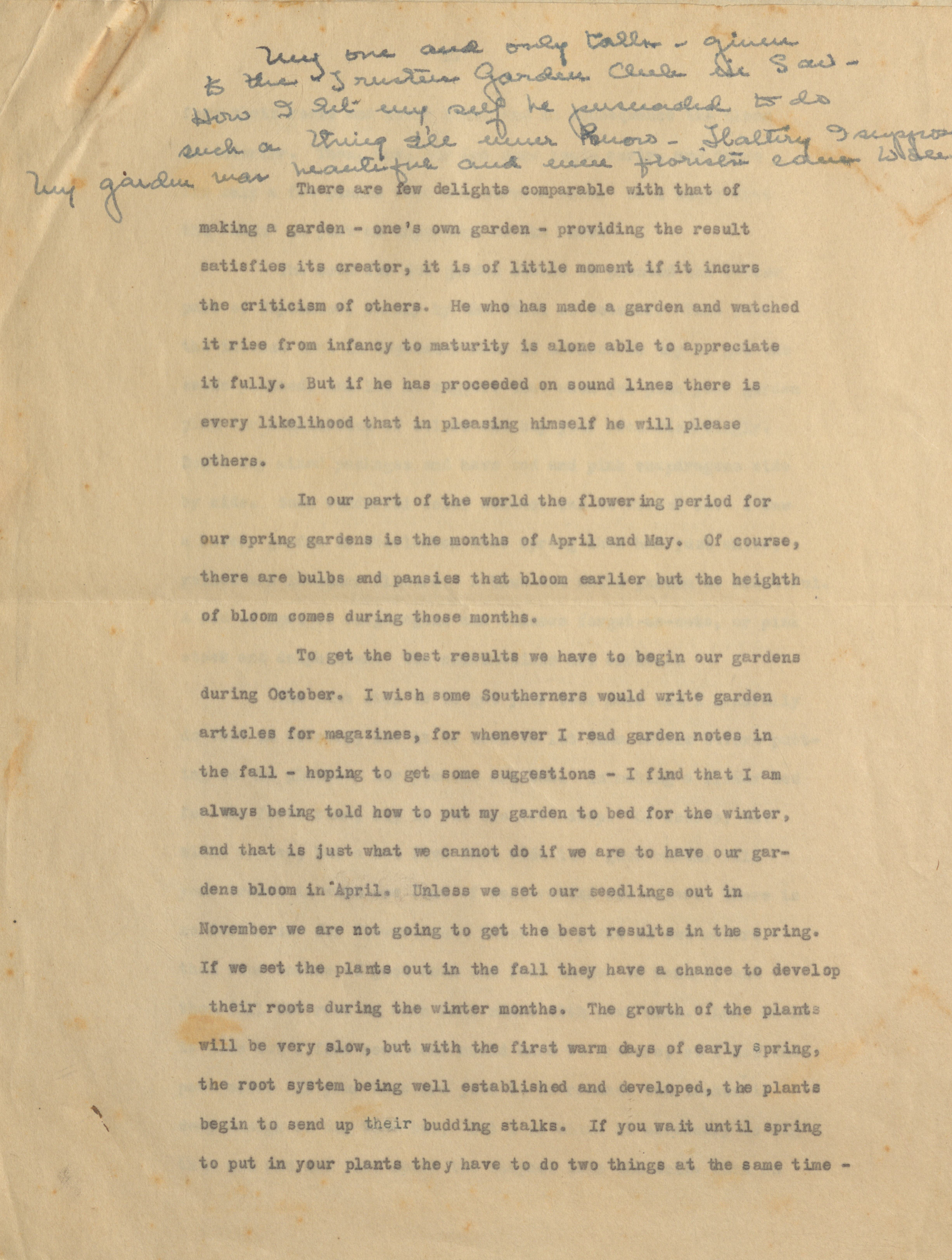
Handwritten note in ink across the top of the page, in the compiler’s hand:
My one and only talk — given to the ‘Trustees’ Garden Club. He said — How I let myself be persuaded to do such a thing the Lord knows — Flattery I suppose; my garden was beautiful and even florists came to see.
Typescript follows:
There are few delights comparable with that of making a garden — one’s own garden — providing the result satisfies its creator, it is of little moment if it incurs the criticism of others. He who has made a garden and watched it rise from infancy to maturity is alone able to appreciate it fully. But if he has proceeded on sound lines there is every likelihood that in pleasing himself he will please others.
In our part of the world the flowering period for our spring gardens is the months of April and May. Of course, there are bulbs and pansies that bloom earlier but the height of bloom comes during these months.
To get the best results we have to begin our gardens during October. I wish some Southerners would write garden articles for magazines, for whenever I read garden notes in the fall — hoping to get some suggestions — I find that I am always being told how to put my garden to bed for the winter, and that is just what we cannot do if we are to have our gardens bloom in April. Unless we set our seedlings out in November we are not going to get the best results in the spring. If we set the plants out in the fall they have a chance to develop their roots during the winter months. The growth of the plants will be very slow, but with the first warm days of early spring, the root system being well established and developed, the plants begin to send up their budding stalks. If you wait until spring to put in your plants they have to do two things at the same time —
AI Notes
First numbered sheet (typescript, single-spaced, faded purple-blue ribbon) of a four-page essay on Southern flower-gardening, evidently the author’s own composition. The body advises beginning the garden in October, planting seeds in late September or early October, and explains how Southern springs and short winters dictate a different schedule from the magazine garden-articles written for the North. A handwritten note in ink across the top of the sheet, in the compiler Amy FitzSimons Walker’s hand, identifies the typescript as the text of her ‘one and only talk — given to the Trustees Garden Club’ (Savannah, founded 1926) and disclaims her own qualifications (‘How I let myself be persuaded to do such a thing the Lord knows — Flattery I suppose; my garden was beautiful and even florists came to see’).
The Trustees’ Garden Club of Savannah — founded 15 February 1926, named for Georgia’s original 1733 colonial garden, and a Garden Club of America member chapter — was the elite garden society of the city. The essay continues across pages 159–161.