Memoir continues: Larsen daughters at Rock Spring school, plantation hospitality, breakfasts of game; first journeys to Charleston
Book 2, Page 18 ·1888–1900
Transcription
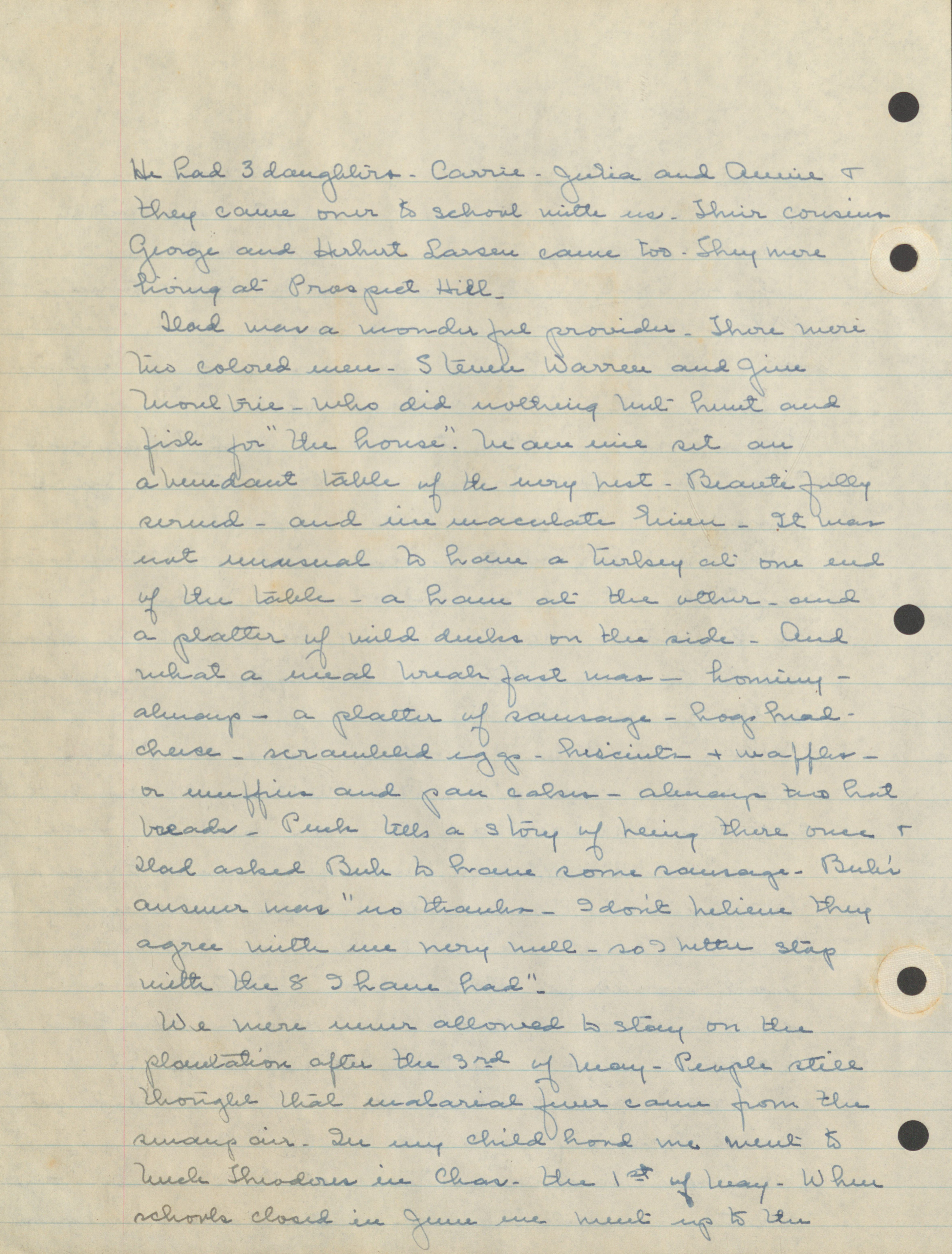
He had 3 daughters — Carrie — Judith and Annie & they came over to school with us. Their cousins George and Herbert Larsen came too. They were living at Prospect Hill.
Dad was a wonderful provider. There were two colored men — Steven Warren and Jim Montrie — who did nothing but hunt and fish for “the house”. We were ever set an abundant table of the very best — Breakfasts fully served — and immaculate linen. It was not unusual to have a turkey at one end of the table — a ham at the other — and a platter of wild ducks on the side. And what a meal breakfast was — hominy — always — a platter of sausage — hog’s head cheese — scrambled eggs — biscuits + waffles — or muffins and game salmi — always two hot breads. Puck tells a story of being there once + Dad asked Bub to have some sausages. Bub’s answer was “no thanks — I don’t believe they agree with me very well — so I’d better stop with the 8 I have had”.
We were never allowed to stay on the plantation after the 3rd of May — People still thought that malarial fever came from the swamp air. In my child hood we went to Uncle Theodore in Chas. the 1st of May. When schools closed in June we went up to the
AI Notes
Handwritten page in blue ink on ruled album paper, continuing the memoir. Three Larsen daughters (Carrie, Judith, Annie) and their cousins George and Herbert Larsen — living at Prospect Hill — attended school with the writer. Recollections of the plantation breakfast table: hominy, sausage, hog’s head cheese, scrambled eggs, biscuits and waffles or muffins, and game salmi, with two hot breads. The two huntsmen for the household are Steven Warren and Jim Montrie. Family anecdote about Uncle Theodore’s bewildered guest ‘Bub’ who declined sausage at every meal after having eaten eight. Children were not allowed to remain on the plantation after the 3rd of May because of malarial fever; the family decamped to Uncle Theodore in Charleston on the 1st of May.
The “swamp air” (miasma) theory of malaria was the standard medical understanding in Amy’s childhood; Ronald Ross’s 1897 demonstration that Anopheles mosquitoes were the actual vector only slowly displaced it. The Lowcountry planter custom of decamping for upland or coastal residences from May through frost was nonetheless a sound public-health practice — the mosquitoes that did the transmitting were most active in exactly those months.