Memoir, page 7: Dunkin's death on Feb 4th, Mammie's grief, the nursery
Book 2, Page 7 ·1890–1900
Transcription
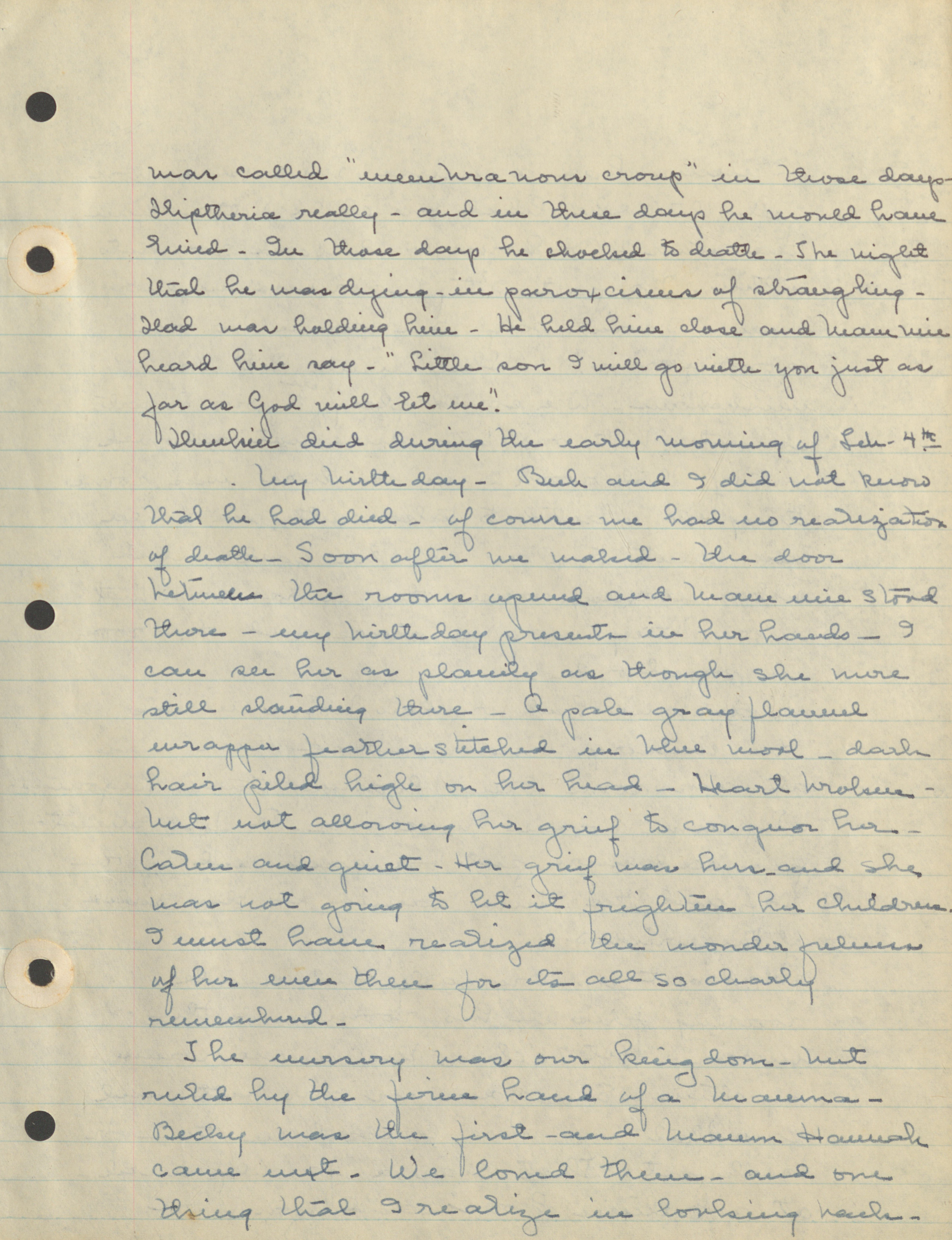
was called “membranous croup” in those days — diphtheria really — and in these days he would have lived — In those days he choked to death — The night that he was dying — in paroxysms of strangling — Dad was holding him — He held him close and Mammie heard him say — “Little son I will go with you just as far as God will let me!”
Dunkin died during the early morning of Feb 4th — my birthday — Buck and I did not know that he had died — of course we had no realization of death — Soon after we waked — the door between the rooms opened and Mammie stood there — my birthday present in her hands — I can see her as plainly as though she were still standing there — A pale gray flannel wrapper feather stitched in blue wool — dark hair piled high on her head — Heart broken — but not allowing her grief to conquer her. Calm and quiet — her grief was hers and she was not going to let it frighten the children. I must have realized the wonderfulness of her even then — for it’s all so clearly remembered.
The nursery was our kingdom — but ruled by the firm hand of a Maumie — Becky was the first — and Maum Hannah came next. We loved them — and one thing that I realize in looking back —
AI Notes
Continuation of the memoir, recording Dunkin’s death from membranous croup (diphtheria) on the early morning of February 4th — the writer’s birthday. Describes Mammie standing at the doorway in a pale gray flannel wrapper feather-stitched in blue wool, dark hair piled high — not letting her grief conquer her, calm and quiet for the sake of the other children. The page closes recalling the nursery as ‘our kingdom’ ruled by the firm hand of a Maumie — Becky being the first, then Maum Hannah.
Diphtheria — the “membranous croup” that killed Dunkin — was one of the leading childhood killers of the 19th century. The diphtheria antitoxin was developed by Emil von Behring in 1890 and reached widespread American clinical use only in the mid-1890s; depending on the year of Dunkin’s death (he was the family’s third child after Amy and Buck), the treatment that would have saved him was either not yet available or not yet in country practice.