Memoir, page 6: Dad plants Mt. Hope 1893, the Storm of '93, Dunkin's illness
Book 2, Page 6 ·1893–1950
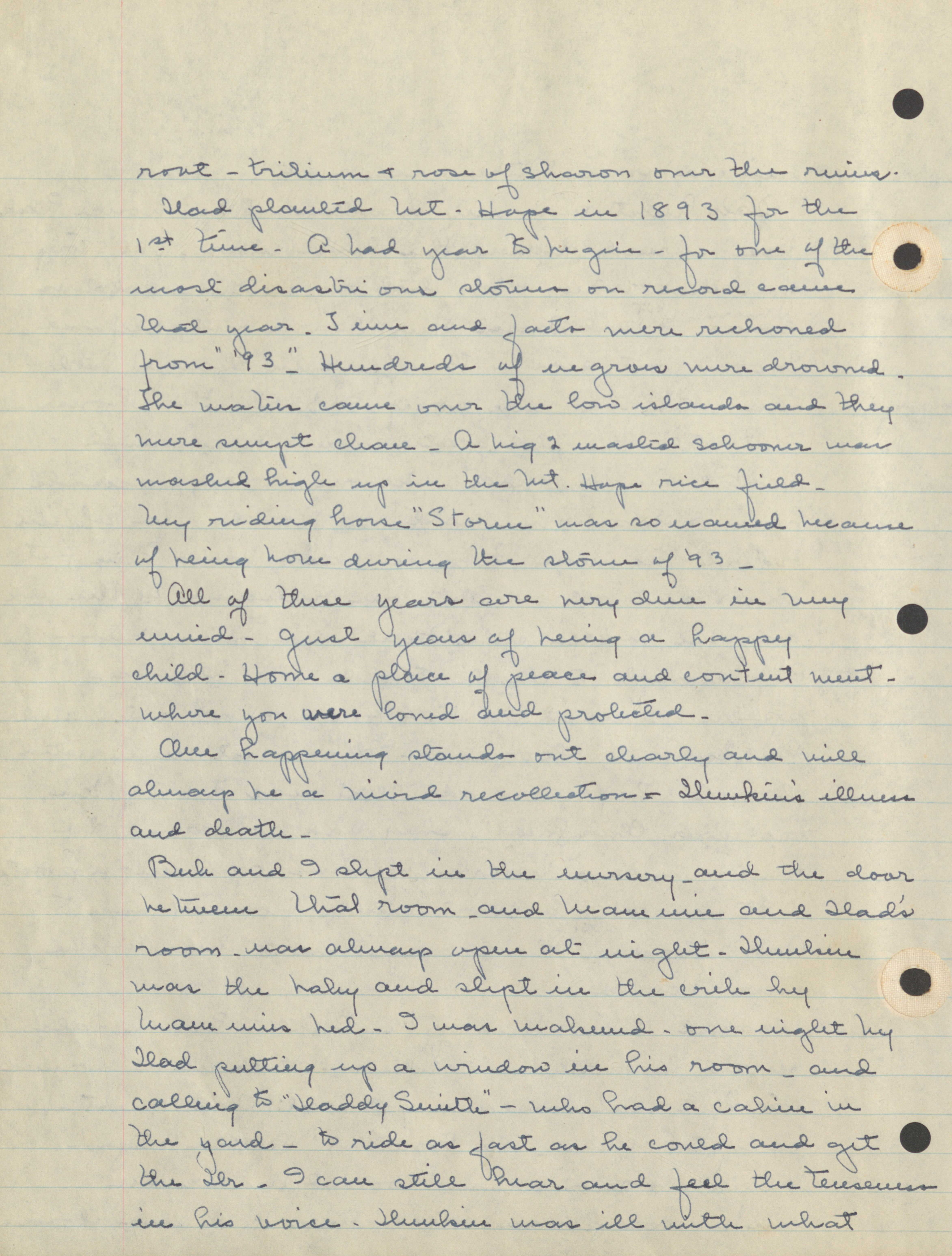
Transcription
[fr]ost — trillium & rose of sharon over the ruins.
Dad ploughed Mt. Hope in 1893 for the 1st time. A bad year to begin — for one of the most disastrous storms on record came that year. Time and dates were reckoned from “93.” Hundreds of negroes were drowned. The waters came over the low islands and they were swept clean — A big 2 masted schooner was washed high up in the Mt. Hope rice field. My riding horse “Storm” was so named because of being born during the storm of '93 —
All of these years are very dear in my mind — quiet years of being a happy child — Home a place of peace and content ment — where you were loved and protected.
One happening stands out clearly and will always be a vivid recollection — Dunkin’s illness and death.
Bub and I slept in the nursery, and the door between that room and Mammie and Dad’s room was always open at night. Dunkin was the baby and slept in the crib by Mammie’s bed. I was wakened, one night by Dad putting up a window in his room — and calling to “Daddy Smith” — who had a cabin in the yard — to ride as fast as he could and get the Dr. I can still hear and feel the tenseness in his voice. Dunkin was ill with what
AI Notes
Continuation of Amy’s memoir. Records Dad ploughing Mt. Hope in 1893 for the first time — a disastrous year because of the August 1893 hurricane, the deadliest in S.C. history. Amy recalls the storm casting a two-masted schooner high into the Mt. Hope rice field and notes her riding horse ‘Storm’ was so named because he was born during it. The page ends with the beginning of an account of Dunkin’s fatal illness — Bub (Samuel Gaillard FitzSimons Jr.) and Amy in the nursery, Dad calling ‘Daddy Smith’ from his window to fetch the doctor. The ‘rost’ at the top of the page is part of an unclear preceding word — likely ‘frost’.
The “storm of '93” was the Sea Islands hurricane that struck the South Carolina and Georgia coasts on the night of 27 August 1893 — a Category 3 storm with a 16-foot surge that killed an estimated 1,000–2,000 people (mostly Gullah residents of the barrier islands) and left some 30,000 homeless. It remains among the deadliest hurricanes in U.S. history, and Lowcountry chronology was reckoned from it for a generation afterward.