Hedley family Bible record (page 3 of 3): births of enslaved persons in J. L. Hedley's household and note on Maria Ann Mauger (née Hedley), transcribed by Minnie P. FitzSimons, 1924
Book 1, Page 637 ·1841–1924
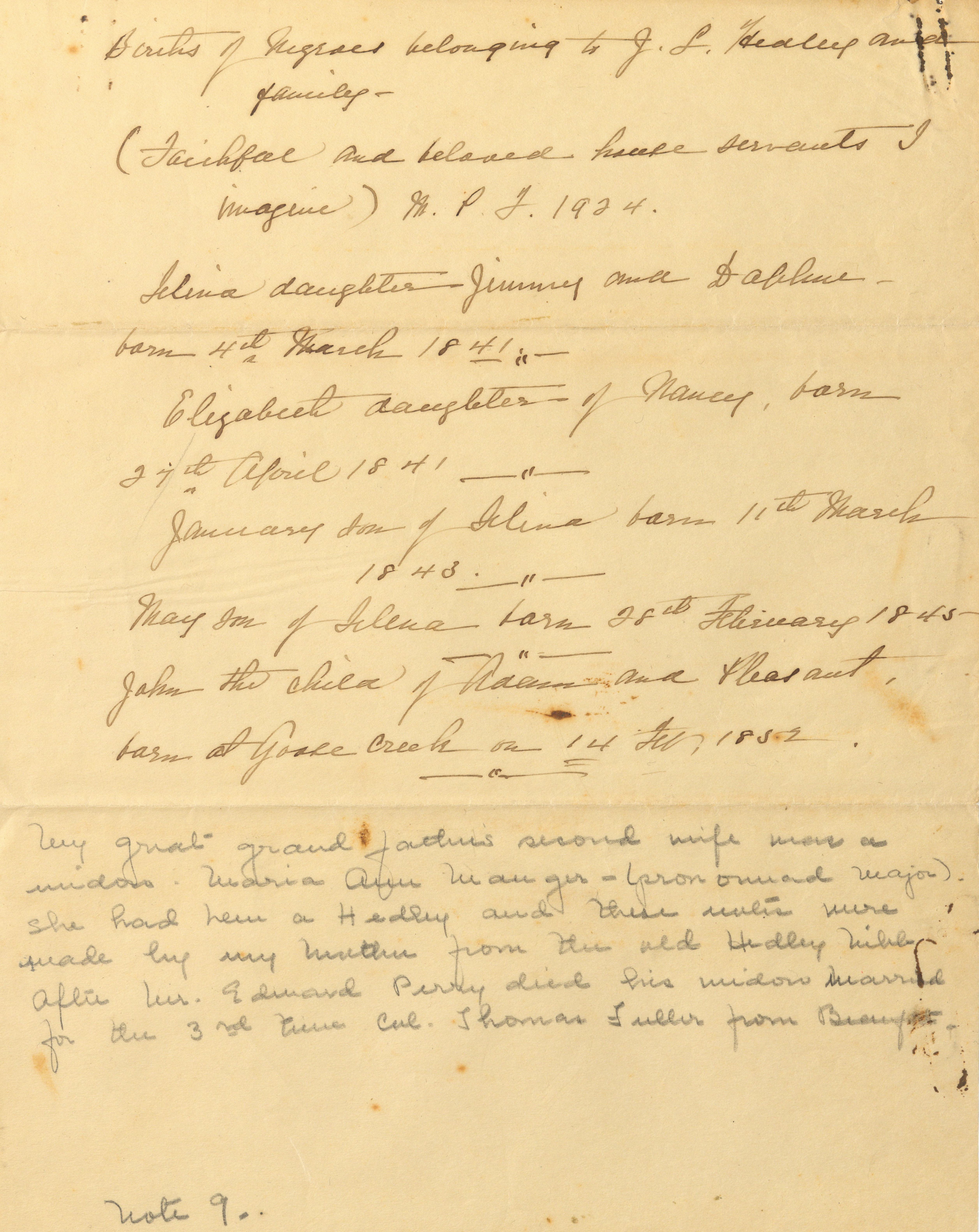
Transcription
Births of negroes belonging to J. L. Hedley and family.
(Faithful and beloved house servants I imagine.) M. P. F. 1924.
Selina daughter — Jimmy and Daphne — born 4th March 1841.
Elizabeth daughter of Nancy, born 27th April 1841.
January son of Selina born 11th March 1843.
May son of Selina, born 28th February 1845.
John the child of [Adamson] and Pleasant, born at Goose Creek on 14th Feb., 1842.
[In Minnie’s pencilled hand below, as an explanatory note to her transcript:]
My great grand father’s second wife was a widow — Maria Ann Mauger — (pronounced major). She had been a Hedley and these notes were made by my mother from the old Hedley Bibles. After Mr. Edward Perry died his widow married for the 3rd time Col. Thomas Fuller from Beaufort.
note 9.
AI Notes
Loose sheet of laid paper, brown ink in a tidy 19th-century hand at top with a second, looser hand in lighter ink at the bottom half. This is the third (final) page of Minnie P. FitzSimons’s 1924 transcription from John L. Hedley’s family Bible (continues from pp. 635-636). The upper section records births of enslaved persons in the household; the lower section is Minnie’s separate explanatory note in her own pencilled hand. ‘note 9’ is pencilled at the lower left as a sequence marker. The surname is HEDLEY (matches Minnie’s consistent usage on pp. 635-636 and the Perry-Hedley memo at book-002/p031). The parenthetical ‘I imagine’ is M.P.F.'s editorial aside. The parenthetical ‘(pronounced major)’ after ‘Maria Ann Mauger’ is a phonetic gloss, clarifying that Mauger rhymes with major. The pencilled note’s third husband ‘Col. Thomas Fuller’ should read Col. William Fuller of Beaufort (per Minnie’s own hand on the facing p. 634, which reads ‘old Col. Wm. Fuller’); ‘Thos.’ here is a likely misread of ‘Wm.’
Recording the births of enslaved people in the family Bible alongside white family events was standard practice in antebellum slaveholding households — the Bible served as a property ledger as much as a spiritual record. The transcriber Minnie Perry FitzSimons’s 1924 parenthetical — “Faithful and beloved house servants I imagine” — reflects the sentimentalized “loyal slave” framing common to Lost Cause–era white Southern memory; she had never met the people named (most of these births predate her own by nearly two decades) and is reconstructing them from sympathy with her grandmother’s household, not from acquaintance.