Letter fragment — reflections on temperament and the 'Philistine,' undated (page 1)
Book 1, Page 499 ·1900–1950
Transcription
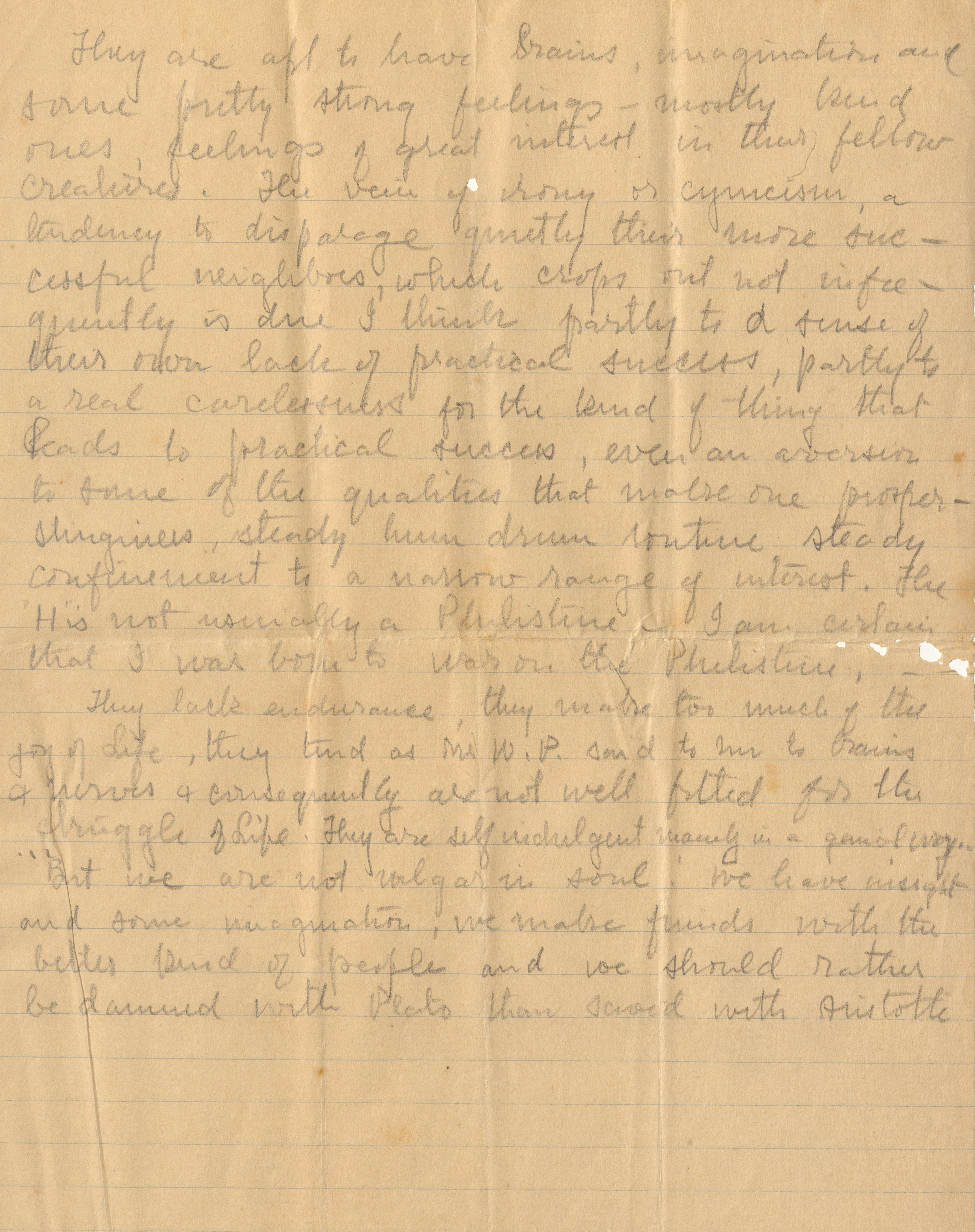
They are apt to have brains, imaginations and some pretty strong feelings — mostly kind ones, feelings of great interest in their fellow creatures. The vein of irony or cynicism, a tendency to disparage gently their more successful neighbors, which crops out not infrequently is due I think partly to a sense of their own lack of practical success, partly to a real carelessness for the kind of thing that leads to practical success, even an aversion to some of the qualities that make one prosper — shrewdness, steady humdrum routine, steady confinement to a narrow range of interest. He’s not unusually a Philistine — & I am certain that I was born to war on the Philistine. —
They lack endurance, they crumble too much of the joy of life, they tend, as Mr. W. P. said to me, to brains & nerves & consequently are not well fitted for the struggle of life. They are self-indulgent mainly in a genial way. “But we are not vulgar in soul.” We have minds and some imagination; we make friends with the better kind of people and we should rather be damned with Plato than saved with Aristotle.
AI Notes
A single sheet of cream wove paper covered in cursive in blue or gray ink. No salutation visible at the top — the page begins mid-sentence and is one of several pages of a longer philosophical letter (continued on page 500 and apparently page 502). The writer reflects on people who are ‘apt to have brains, imaginations and some pretty strong feelings,’ the limitations of the ‘Philistine,’ and references a ‘Mr. W. P.’ — possibly W. P. Trent (William Peterfield Trent, 1862-1939) or another literary correspondent. Handwriting and tone resemble the philosophical-literary voice elsewhere in the album. A small tear and stains affect the right edge. ‘The vein of irony or cynicism’ (not ‘He being of downy or cynicism’); ‘tendency to disparage gently’ confirmed; ‘they crumble too much of the joy of life’ (not ‘if the joy’); ‘tend, as Mr. W. P. said to me, to brains & nerves’ (this resolves the prior [hauns] [.?.] crux — the writer is contrasting brains/nerves with physical endurance); ‘self-indulgent mainly in a genial way’ (not ‘enough in a genial way’); ‘But we are not vulgar in soul’ (not ‘vulgarian souls’) — note quotation marks in original suggesting writer is quoting a maxim. The closing ‘damned with Plato than saved with Aristotle’ is a known late-Victorian/Edwardian literary tag (it appears in F. W. H. Myers, Walter Pater circles).
Continues on page 500.