Letter from Ellen M. FitzSimons to Amy, Dec. 9, 1948 (page 2 of 2)
Book 1, Page 498 ·1948
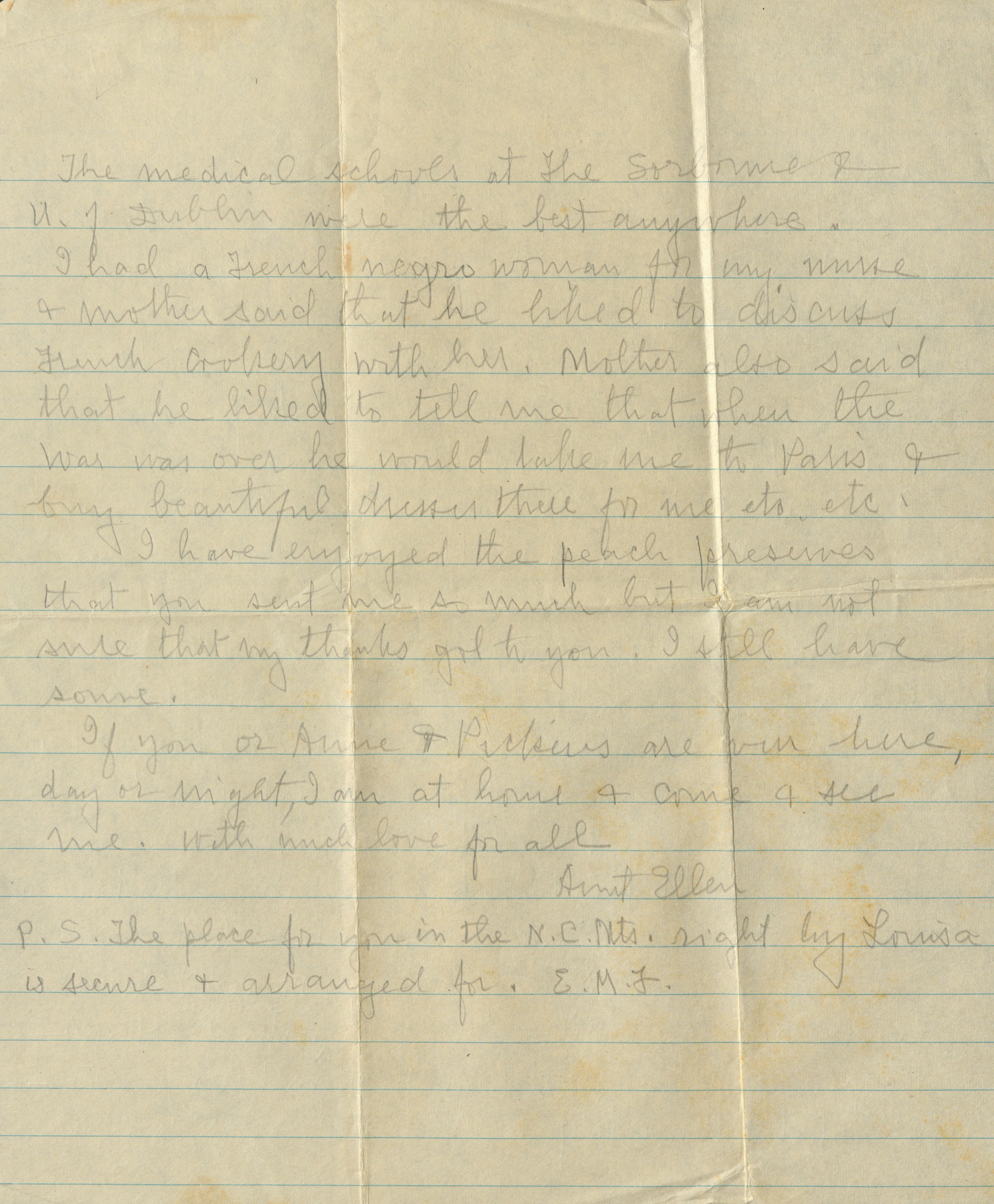
Transcription
[Continued from page 497.]
the medical schools at the Sorbonne & U. of Dublin were the best anywhere. I had a French Negro woman for my nurse & mother said that he liked to discuss French cookery with her. Mother also said that he liked to tell me that when the war was over he would take me to Paris & buy beautiful dresses there for me etc. etc.
I have enjoyed the peach preserves that you sent me so much, but I am not sure that my thanks got to you. I still have some.
If you or Anne & Pickens are ever here, day or night, I am at home & come & see me. With much love for all —
Aunt Ellen
P.S. The place for you in the N.C. Mts. sought by Louisa is secured & arranged for. — E.M.F.
AI Notes
Second page of the Dec. 9, 1948 letter from Aunt Ellen FitzSimons. Continues a defense of the FitzSimons family’s history and her father’s medical training in Paris and Dublin. Mentions a French Negro nurse, peach preserves, and a North Carolina mountain place to be secured for Amy by Louisa. Signed ‘Aunt Ellen’ with postscript initialed ‘E.M.F.’ Page shows heavy fold-creases. ‘when the war was over’ (not ‘when life was nice over’) — references end of the Franco-Prussian War (1870-71), when Ellen’s father was studying medicine in Paris; ‘French Negro woman’ (not ‘Creole’); ‘secured & arranged for’ (not ‘secure & arranged’); ‘love for all’ confirmed.
“When the war was over” refers to the Franco-Prussian War of 1870–71, the conflict that brought down the Second French Empire and ended with the Siege of Paris (September 1870 – January 1871). Ellen’s father Dr. Christopher FitzSimons (3rd) was pursuing medical training at the Sorbonne during this period and lived through the upheaval; Ellen, born 1862 at Mulberry Plantation, was a small child in Paris while the war unfolded. The “place in the N.C. Mts.” reflects the Lowcountry diaspora’s long tradition of summer or retirement homes in the Blue Ridge — particularly Flat Rock and Hendersonville — where many branches of the family had relocated after the Civil War.