Ellen M. FitzSimons to her brother Sam, Aug. 28, 1927 (page 2), signed Affec. E. M. F.
Book 1, Page 316 ·1927
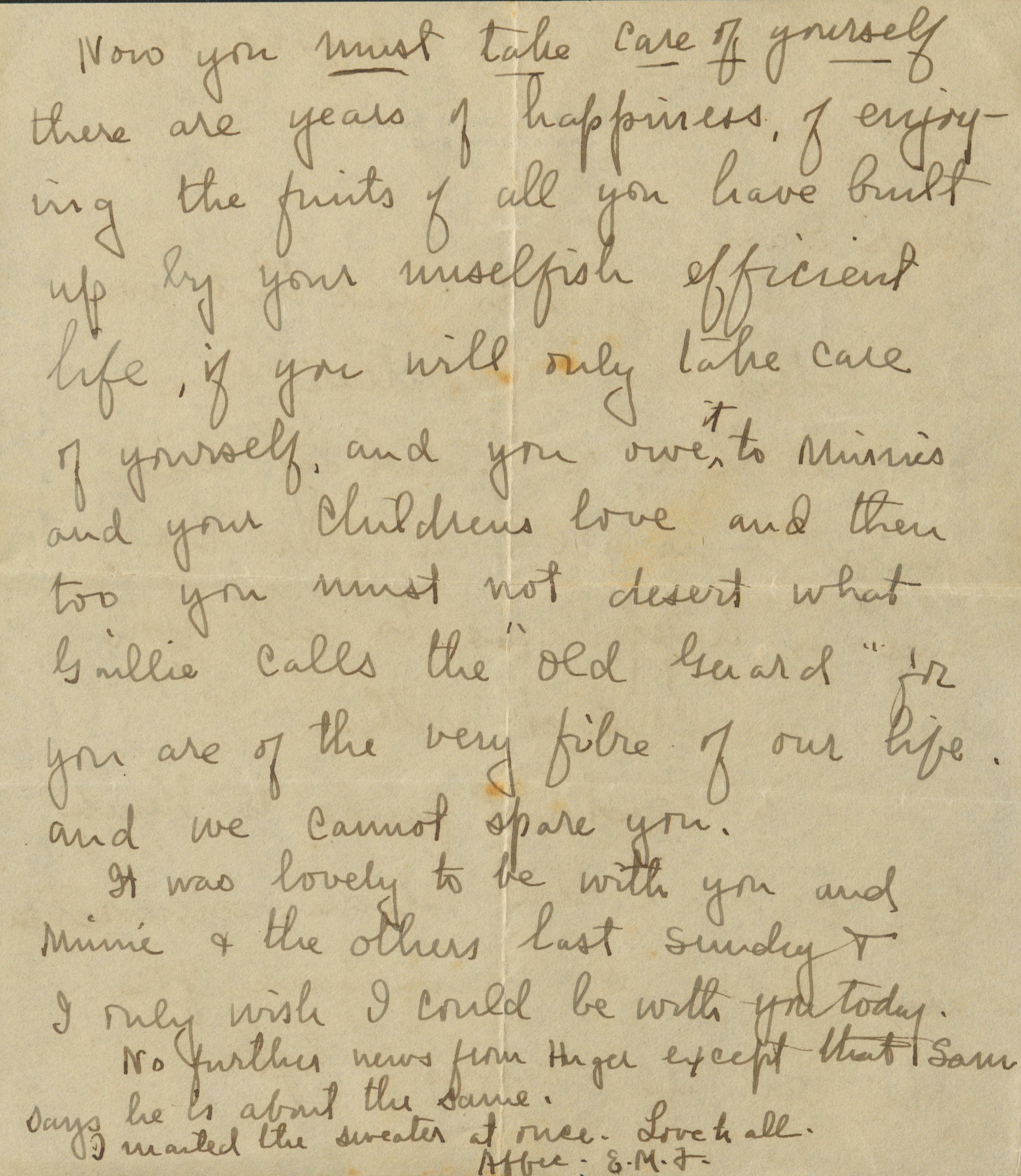
Transcription
[Continued from page 315. Pencil cursive on cream paper, no letterhead visible — the printed Charleston Library Society heading is on the recto.]
Now you must take care of yourself — there are years of happiness, of enjoying the fruits of all you have built up by your unselfish efficient life, if you will only take care of yourself, and you owe it to Minnie’s and your Children’s love and then too you must not desert what Gillie calls the “Old Guard” for you are of the very fibre of our life, and we cannot spare you.
It was lovely to be with you and Minnie & the others last Sunday & I only wish I could be with you today.
No further news from Huger except that Sam says he is about the same.
I mailed the sweater at once. Love to all.
Affec. E. M. F.
AI Notes
Second page of the pencilled letter begun on page 315. Same cream paper as page 315 (Charleston Library Society stationery turned so the printed letterhead is on the reverse), vertical and horizontal folds. The hand is the same loose pencil cursive. The page closes with two short lines crowded into the lower margin and the sign-off ‘Affec. E. M. F.’ Writer is Ellen Milliken FitzSimons; addressee is her brother Samuel Gaillard FitzSimons Sr. ‘Minnie’ is Sam Sr.'s wife Mary Anne Perry FitzSimons; ‘Gillie’ (an in-text spelling of the nickname) is their brother Gaillard Stoney FitzSimons (‘Gaillie’), the compiler Amy’s father. ‘Huger’ is unidentified but evidently a member of the family circle; the second ‘Sam’ mentioned in the body — ‘Sam says he is about the same’ — is presumably Samuel Gaillard FitzSimons Jr. (Sam Sr.'s son, then about 23), since the elder Sam is the addressee. The words ‘must’, ‘care’ and ‘yourself’ in the opening line are heavily underlined for emphasis.
The underscores beneath “must”, “care”, and “yourself” in the opening line are emphatic strokes in the writer’s hand; rendered here as italics per the style guide. The interlinear ‘t’ over ‘owe’ is the writer correcting ‘owe’ to ‘owe[s] it’ — preserved as ‘owe it’ in the text.