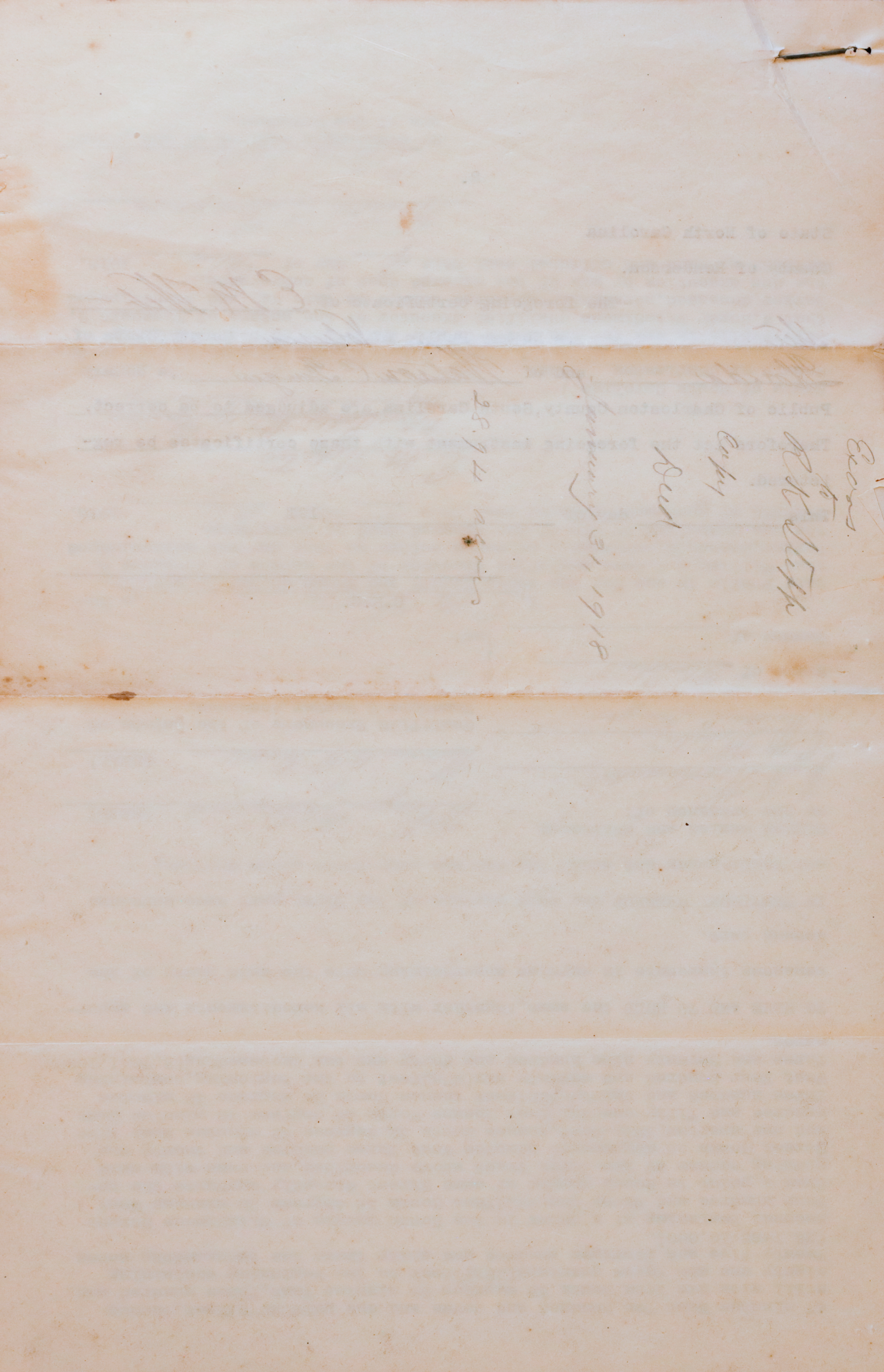
Verso of the 1918 indenture — folded back of document, with pencil endorsement (January 21, 1918)
Book 1, Page 245 ·1918
Transcription
The back (verso) of a folded document. The recto’s typescript shows through the paper in faint mirror image; a pencilled docket endorsement in normal orientation is visible across the upper-middle of the sheet.
Pencilled endorsement (upper centre, in normal orientation)
[docketed in pencil:] E.M.F.S.
Copy
Seal
January 21, 1918
Show-through from the recto (reversed mirror image)
[partly legible, mirrored:] State of North Carolina
[illegible line]
[mirrored:] Public of Charleston Co[unty], S.C. [illegible] foregoing affidavit [illegible] No.
[several mirrored lines about certified copies, illegible]
The remainder of the sheet is blank.
AI Notes
Fifth and last sheet of the FitzSimons/Howe-to-Stepp indenture group (241, 242, 243, 245) — the blank back of the folded document, with the recto’s text bleeding through faintly in mirror image. Visible reversed fragments include “State of North Carolina”, “Public of Charleston Co[unty]”, and references to certified copies. A pencilled docket endorsement runs in normal orientation across the upper-middle: it reads as the docketing of a copy retained by the family — initials “E.M.F.S.” (for Ellen Milliken FitzSimons, the Charleston Library Society librarian and de-facto keeper of the family papers), the word “Copy”, a “Seal” notation, and the date “January 21, 1918” — i.e. about ten days before the indenture was executed (31 Jan 1918), so the docket date probably refers to the date the copy was made or filed rather than the deed itself. The sheet is folded into quarters with visible horizontal creases. Page 244 sits between this sheet and the rest of the indenture in the album, but is an unrelated typescript reminiscence about Mulberry Plantation; the compiler appears to have inserted it on the facing leaf by accident or simply for space.