Typescript reminiscence: childhood visits to Mulberry Plantation — the Millikens, Mrs. Barker, and Mr. Tom Broughton's ghost
Book 1, Page 244 ·1920–1935
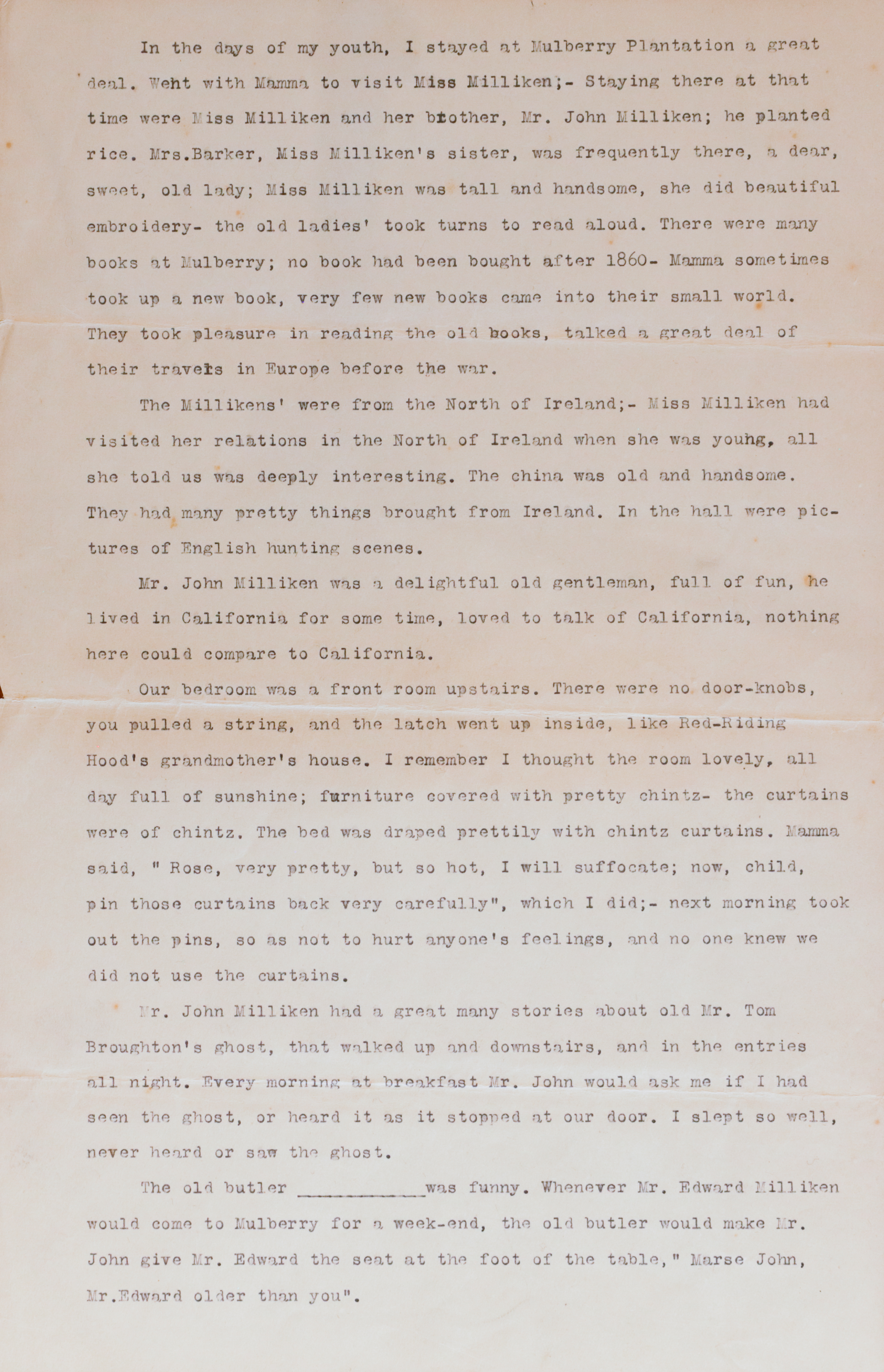
Transcription
A typewritten sheet, the carbon faded and the typescript indistinct in many places. Strikethroughs and ink-overstrike corrections appear throughout.
In the days of my youth, I stayed at Mulberry Plantation a great deal. Went with Mamau to visit Miss Milliken;– Staying there at that time were Miss Milliken and her brother, Mr. John Milliken; he planted rice. Mrs. Barker, Miss Milliken’s sister, was frequently there, a dear, sweet, old lady; Miss Milliken was tall and handsome, she did beautiful embroidery– the old ladies’ took turns to read aloud. There were many books at Mulberry; no book had been bought after 1860– Mamau sometimes took up a new book, very few new books came into their small world. They took pleasure in reading the old books, talked a great deal of their travels in Europe before the war.
The Millikens’ were from the North of Ireland;– Miss Milliken had visited her relations in the North of Ireland when she was young, all she told us was deeply interesting. The china was old and handsome. They had many pretty things brought from Ireland. In the hall were pictures of English hunting scenes.
Mr. John Milliken was a delightful old gentleman, full of fun. He lived in California for some time, loved to talk of California, nothing here could compare to California.
Our bedroom was a front room upstairs. There were no door-knobs, you pulled a string, and the latch went up inside; like Red-Riding Hood’s grandmother’s house. I remember I thought the room lovely, all day full of sunshine; furniture covered with pretty chintz– the curtains were of chintz. The bed was draped prettily with chintz curtains. Mamau said, “Rosa, very pretty, but so hot, I will suffocate; now, child, pin those curtains back very carefully”, which I did;– next morning took out the pins, so as not to hurt anyone’s feelings, and no one knew we did not use the curtains.
Mr. John Milliken had a great many stories about old Mr. Tom Broughton’s ghost, that walked up and downstairs, and in the entries all night. Every morning at breakfast Mr. John would ask me if I had seen the ghost, or heard it as it stopped at our door. I slept so well, never heard or saw the ghost.
The old butler __________ was funny. Whenever Mr. Edward Milliken would come to Mulberry for a week-end, the old butler would make Mr. John give Mr. Edward the seat at the foot of the table," Marse John, Mr. Edward older than you".
AI Notes
Unrelated to the 1918 Barker-Stepp indenture on 241–243 + 245 — this is a separate single-sheet typewritten reminiscence (carbon, faded, corrected in ink) of childhood visits to Mulberry Plantation on the Cooper River with the writer’s “Mamau.” Describes the household of Miss Milliken and her brother Mr. John Milliken (a rice planter), the frequent visits of their sister Mrs. Barker, the pre-1860 library, the embroidery, evening readings aloud, the Millikens’ European travel and Irish kin, and the chintz-curtained four-poster (formerly Mr. John Milliken’s grandmother Hood’s) in the writer’s upstairs bedroom. Closes with Mr. John’s tales of old Mr. Tom Broughton’s ghost walking the upstairs entries at night (Mulberry was the seat of Lt. Gov. Thomas Broughton, d. 1737, whose shade is the plantation’s standing legend), and a vignette of the old butler who insisted Mr. John yield the foot of the table to his elder brother Mr. Edward Milliken. The writer is addressed by name as “Rosa” by Mamau. The “Mrs. Barker” of the text is almost certainly Ellen Milliken Barker (1807–1874), wife of Samuel Gaillard Barker and mother of Theodore Gaillard Barker — i.e. Susan Milliken Barker FitzSimons’s mother; “Miss Milliken” is Ellen’s unmarried sister. Mr. John Milliken (the California-loving rice planter) is their brother; Edward Milliken (the elder brother) another.
“Old Mr. Tom Broughton” is Lt. Gov. Thomas Broughton (d. 1737), the builder of Mulberry in 1714, who died serving as acting royal governor of South Carolina; his ghost walking the upstairs entries is one of the oldest standing legends of the Cooper River plantations. The reminiscence is almost certainly by Rose Pringle Ravenel (see her signed 1923 typescript on p234), the “Rosa” addressed by her grandmother “Mamau.”