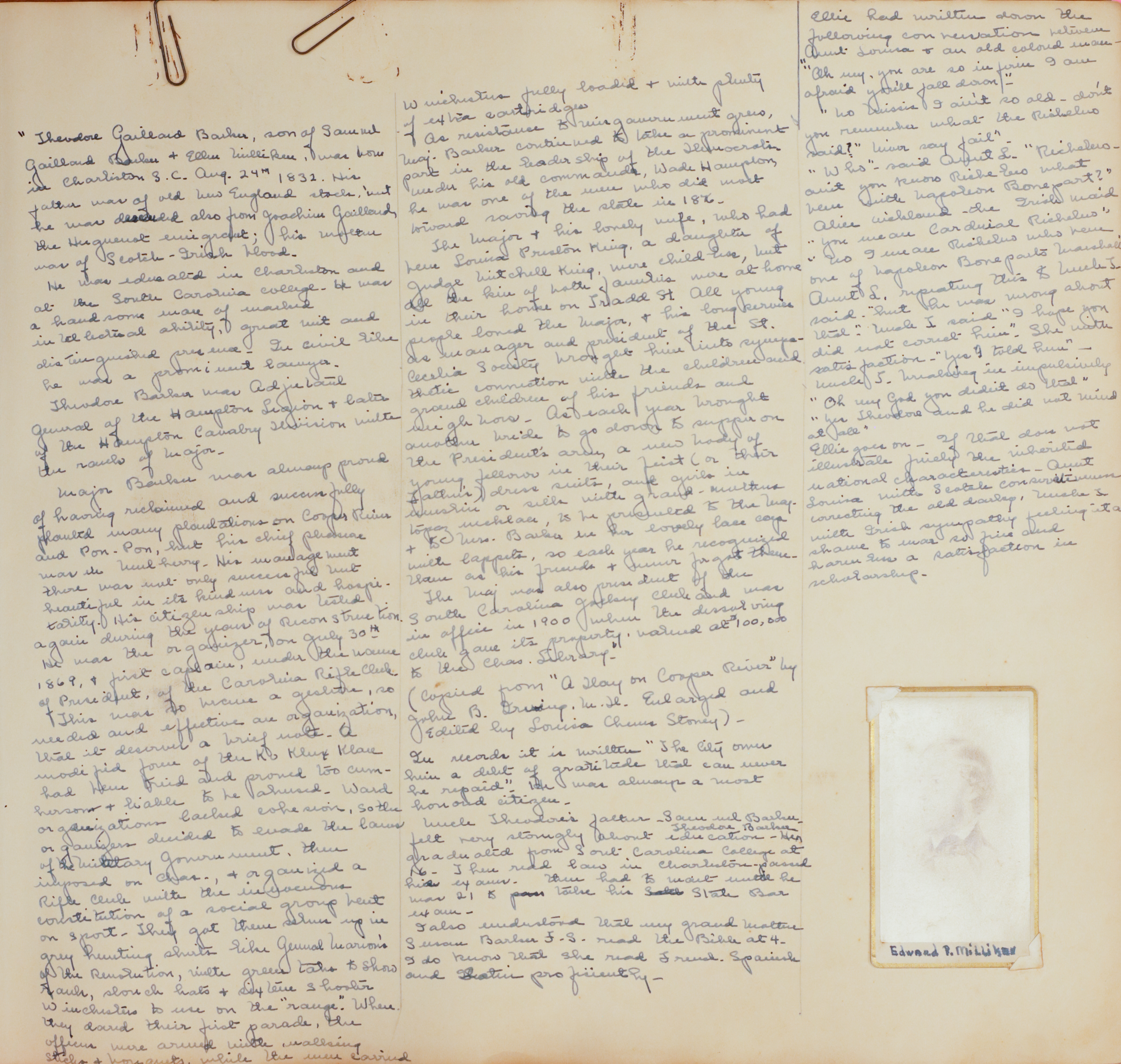
Theodore Gaillard Barker biographical sketch (revealed); carte de visite of Edward P. Milliken
Book 1, Page 240 ·1832–1917
Transcription
Manuscript biographical sketch of Theodore Gaillard Barker
"Theodore Gaillard Barker, son of Samuel Gaillard Barker + Ellen Milliken, was born in Charleston S.C. Aug. 24th 1832. His father was of old New England stock, but he was descended also from Joachim Gaillard, the Huguenot emigrant; his mother was of Scotch-Irish blood.
He was educated in Charleston and at the South Carolina College. He was a handsome man of marked intellectual ability, great wit and distinguished presence. In civil life he was a prominent lawyer.
Theodore Barker was Adjutant General of the Hampton Legion + later of the Hampton Cavalry Division with the rank of Major.
Major Barker was always proud of having reclaimed and successfully [planted?] many plantations on Coosa River and Pon-Pon, but his chief pleasure was in Mulberry. His management there was not only successful but [beautiful?] in its kindness and hospi- tality. His citizenship was tested again during the years of Reconstruction. He was the organizer, on July 30th [18]69, and first captain, under the [new?] name [of?] President, of the Carolina Rifle Club. This was so unique a gesture, so needed and effective an organization, that it deserves a brief note. A modified form of the Ku Klux Klan had been tried and proved too cum- bersome + liable to be abused. Ward organizations lacked cohesion, so the leaders decided to evade the laws of Military Government, then imposed on Char[leston]., + organized a Rifle Club with the innocuous constitution of a social group bent on sport. They got themselves up in fancy hunting shirts like General Marion’s of the Revolution, with green tabs to shoul- ders, slouch hats + sixteen S[-]hooters [Winchesters] to use on the ‘range’. When they stood their first parade, the officers were armed with walking [sticks?] [illegible], while [the?] men carried winchesters fully loaded + with plenty of extra cartridges.
As resistance to misgovernment grew, Maj. Barker continued to take a prominent part in the leadership of the Democratic party. With his old commander, Wade Hampton, he was one of the men who did most toward saving the state in 1876.
The Major + his lovely wife, who had been Louisa Preston King, a daughter of Judge Mitchell King, were childless, but [made?] the kin of both families one at home in their house on Tradd St. All young people loved the Major, + his long career as manager and president of the St. Cecilia Society brought him into sym- pathetic connection with the children and grandchildren of his friends and neighbors. As each year brought another bride to go down to supper on the President’s arm, a new band of young fellows in their first (or their fathers’) dress suits, and girls in [muslin?] or silk with grand-mother’s topaz necklace, [were presented?] to the [Major] + to Mrs. Barker in her lovely lace [shawl?] with lappets, so each year he recogniz[ed] [some?] of his friends + never forgot the names of his friends + [their?] [illegible].
The Maj. was also president of the South Carolina Jockey Club and was in office in 1900 when the dissolution [took place — the?] club gave its property, valued at $100,000, to the Charleston Library.
(Copied from ‘A Day on Cooper River’ by John B. Irving, M.D., Enlarged and Edited by Louisa Cheves Stoney) —
[In which?] it is written ‘The City owes him a debt of gratitude that can never be repaid’. He was always a most honored citizen.
Uncle Theodore’s father Samuel Barker felt very strongly about education [Theodore Barker?]. [He?] graduated from South Carolina College [in 18__]. He read law in Charleston—[illegible] his exams. Then had to wait until he was 21 to [pass?] take his State Bar exam.
I also understand that my grandmother Susan Barker S.G. read the Bible at [illegible]. I do know that she read French, Spanish, and Latin proficiently."
Domestic anecdote (right column)
"‘Oh my, you are so [infirm?], afraid you’ll fall down’— ‘No Missis, I ain’t so ole [old], don’t you remember what the R[everend?] said?’ was my [reply?]— ‘Who?’ said Aunt L. ‘[Richelieu?]’— ‘Ain’t you know Richelieu was [illegible] [near?] dear Dick Napoleon Bonepart[e]?’ ‘Alice Wishbone—the Irish [washerwoman?]’— ‘[You?] mean Cardinal Richelieu’— ‘No I mean Richelieu who was one of Napoleon Bonepart[e]‘s [generals?]’. Aunt L. repeating this [&] said: ‘But he was wrong, wasn’t he?’ Uncle [J.?] said: ‘I have [or had]’ [and?] did not correct him. She [had?] satisfaction—‘Yes I told him’— Uncle J. [Mulliken?] [or Milliken?] [illegible]— ‘Oh my God you didn’t do [it?]’— ‘Yes Theodore and he did [it?]’ at [last?]’.
Ellie goes on—If that don’t [illustrate?] [clearly?] the inherent national characteristics — [her?] Louisa with Scotch conservatism correcting the old daddy, [me?] with Irish sympathy for [his?] shame to [him?] was so fine our home was a satisfaction [in our?] scholarship."
[The right-column dialogue passage appears to be in a different hand from the main sketch and reads as a remembered domestic scene. “Aunt L.” is most plausibly Louisa Cheves Stoney; “Ellie” is the narrator. Several names within the dialogue remain uncertain.]
Carte de visite (lower right)
A small mounted oval portrait of a young man. The inked caption beneath the mount reads:
Edward P. Milliken
AI Notes
Same album page as scan 239 but with the overlying clipped sheet folded back, revealing the previously hidden manuscript sketch. The sketch is a biographical reminiscence of Theodore Gaillard Barker (1832-1917) of Charleston: parentage (Samuel Gaillard Barker and Ellen Milliken, of New England and Scotch-Irish / Huguenot Gaillard stock), education at Charleston and South Carolina College, Civil War service as Adjutant General of Hampton Legion and later of Hampton’s Cavalry Division (rank of Major), post-war role with Wade Hampton in saving the state in 1876, organization of the Carolina Rifle Club (July 30 1869) as a successor to the Ku Klux Klan, leadership of the St. Cecilia Society and the South Carolina Jockey Club (dissolved 1900, property to Charleston Library), and his childless marriage to Louisa Preston King (daughter of Judge Mitchell King). The closing pages quote ‘A Day on Cooper River’ by John B. Irving, M.D. (enlarged and edited by Louisa Cheves Stoney), then shift to a domestic anecdote narrated by ‘Ellie’ about an elderly servant confusing Cardinal Richelieu with Napoleon Bonaparte. The lower right carries a small oval carte de visite of Edward P. Milliken, a maternal relative of T.G. Barker.
Almost certainly a paternal-side relative of T.G. Barker’s mother Ellen Milliken; the connection to the Barker family is what links this photograph to the manuscript sketch on the same page.
The Carolina Rifle Club, organized at Charleston on 30 July 1869 with TGB as first president, was the prototype for the Red Shirt rifle clubs that — together with Wade Hampton III’s gubernatorial campaign — carried out the violent paramilitary overthrow of South Carolina’s Reconstruction government in 1876. The sketch’s frank admission that the club was a workaround for Reconstruction-era Military Government, with “innocuous constitution” but Winchester repeaters, makes this one of the album’s most candid documents on the family’s role in ending biracial Republican rule in the state.