Theodore Gaillard Barker biographical sketch (continued from p. 240) with carte de visite of Edward R. McAlister
Book 1, Page 239 ·1832–1917
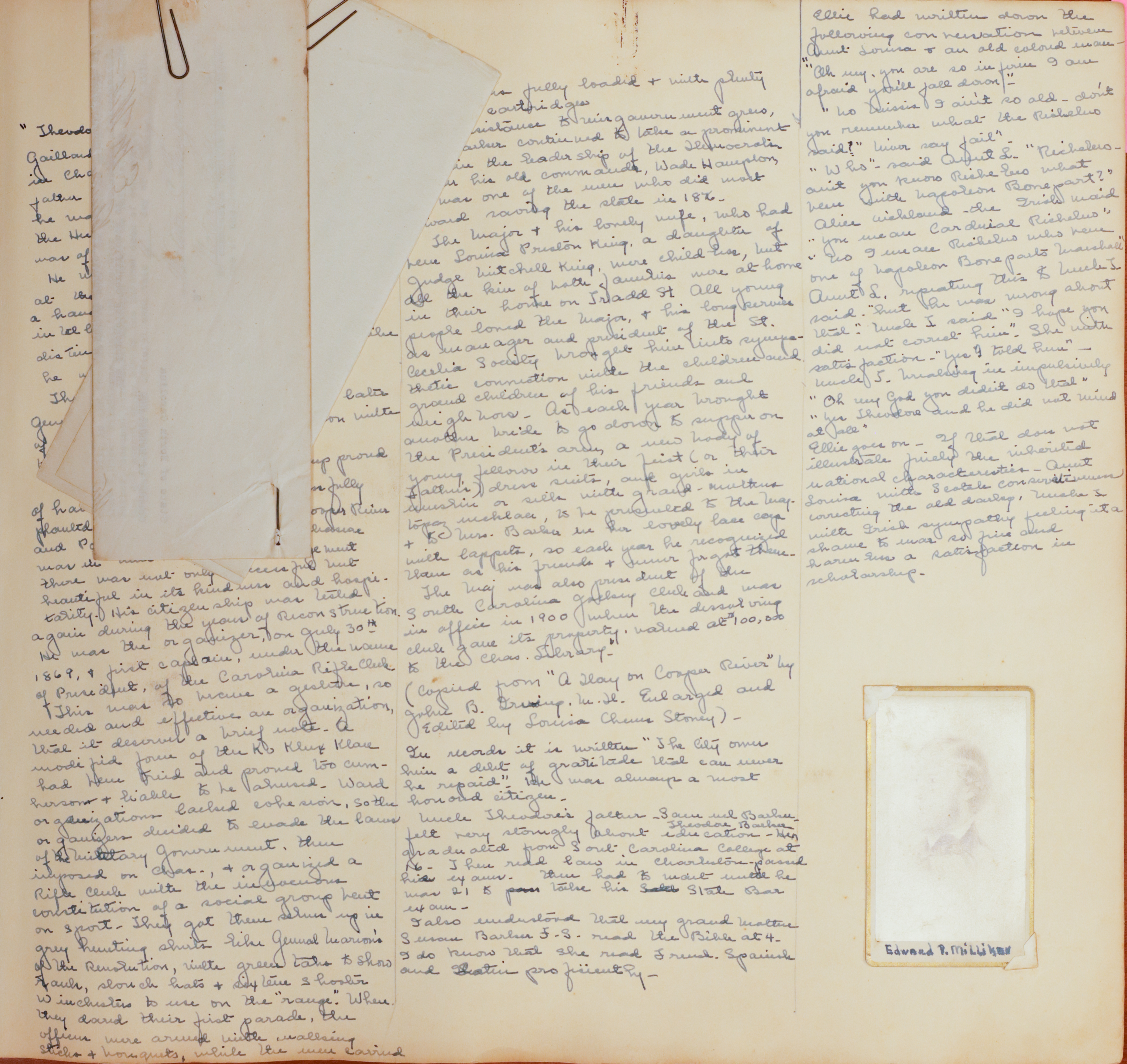
Transcription
Manuscript biographical sketch (continued)
The folded sheet at upper left obscures roughly the first six inches of each line in the left column; the central and right columns are clear. Bracketed material indicates words obscured by the paperclipped sheet or otherwise illegible.
[obscured] … fully loaded & with plenty [of] cartridges … [The disturb]ance during government grew[s,] [Major Barker] continued to take a prominent [part?] in the leadership of the Democratic [Party. As] his old commander, Wade Hampton [he] was one of the men who did most [to]ward saving the state in 1876.
The Major & his lovely wife, who had been Louisa Preston King, a daughter of Judge Mitchell King, were childless, but all the kin of either family were at home in their home on Tradd St. All young people loved the Major & his long service as manager and president of the St. Cecilia Society brought him into sympa- thetic connection with the children and grand children of his friends and neighbors. — As each year brought another wish to go down to suggest one of the President’s army, a new body of young fellows in their first (or later) dinner-suits, and girls in [their first?] tarlatans or silks with grand-mother’s topaz necklace, to be presented to the Maj- or & Mrs. Barker in her lovely lace cap with lappetts, so each year he recognized them as his friends & juniors forgot them- [selves?].
The Maj. was also president of the South Carolina gallery Club and was in office in 1900 [when] the dissolving [of the] club gave its property valued at $100,000 to the Class. History —
(Copied from “A Day on Cooper River” by John B. Irving, M.D., Enlarged and Edited by Louisa Cheves Stoney) —
“In records it is written ‘The City owes him a debt of gratitude that can never be repaid.’ He was always a most honored citizen.”
Uncle Theodore’s father, Samuel Barker, felt very strongly about education — Theodore Barker graduated from South Carolina College at 16 — He read law in Charleston — passed his exams. He had to wait until he was 21 & passed his State Bar exam —
I also understand that my grand mother Susan Barker F.S. read the Bible at 4. I do know that she read French, Spanish and Latin proficiently —
Annotation / family anecdote (right column)
Ellie had written down the following conversation between Aunt Louisa & an old colored woman — “My, you are so infirm I am afraid you’ll fall down.” “I’se as old as old — but I’se livin’ down on the Riteleus Street — never say fail — ‘Oh,’” said Aunt L., “Richeleu — Do you know Richeleu was like Napoleon Bonaparte?” "I’sn’t said the old woman, “he Iri’h” said “I mean Cardinal Richeleu who I’se ace Richeleu who have — of Napoleon Bonaparte’s Marshal” — Aunt L., repeating this to Uncle T. — [“Well, but he was wrong about this”]. “But,” I said, “I hope you didn’t correct him.” She with satisfaction — “Yes I told him” — Uncle T. impulsively — “Oh my God, you didn’t do that” — [Aunt L. answers:] “I love Theodore and he did not mind [my tale?]” — Life goes on — of that does not [we?] still also justly the inherited national characteristics — Aunt Louisa with Scotch conservatism meeting the old daring, Uncle T. the Irish sympathy feeling it a shame to was so firm and there was a satisfaction in [the?] sharing —
Carte de visite (lower right)
A small mounted oval portrait of a young man with mustache. The printed mount caption reads:
EDWARD R. McALISTER
Left-column fragments (partially obscured by paperclipped sheet)
The following fragments are visible from the bottom of the left column and refer to the 1876 Hampton campaign / Carolina Rifle Club:
[“Theodo[re] Gaillar[d Barker, born] in Cha[rleston …] [his] father [was Samuel?] he ma[rried …] the Hu[…] was of […] He w[…] al[ways …] a ha[ndsome man?] in col[lege …] dis[tinguished …] he w[as …] Th[eodore Barker was] Gen[eral / Adjutant?] [of Hampton’s Legion …]”
[continuation, mid-left]: "… of [hair?] [il]loosed and p[…] war [illegible] there was not only a beautiful in its kindn[ess?] [equ]ality. His citizenship again during the years he was the organizer 1869, & first captain, & of President of the Car[olina Rifle Club?]
- This was to [become?] [a] needed and effective o[rganization?] that it deserves a brief [note?] modified form of the [old?] had been tried and p[roven?] harsom + liable to be p[…] organizations lacked [the?] [or?] [g]auger decided to f[orm?] [be]fore [m]ilitary government w[as?] imposed on Chas., + or[ganized the] Rifle Club with the inc[orporated] constitution of a social [club founded?] on Sport — They got the[ir uniforms?] grey hunting shirts lik[e those?] of the Revolution, with gr[ay?] pants, slouch hats & [carried?] Winchesters to use on th[e range. When?] they dared their first p[arade?] officers were armed wi[th walking?] sticks & bouquets, while [the men carried]"
AI Notes
This scan shows the album page with a folded sheet paperclipped over the left portion of the central manuscript, partially obscuring it. A companion scan (240) reveals the obscured text. The handwritten narrative continues a biographical sketch of Theodore Gaillard Barker (1832–1917), discussing Reconstruction-era South Carolina politics, the Carolina Rifle Club, Hampton’s red-shirt campaign of 1876, Barker’s marriage to Louisa Preston King (daughter of Judge Mitchell King), his presidency of the St. Cecilia Society, his role in the South Carolina dispensary case of 1900, a citation to John B. Irving’s ‘A Day on Cooper River’ (edited by Louisa Cheves Stoney), and the compiler’s reminiscences of her grandmother Susan (Milliken) Barker and a family anecdote comparing Uncle Theodore to Cardinal Richelieu. At lower right is a small carte de visite labeled ‘Edward R. McAlister’.
End of legible left-column text on this scan; remaining material is concealed by the paperclipped sheet. See page 240 for the unobscured version.