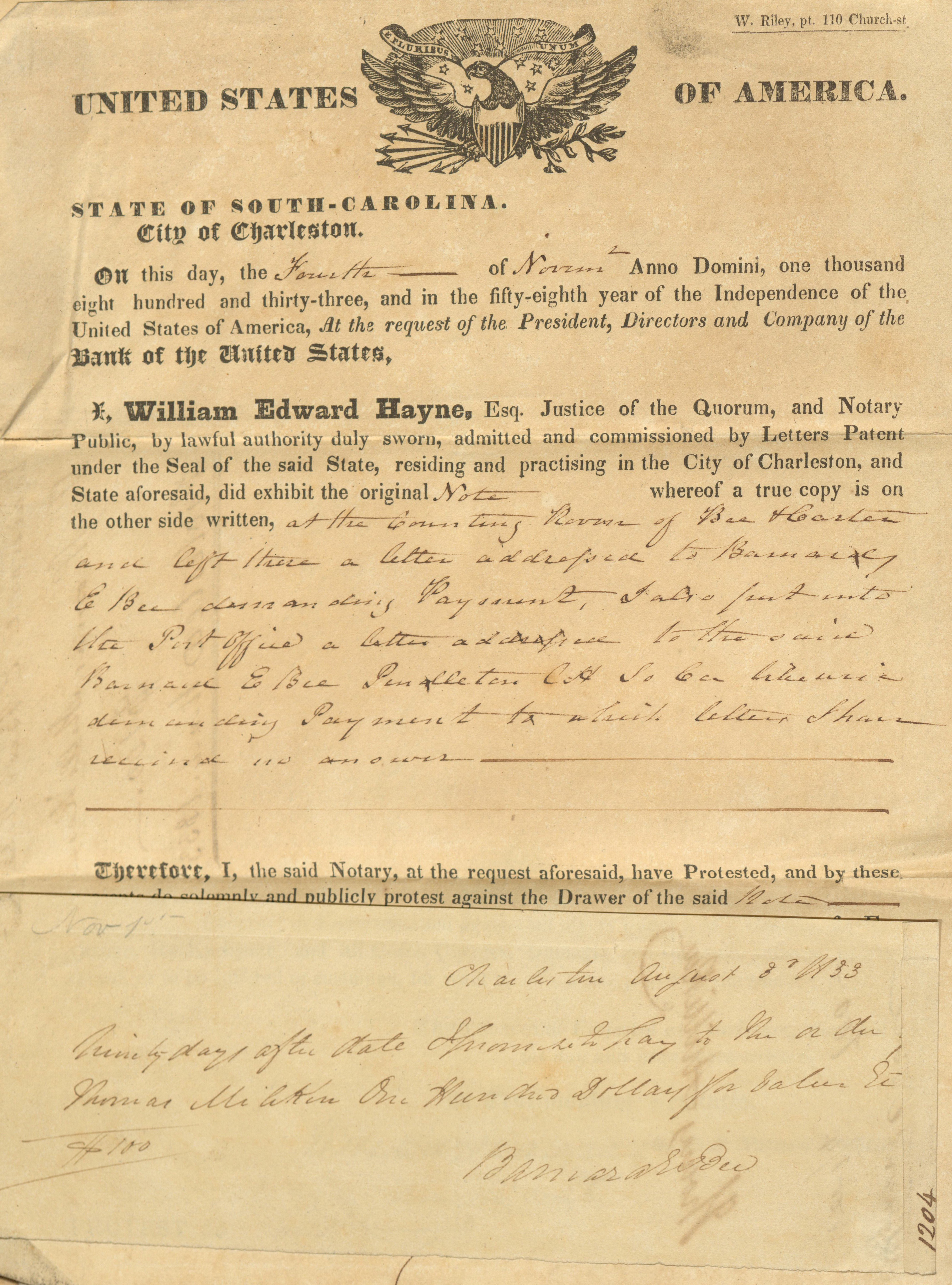
Notary Protest by William Edward Hayne, Charleston, November 4, 1833 (interior)
Book 1, Page 215 ·1833
Transcription
A printed Notary Protest form, single sheet, with handwritten insertions in brown ink. A small printer’s imprint at the upper right reads W. Riley, pt. 110 Church-st.
(eagle and shield vignette)
UNITED STATES OF AMERICA.
STATE OF SOUTH-CAROLINA. City of Charleston.
On this day, the [Fourth] of [Novr.] Anno Domini, one thousand eight hundred and thirty-three, and in the fifty-eighth year of the Independence of the United States of America, At the request of the President, Directors and Company of the Bank of the United States,
I, William Edward Hayne, Esq. Justice of the Quorum, and Notary Public, by lawful authority duly sworn, admitted and commissioned by Letters Patent under the Seal of the said State, residing and practising in the City of Charleston, and State aforesaid, did exhibit the original [Note] whereof a true copy is on the other side written, at the Counting Room of [Bee & Carter] and [left] there a letter addressed to [Bernard] E. Bee demanding Payment, I also put into the Post Office a letter addressed to the said [Bernard E. Bee Pendleton C.H., So. Ca.] demanding Payment to which letters I have received no answer.
Therefore, I, the said Notary, at the request aforesaid, have Protested, and by these [presents do solemnly] and publicly protest against the Drawer of the said [Note]
[Form continues; the lower margin and bottom of sheet are reproduced on page 217. A pencilled note in the left margin near the fold reads “Nov 1st” — the note’s maturity date.]
The lower portion of the sheet shows the body of the protested promissory note itself, in a different hand (Bernard E. Bee’s):
Charleston August 3d 1833
Ninety days after date I Promise to Pay to the or[der of] Thomas Milliken One Hundred Dollars for Value [Received] $100 Bernard E Bee
A printed page-foot identifier in the lower right reads 1204.
AI Notes
Detail view of the unfolded Notary Protest mounted on page 214. Printed form filled in by hand by Notary Public William Edward Hayne, recording his protest of a promissory note for $100 drawn at Charleston August 3, 1833 by Bernard E. Bee, payable to Thomas Milliken, ninety days after date. Since the note ran 90 days from Aug. 3, it fell due Nov. 1; the protest is dated three days later — the ‘Fourth’ of ‘Novr’ (November). The counting-room is ‘Bee & Carter,’ and the maker’s signature on the note reads ‘Bernard E Bee.’ The lower portion reproduces the body of the promissory note itself. A pencilled marginal note at left reads ‘Nov 1st’ (the maturity date).
The maker Barnard E. Bee Sr. (1787–1853) was a Charleston attorney and merchant who relocated his family from Charleston to Pendleton C.H. in 1833 — the same year as this protested note — before moving on to Texas in 1836, where he served as Republic of Texas secretary of state. His son Barnard Elliott Bee Jr. (1824–1861) became the Confederate brigadier general who, on 21 July 1861 at First Manassas, gave Thomas J. Jackson the nickname “Stonewall”. The note’s protest is a small artifact of the elder Bee’s commercial troubles at the moment of that Pendleton relocation.