Envelope: Milliken tombstone inscriptions; folded Notary Protest (1833)
Book 1, Page 214 ·1833
Transcription
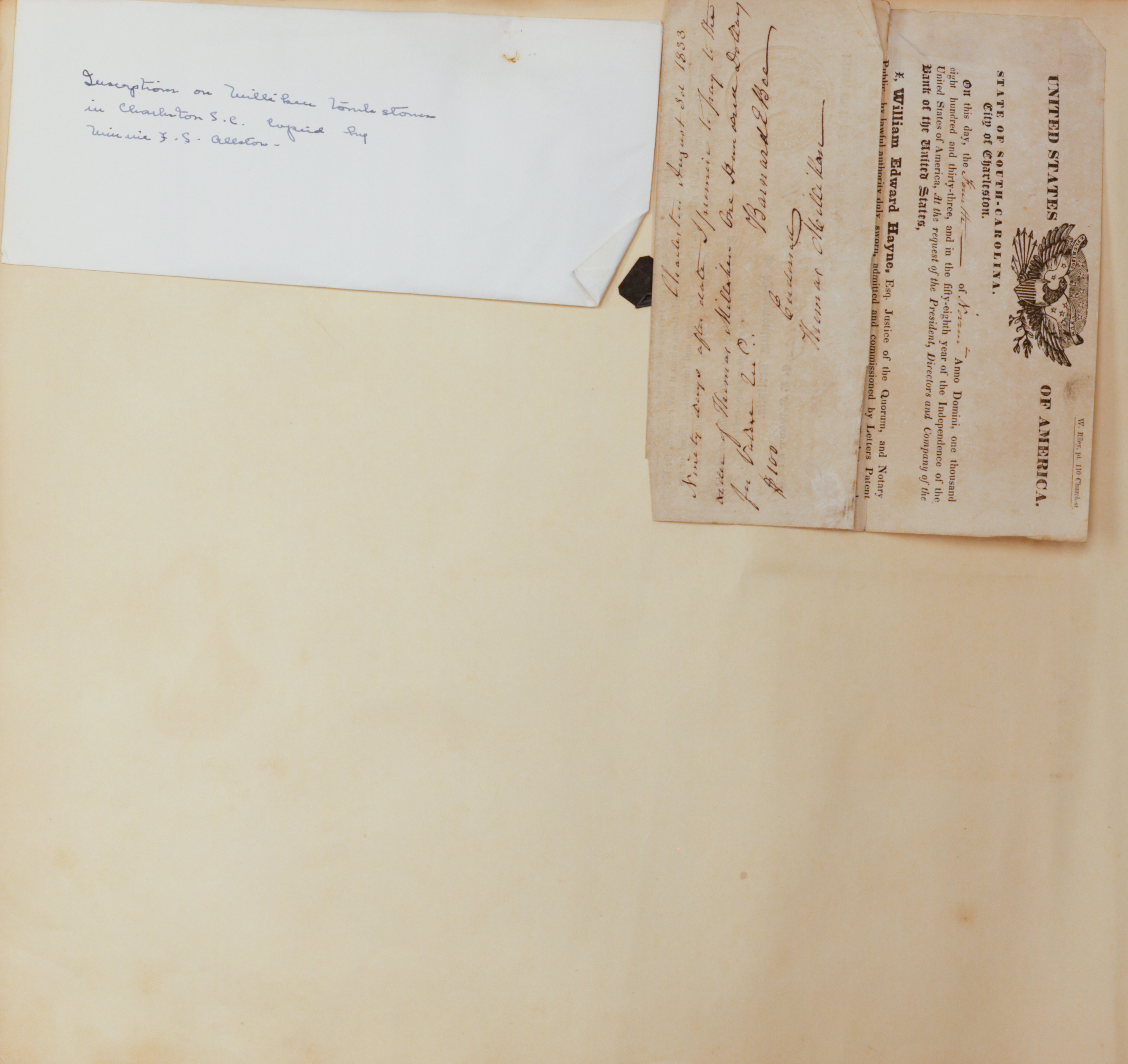
The page mounts two items in the upper portion; the lower two-thirds of the album leaf is blank.
Envelope (top left)
A small white envelope, flap closed, inscribed in cursive blue ink:
Inscription on Milliken Tombstones in Charleston S.C. Copied by Minnie F. S. Allston —
Folded Notary Protest (top right)
A folded printed legal document. The printed face on the right shows an eagle-and-shield vignette and the heading:
UNITED STATES (eagle) OF AMERICA.
STATE OF SOUTH-CAROLINA. City of Charleston.
On this day, the [blank] of [blank] Anno Domini, one thousand eight hundred and thirty-three, and in the fifty-eighth year of the Independence of the United States of America, At the request of the President, Directors and Company of the Bank of the United States,
I, William Edward Hayne, Esq. Justice of the Quorum, and Notary Public, by lawful authority duly sworn, admitted and commissioned by Letters Patent
[Printed form continues; the right panel folds away from view. The fully filled-in interior is reproduced on page 215.]
The folded centre flap carries the body of the protested promissory note in Bernard E. Bee’s hand (rotated 90° relative to the printed form):
Charleston August 3d 1833
Ninety days after date I promise to pay to the Order of Thomas Milliken One Hundred Dollars for Value rec’d $100 Barnard E Bee Endorsed Thomas Milliken
AI Notes
Two items mounted along the top of an otherwise blank album page. Top left: a small white envelope inscribed in blue ink by Minnie F. S. Allston, containing inscriptions copied from Milliken tombstones in Charleston. Top right: the folded outer face of a printed 1833 Notary Protest from Charleston, with the printed face partially visible at right and the rotated handwritten body (the protested promissory note itself) visible on the central flap. The unfolded interior of this document is reproduced on page 215, with the printed form fully filled in. The handwritten note is dated ‘Charleston August 3d 1833’; the maker’s signature on this slip reads ‘Barnard E Bee,’ while the matching interior page 215 spells the canonical form ‘Bernard E. Bee’ (a 19th-c. spelling variant) — the people-list uses ‘Bernard’ for consistency with 215. The printed protest date on page 215 is November 4, 1833; this folded outer face shows the body of the promissory note rather than the protest text. The compiler’s envelope inscription reads ‘Minnie F. S. Allston’ (page 213 uses the variant spelling ‘Alston’).
The complete unfolded protest, with the Notary’s printed declaration filled in, is shown on page 215; the docketing slip is on page 213.