Typescript fragment: 'The childless widow played her part to the end' — closing of a 'Ruth' / Charleston legend
Book 1, Page 186 ·1920–1960
Transcription
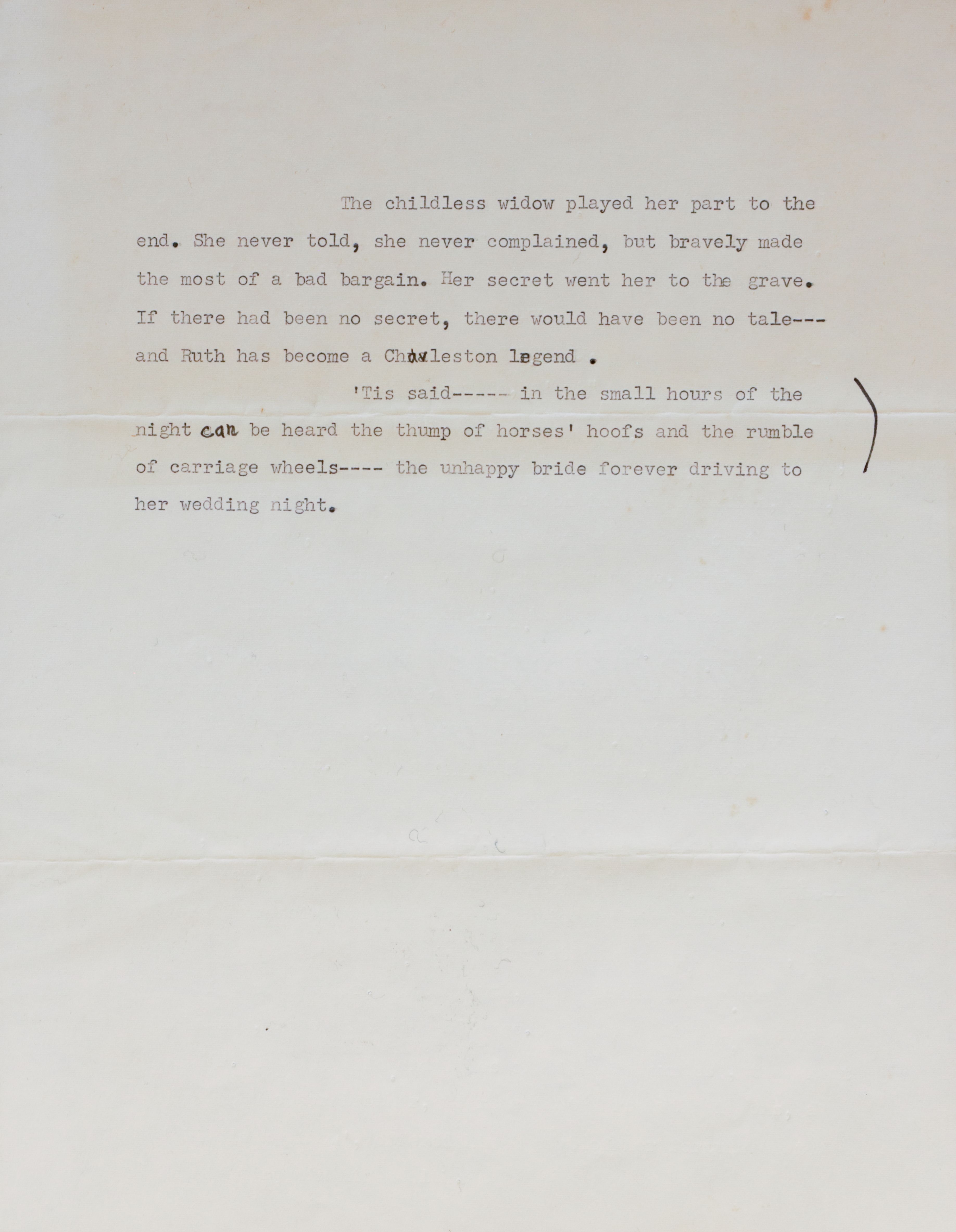
A typewritten sheet. Only two short paragraphs of text appear, upper-center; the rest of the page is blank apart from fold creases. A hand-drawn ink curve (a closing parenthesis or bracket) is in the right margin alongside the second paragraph.
The childless widow played her part to the end. She never told, she never complained, but bravely made the most of a bad bargain. Her secret went her to the grave. If there had been no secret, there would have been no tale—and Ruth has become a Charleston legend.
‘Tis said— in the small hours of the night can be heard the thump of horses’ hoofs and the rumble of carriage wheels— the unhappy bride forever driving to her wedding night.
AI Notes
A single typewritten sheet (cream paper, fading purple-brown ribbon) bearing only two short paragraphs upper-center; the lower two-thirds of the sheet is blank apart from horizontal fold creases. A hand-drawn ink curve (a closing parenthesis) appears in the right margin opposite the second paragraph, possibly marking the passage for inclusion. Several characters were corrected by typewriter overstrike (e.g. ‘Ch[a]rleston’, ‘l[e]gend’, ‘c[a]n’). The text is the closing portion of a longer narrative concluding the tale of ‘Ruth,’ a childless widow described as a Charleston legend whose carriage may still be heard at night driving to her wedding. The author of the typescript is unknown; the page is a fragment lifted from a longer piece. Likely 20th-century filing (mid-century paper).
The page is a fragment — the closing of a longer narrative whose opening is not in the album. The protagonist ‘Ruth’ is unidentified.