Typescript: Major Theodore G. Barker, the Jockey Club, and the Charleston Library Society
Book 1, Page 185
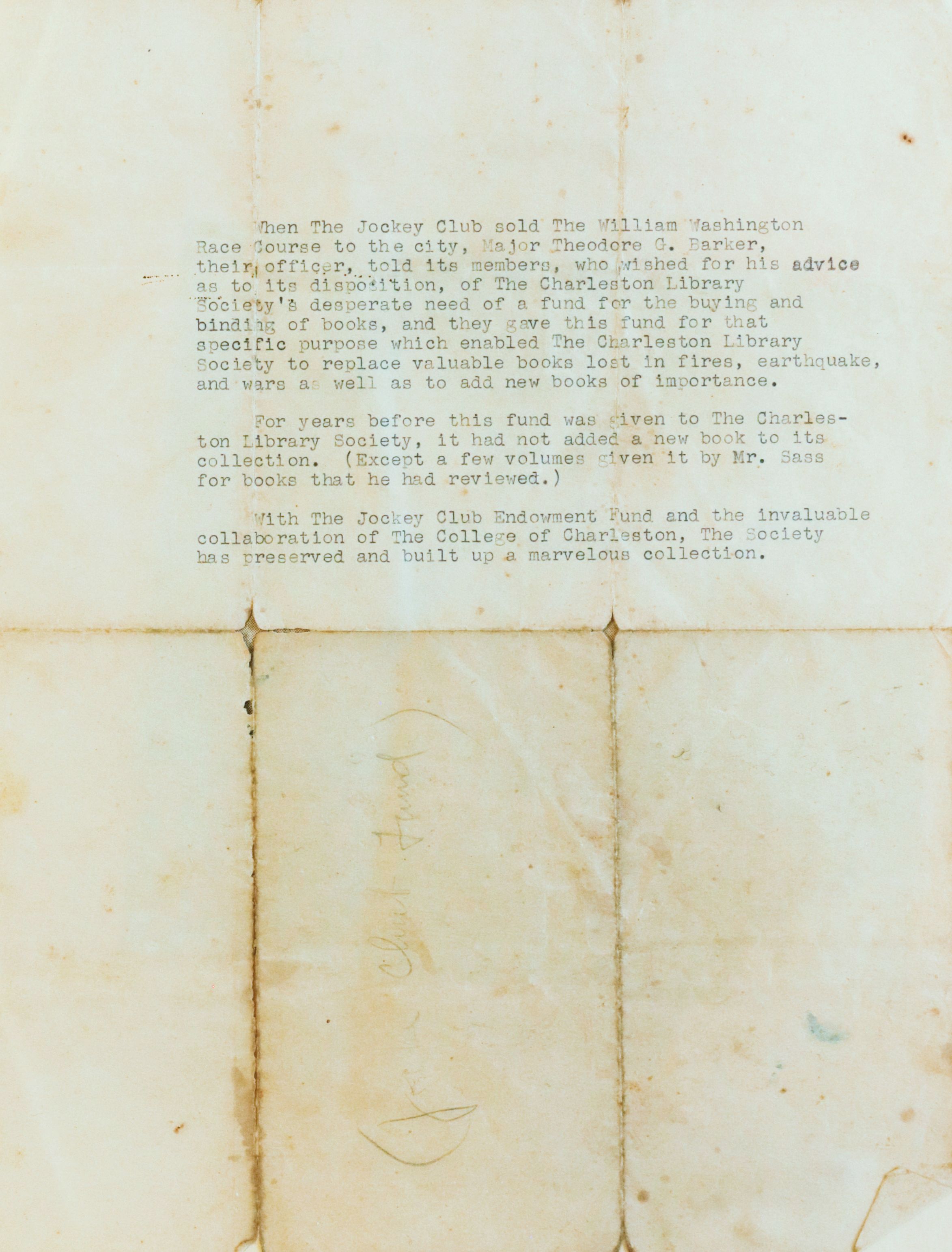
Transcription
A typewritten sheet. Only the upper portion contains text. The lower two-thirds of the sheet is blank apart from horizontal fold creases and a pencilled topic-label written sideways across the middle, in parentheses, reading “(Jockey Club Fund)” — evidently the compiler’s index note identifying the subject of the typescript.
When The Jockey Club sold The William Washington Race Course to the city, Major Theodore G. Barker, their officer, told its members, who wished for his advice as to its disposition, of The Charleston Library Society’s desperate need of a fund for the buying and binding of books, and they gave this fund for that specific purpose which enabled The Charleston Library Society to replace valuable books lost in fires, earthquake, and wars as well as to add new books of importance.
For years before this fund was given to The Charleston Library Society, it had not added a new book to its collection. (Except a few volumes given it by Mr. Sass for books that he had reviewed.)
With The Jockey Club Endowment Fund and the invaluable collaboration of The College of Charleston, The Society has preserved and built up a marvelous collection.
AI Notes
A typewritten sheet (only the upper third bears text; the lower portion is blank with horizontal fold creases). A pencilled topic-label, written sideways across the blank lower half, reads ‘(Jockey Club Fund)’. The typescript recounts how Major Theodore G. Barker advised the members of the Jockey Club, on the sale of the William Washington Race Course, to give the proceeds to the Charleston Library Society as an endowment for the buying and binding of books.
The South Carolina Jockey Club — the oldest in America, founded 1758 — voted in 1899 to disband. Its remaining assets, the Washington Race Course (the one-mile track around today’s Hampton Park) and roughly $13,500 in securities and cash, were deeded to the Charleston Library Society on Theodore G. Barker’s advice; the endowment supported book purchases for the next half-century, the same decades during which his niece Ellen Milliken FitzSimons served as the Library’s directress (1898–1948).