Legal complaint, Barker v. FitzSimons et al., page 1 (opening paragraphs)
Book 1, Page 172 ·1877–1889
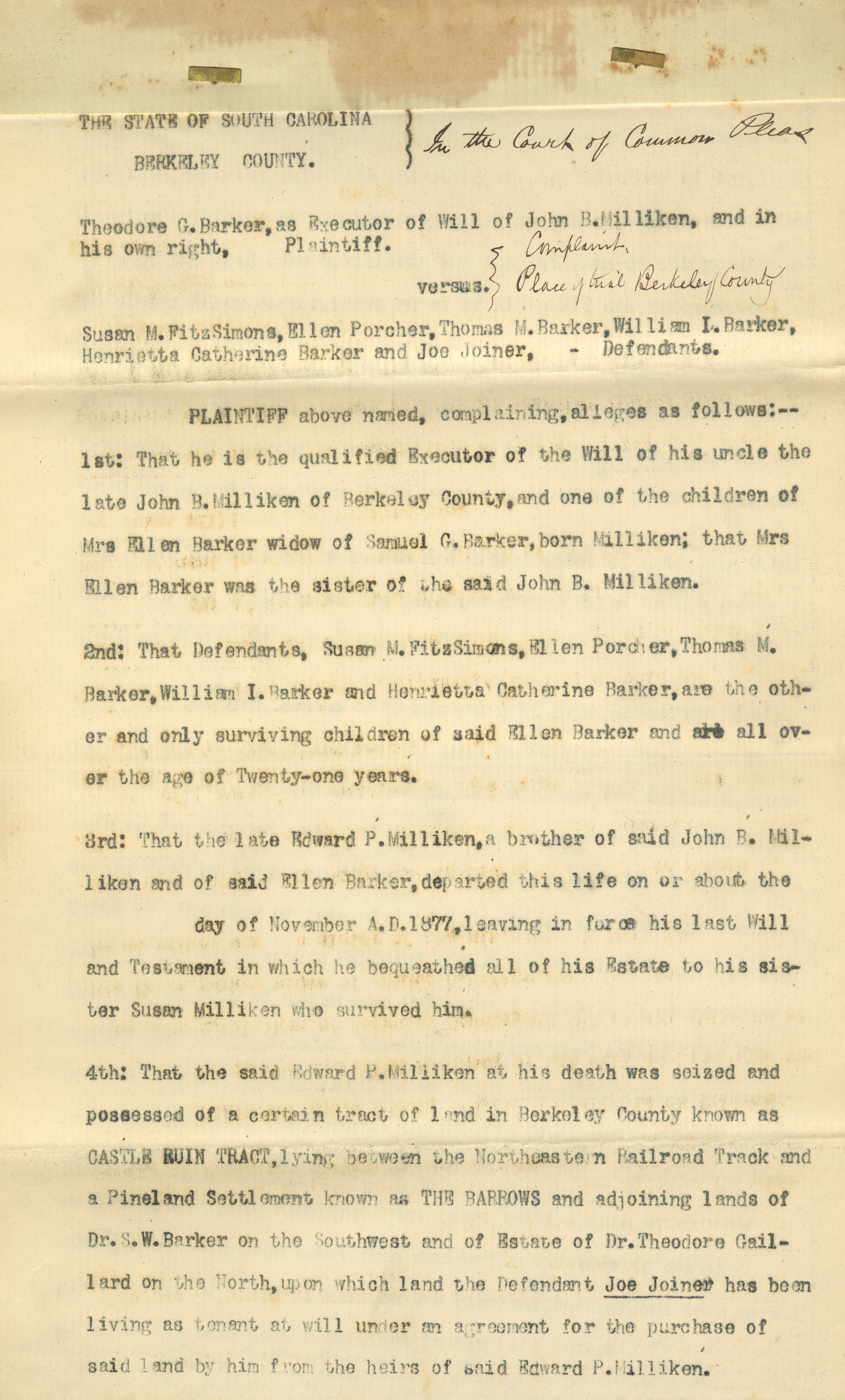
Transcription
A typewritten page on aged paper. At top, the case caption is set out in three blocks: parties at left, court designation at right inside a bracketed line. Three handwritten ink annotations appear at upper right margin, written in the same clerical cursive that supplies fill-ins elsewhere in the cluster.
THE STATE OF SOUTH CAROLINA, } [in ink:] In the Court of Common Pleas
BERKELEY COUNTY.
Theodore G. Barker, as Executor of Will of John B. Milliken, and in his own right, Plaintiff. } [in ink:] Complaint.
versus } [in ink:] Place of trial Berkeley County.
Susan M. FitzSimons, Ellen Porcher, Thomas M. Barker, William I. Barker, Henrietta Catherine Barker and Joe Joiner, - Defendants.
PLAINTIFF above named, complaining, alleges as follows:–
1st: That he is the qualified Executor of the Will of his uncle the late John B. Milliken of Berkeley County, and one of the children of Mrs Ellen Barker widow of Samuel G. Barker, born Milliken; that Mrs Ellen Barker was the sister of the said John B. Milliken.
2nd: That Defendants, Susan M. FitzSimons, Ellen Porcher, Thomas M. Barker, William I. Barker and Henrietta Catherine Barker, are the other and only surviving children of said Ellen Barker and are all over the age of Twenty-one years.
3rd: That the late Edward P. Milliken, a brother of said John B. Milliken and of said Ellen Barker, departed this life on or about the [blank] day of November A.D.1877, leaving in force his Last Will and Testament in which he bequeathed all of his Estate to his sister Susan Milliken who survived him.
4th: That the said Edward P. Milliken at his death was seized and possessed of a certain tract of land in Berkeley County known as CASTLE RUIN TRACT, lying between the Northeastern Railroad Track and a Pineland Settlement known as THE BARROWS and adjoining lands of Dr. S.W. Barker on the Southwest and of Estate of Dr. Theodore Gaillard on the North, upon which land the Defendant Joe Joiner has been living as tenant at will under an agreement for the purchase of said land by him from the heirs of said Edward P. Milliken.
AI Notes
A typewritten page on lightly aged paper, the opening of a legal complaint in the Court of Common Pleas, State of South Carolina, Berkeley County. Caption identifies Theodore G. Barker (as Executor of the Will of John B. Milliken and in his own right) as Plaintiff against Susan M. FitzSimons, Ellen Porcher, Thomas M. Barker, William I. Barker, Henrietta Catherine Barker, and Joe Joiner, Defendants. Paragraphs 1 through 4 recount: that Plaintiff is the qualified Executor of John B. Milliken; that the named Defendants (excepting Joe Joiner) are the surviving children of Mrs. Ellen Barker, widow of Samuel G. Barker, and sister of John B. Milliken; that Edward P. Milliken (brother of John B. Milliken) died about Nov. [blank], 1877 leaving his Last Will and Testament; and that John B. Milliken at his death was seized of a tract of land in Berkeley County known as the Castle Ruin Tract, lying between the Northeastern Railroad Track and a Pineland Settlement known as The Barrows, with Joe Joiner living thereon under an agreement for purchase. Three handwritten ink annotations appear in the right margin alongside the bracket — ‘In the Court of Common Pleas,’ ‘Complaint,’ and ‘Place of trial Berkeley County’ — written in the clerk’s hand, not stamps. Continues onto page 173.
Complaint continues on next page.
Pages 172–175 (and onward) reproduce the full text of the Barker v. FitzSimons partition complaint filed in the Court of Common Pleas for Berkeley County, SC, c. 1890 — the same case whose cover sheet is mounted on page 169. The plaintiff Theodore G. Barker is suing in his dual capacity as Executor of the Will of his uncle John B. Milliken (d. 1 Nov 1889) and in his own right as one of Milliken’s heirs at law. The named defendants — Susan M. FitzSimons (the compiler’s grandmother), Ellen Porcher, Thomas M. Barker, William I. Barker, and Henrietta Catherine Barker — are TGB’s own siblings, joined together so that the court could partition real estate (chiefly Mulberry Plantation on the Cooper River) that could not be physically divided. Such “friendly suits” were standard 19th-century probate practice. The named tenant Joe Joiner, an African-American farmer holding the Castle Ruin Tract under an 1888 installment-sale agreement, was a routine party to the suit because his interest had to be preserved through the partition.