Handwritten letter, continuation: 'persons what a perfect type of the end of such a life'
Book 1, Page 154 ·1874
Transcription
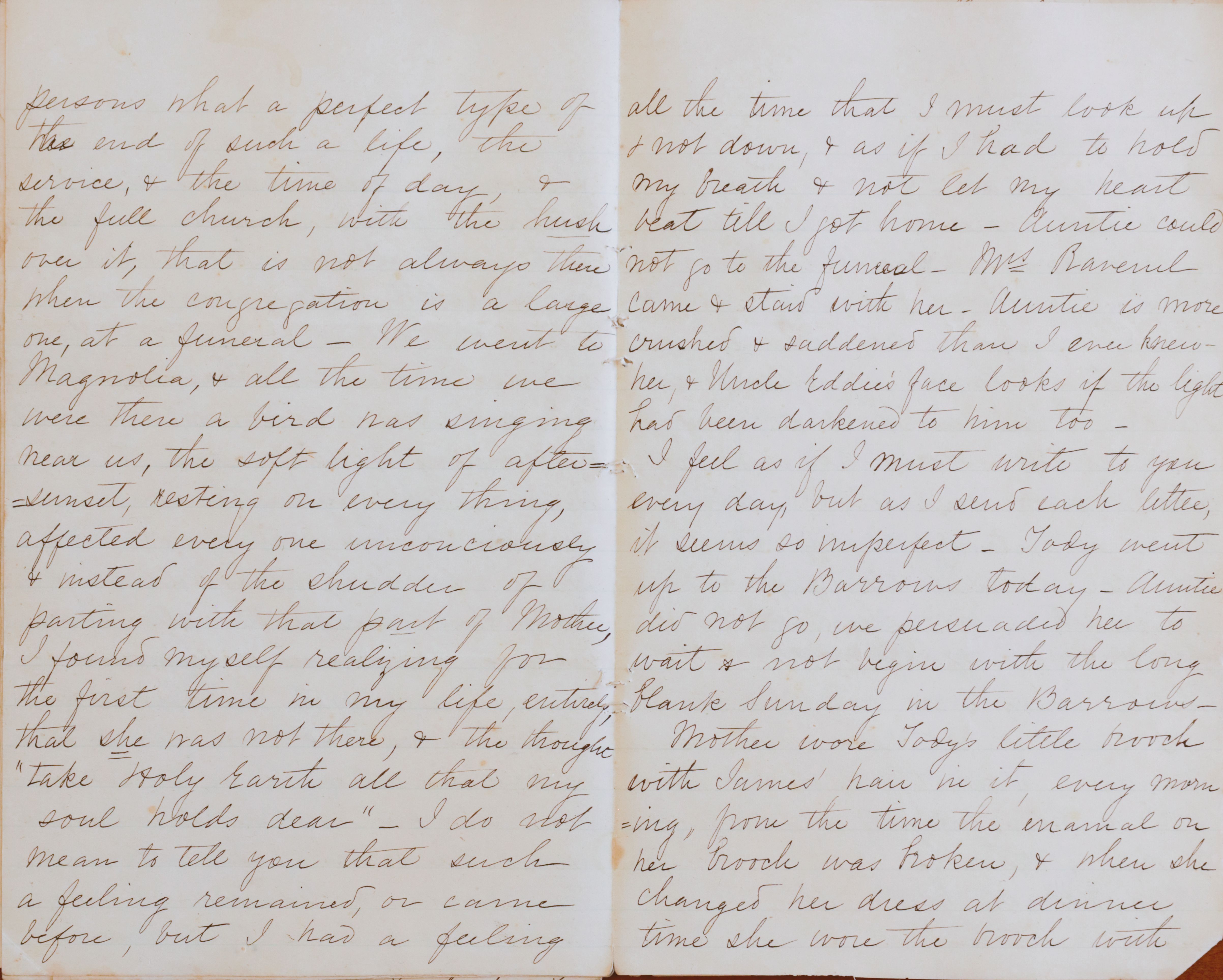
A handwritten letter on lined paper in brown ink, an open-book scan showing the left and right columns of facing pages. The text is dense cursive, written across the full width of each leaf. Both the top and bottom of the visible text are continuations.
Left column
persons what a perfect type of the end of such a life — the service, & the time of day, & the full church, with the hush over it, that is not always there when the congregation is a large one, at a funeral — We went to Magnolia, & all the time we were there a bird was singing near us, the soft light of afternoon sunset, resting on every thing, affected every one unconsciously, & instead of the shudder of parting with that part of Mother, I found myself realizing for the first time in my life entirely that she was not there, & the thought “take Holy Earth all that my soul holds dear” — I do not mean to tell you that such a feeling remained, or came before, but I had a feeling
Right column
all the time that I must look up & not down, & as if I had to hold my breath & not let my heart beat till I got home — Auntie could not go to the funeral — Mrs Barnwell came & stay’d with her — Auntie is more crushed & saddened than I ever knew her, & Uncle Eddie’s face looks as if the light has been darkened to him too — I feel as if I must write to you every day, but as I sent each letter, it seems so imperfect — Tody went up to the Barrows today — Auntie did not go, we persuaded her to wait & not begin with the long blank Sunday in the Barrows. — Mother wore Tody’s little brooch with James’ hair in it every morning, from the time the enamal on her brooch was broken, & when she changed her dress at dinner time she wore the brooch with
AI Notes
An open-book scan showing two columns of a handwritten letter in brown ink on lined paper, part of the 1874 Barker family death cluster. The letter — a continuation from earlier pages — describes the burial at Magnolia Cemetery (Charleston), the writer’s emotional state at the graveside (bird singing, sunset light, Bryant-esque verse ‘Take Holy Earth all that my soul holds dear’), the realization that ‘she was not there’, Auntie’s overwhelming grief, Uncle Eddie’s darkened face, Tody’s trip to the Barrows (the country place that recurs on p151), and Mother’s habit of wearing Tody’s little brooch (with James’ hair in it) every morning after the enamel on her own brooch was broken. Both columns continue mid-sentence; the letter runs through pp155-158. The writer’s own spelling ‘enamal’ is preserved.
Letter continues on next page.
Magnolia Cemetery — Charleston’s principal rural cemetery, dedicated in 1850 on the site of the former Magnolia Umbra plantation north of the city — had by 1874 become the Lowcountry gentry’s standard burying ground, displacing the older churchyards of St. Michael’s and St. Philip’s.