Album leaf with Barker family portraits, Brookland house photograph, Washington Race Course card, Tradd Street home, and clippings on Major Theodore G. Barker
Book 1, Page 133 ·1807–1917
Transcription
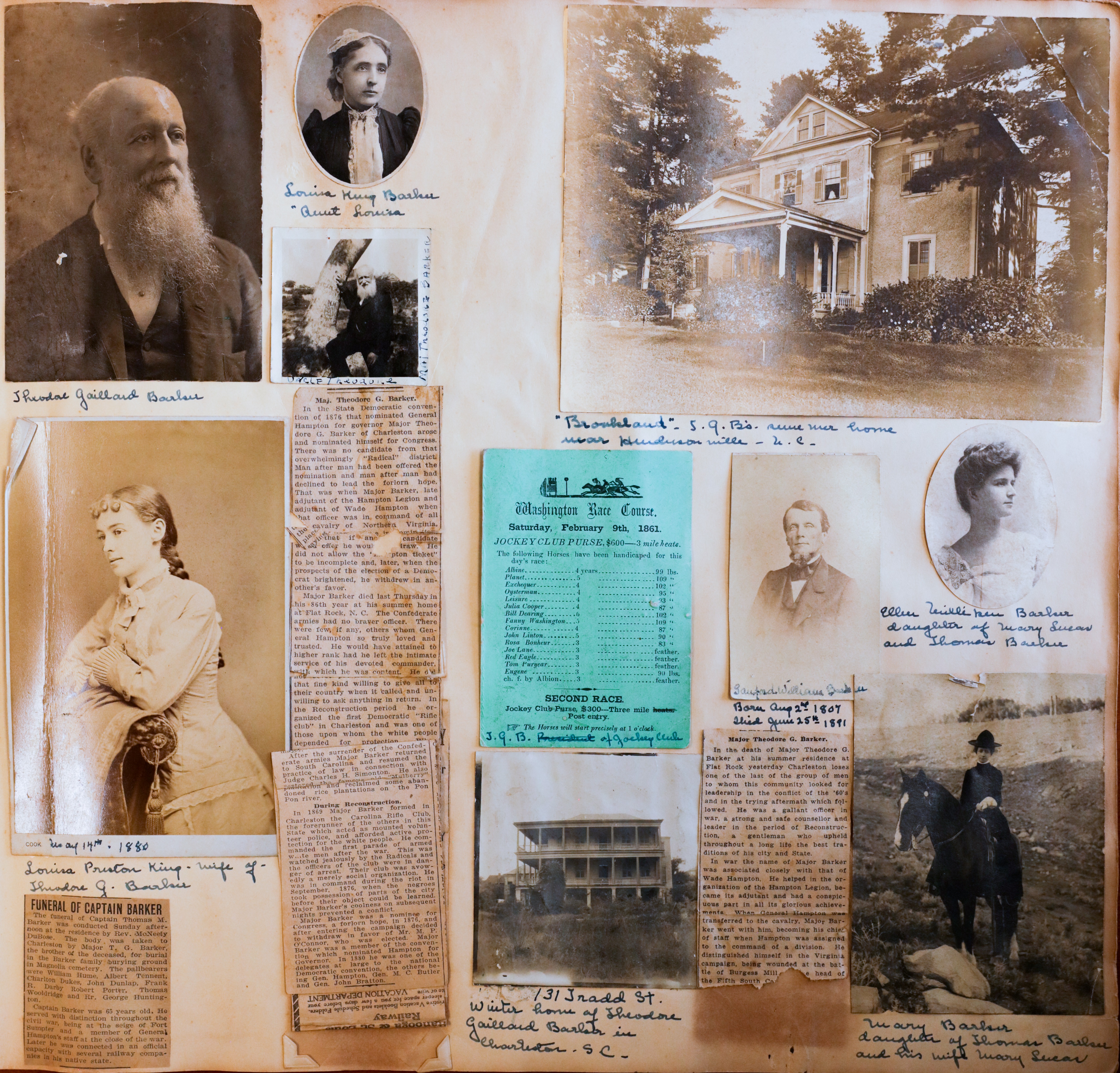
The page is a composite of seven mounted photographs and three newspaper clippings, with handwritten cursive captions in dark ink identifying most of the photographs.
Upper-left: Theodore Gaillard Barker
A large head-and-shoulders portrait of an older gentleman with a long white beard and dark coat, with a small white insignia pinned at the lapel. Caption beneath in cursive:
Theodore Gaillard Barker.
Upper-center: Louisa King Barker (“Aunt Louisa”)
A small oval portrait of a woman in dark dress with white ruffled collar, hair pulled back. Caption beneath:
Louisa King Barker / “Aunt Louisa”
Below the oval: Maj. Theodore Barker
A small standing photograph of an elderly bearded man outdoors beneath a tree. A vertical caption written along the right edge reads:
Maj. Theodore Barker
Upper-right: Brookland house
A larger sepia photograph of a two-story frame house with porch, set among trees and shrubs. Caption beneath in cursive ink:
“Brookland”. S.G.B’s summer home / near Hendersonville — N.C.
Center column: Washington Race Course card and Tradd Street house
A green printed card with a small horse-and-rider vignette at the head:
![horse and rider vignette]
Washington Race Course.
Saturday, February 9th, 1861.
JOCKEY CLUB PURSE, $600 — 3 mile heats.
The following Horses have been handicapped for this day’s race:
Albine 4 years 99 lbs. Planet 5 109 " Exchequer 4 102 " Oysterman 4 95 " Leisure 4 93 " Julia Cooper 4 87 " Bill Dearing 6 102 " Fanny Washington 5 109 " Corinne 4 87 " John Linton 5 90 " Rosa Bonheur 3 83 " Joe Lane 3 feather. Red Eagle 3 feather. Tom Puryear 3 feather. Eugene 3 90 lbs. ch. f. by Albion 3 feather. SECOND RACE.
Jockey Club Purse, $300 — Three mile
heater[heats] — Post entry.The Horses will start precisely at 1 o’clock.
A pencilled annotation along the bottom of the card reads:
[Pencilled annotation across the bottom of the card]: J.G.B. President of Jockey Club
Below the green card, a small photograph of a long, two-story building with a wide porch (the Tradd Street house). Caption beneath in cursive:
131 Tradd St. / Winter home of Theodore / Gaillard Barker in / Charleston — S.C.
Center-right: Sanford Williams Barker
A small carte-de-visite of a clean-shaven gentleman in dark coat and tie. Caption beneath in cursive:
Sanford Williams Barker
Born Aug 2nd 1807 / Died June 25th 1891
Right column: Ellen Milliken Barker (oval) and Mary Barker on horseback
An oval portrait at upper right of a young woman with dark hair and dark dress with white lace at the throat. Caption beneath:
Ellen Milliken Barker / daughter of Mary Lucas / and Thomas Barker
A larger photograph at lower right of a young woman in a dark riding habit and broad-brimmed dark hat, mounted side-saddle on a dark horse in a rocky outdoor setting. Caption beneath in cursive:
Mary Barker / daughter of Thomas Barker / and his wife Mary Lucas
Lower-left: photograph of Louisa Preston King and “Funeral of Captain Barker” clipping
A photograph of a young woman in a high-collared light dress with elaborate trim, standing beside a tasselled chair. The studio mark COOK sits in the lower left of the mount, with date No. Aug 14th, 1880 (the “No.” likely a studio serial-number prefix). Caption beneath in cursive:
Louisa Preston King — wife of — / Theodore G. Barker.
Below the photograph, a newspaper clipping in two narrow columns, headlined:
FUNERAL OF CAPTAIN BARKER
The funeral of Captain Thomas M. Barker was conducted Sunday afternoon at the residence by Rev. McNeely DuBose. The body was taken to Charleston by Major T. G. Barker, the brother of the deceased, for burial in the Barker family burying ground in Magnolia cemetery. The pallbearers were William Hume, Albert Tennent, Charlton Dukes, John Dunlap, Frank R. Darby, Robert Porter, Thomas Wooldridge and Mr. George Huntington.
Captain Barker was 65 years old. He served with distinction throughout the civil war, being at the seige of Fort Sumpter and a member of General Hampton’s staff at the close of the war. Later he was connected in an official capacity with several railway companies in his native state.
Lower-center / right: long clipping on Major Theodore G. Barker
A long newspaper clipping pasted vertically, headlined and continuing in narrow columns. Pencilled vertical annotation across the top reads:
[Pencilled across the top of the clipping]: Maj. Theodore Barker
Major Theodore G. Barker.
In the death of Major Theodore G. Barker at his summer residence at Flat Rock yesterday Charleston loses one of the last of the group of men to whom this community looked for leadership in the conflict of the '60’s and in the trying aftermath which followed. He was a gallant officer in war, a strong and safe counsellor and leader in the period of Reconstruction, a gentleman who upheld throughout a long life the best traditions of his city and State.
In war the name of Major Barker was associated closely with that of Wade Hampton. He helped in the organization of the Hampton Legion, became its adjutant and had a conspicuous part in all its glorious achievements. When General Hampton was transferred to the cavalry, Major Barker went with him, becoming his chief of staff when Hampton was assigned to the command of a division. He distinguished himself in the Virginia campaign, being wounded at the battle of Burgess Mill at the head of the Fifth South Ca[rolina Cavalry].
In the State Democratic convention of 1876 that nominated General Hampton for governor Major Theodore G. Barker of Charleston arose and nominated himself for Congress. There was no candidate from that overwhelmingly “Radical” district. Man after man had been offered the nomination and man after man had declined to lead the forlorn hope. That was when Major Barker, late adjutant of the Hampton Legion and adjutant of Wade Hampton when that officer was in command of all the cavalry of Northern Virginia, [proposed his name as a candidate, declaring] that if another candidate [should] offer he would [with]draw. He would not allow the “[Hamp]ton ticket” to be incomplete and, later, when the prospects of the election of a Democrat brightened, he withdrew in another’s favor.
Major Barker died last Thursday in his 86th year at his summer home at Flat Rock, N. C. The Confederate armies had no braver officer. There were few, if any, others whom General Hampton so truly loved and trusted. He would have attained to higher rank had he left the intimate service of his devoted commander, with which he was content. He [was] of all that fine kind willing to give all to their country when it called and unwilling to ask anything in return. In the Reconstruction period he reorganized the first Democratic “Rifle club” in Charleston and was one of those upon whom the white people depended for protection.
After the surrender of the Confederate armies Major Barker returned to South Carolina and resumed the practice of law in connection with Judge Charles H. Simonton. He also [aided in] reclaiming some abandoned rice plantations on the Pon Pon river.
During Reconstruction.
In 1869 Major Barker formed in Charleston the Carolina Rifle Club, the forerunner of the others in this State, which acted as mounted volunteer police, and afforded active protection to the white people. He commanded the parade of armed white men after the war. This was watched jealously by the Radicals and the officers of the club were in danger of arrest. Their club was severely & merely social organization. He was in command during the riot in September, 1876, when the negroes took possession of parts of the city before their object could be learned. Major Barker’s coolness on subsequent nights prevented a conflict.
Major Barker was a nominee for Congress, a forlorn hope, in 1876, and after entering the campaign withdrew in favor of Mr. M. P. O’Connor, who was elected. Major Barker was a member of the convention which nominated Hampton for Governor. In 1880 he was one of the delegates at large to the national Democratic convention, the others being Gen. Hampton, Gen. M. C. Butler and Gen. John Bratton.
AI Notes
An album leaf with seven mounted photographs and three newspaper clippings, all related to the Barker family. Photographs include: Theodore Gaillard Barker (large bearded portrait at upper left); Louisa King Barker (‘Aunt Louisa,’ small oval); Maj. Theodore Barker (small standing photograph below the oval); the Brookland house near Hendersonville, N.C.; Sanford Williams Barker (b. Aug 2, 1807, d. June 25, 1891); the Tradd Street house in Charleston (winter home of Theodore Gaillard Barker); Ellen Milliken Barker (oval portrait); Mary Barker on horseback. The center holds a green Washington Race Course Jockey Club Purse card dated Saturday February 9th, 1861, with a handwritten note ‘J.G.B. President of Jockey Club.’ A photograph of a seated young woman (also Louisa Preston King) sits at lower left, mounted by photographer Cook and dated Aug 14th 1880. Two newspaper clippings flank the page: ‘Funeral of Captain Barker’ (lower left, for Thomas M. Barker) and a long obituary ‘Major Theodore G. Barker’ (right column, recounting his death at his summer home at Flat Rock, NC, in his 86th year, his roles as adjutant of the Hampton Legion and chief of staff to Wade Hampton, the 1876 ‘forlorn hope’ candidacy, the Reconstruction-era Carolina Rifle Club, and his postwar law practice with Judge Charles H. Simonton).