Handwritten letter from Walhalla, addressed 'Dear William,' beginning page
Book 1, Page 101 ·1860s–1870s
Transcription
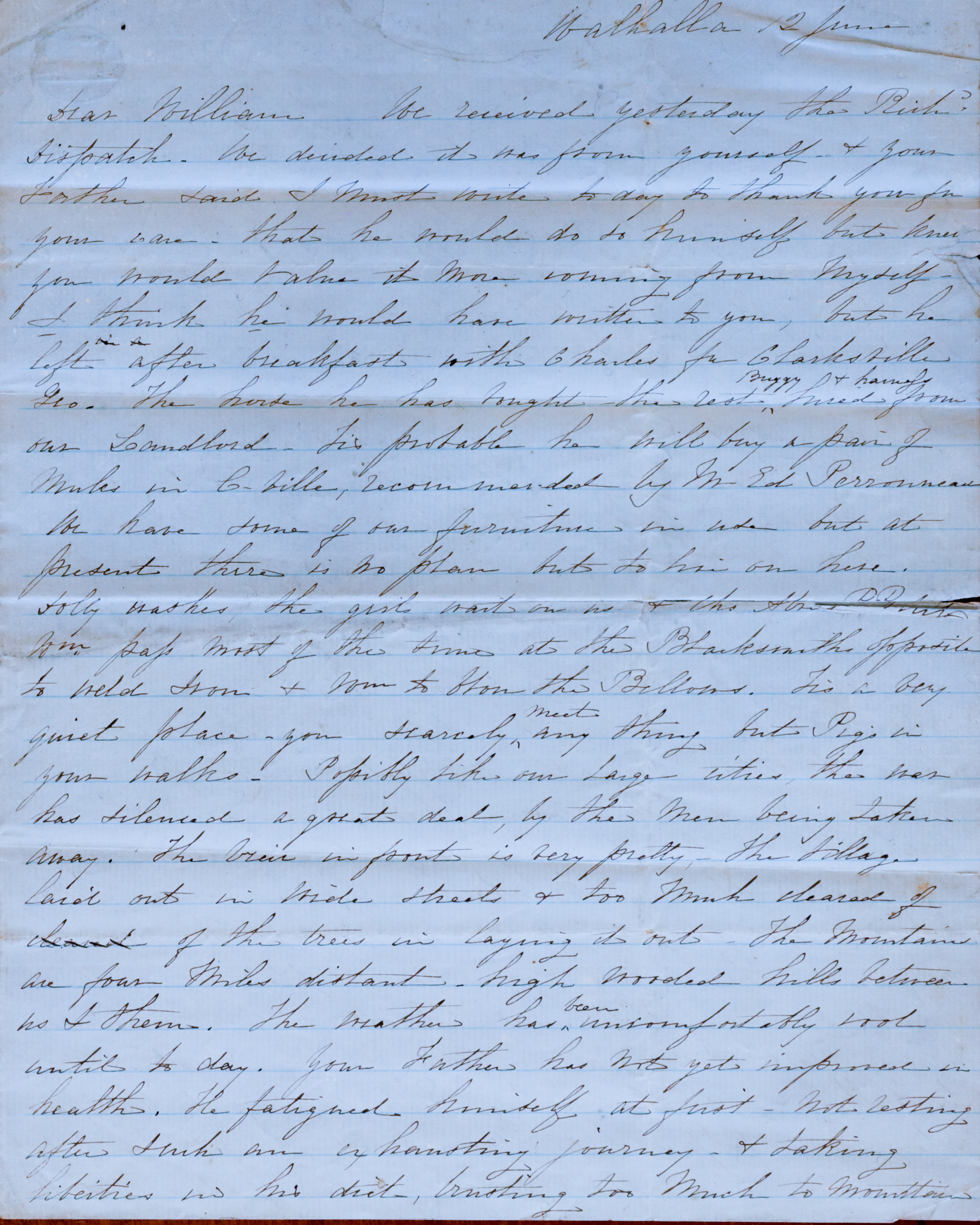
A handwritten letter, page 1 of multiple, in faded blue ink on plain paper. The dateline is written at the upper right; the body begins below at the left.
Walhalla 12 June
Dear William —
We received yesterday the [illegible] Dispatch. We deemed it very kind from yourself & your Father. Said I must write to-day to thank you for your care. — That he would do so himself but knew you would & also the More coming from Myself — I think he would have written to you, but he left after breakfast with Charles for Clarksville &c. The horse he has bought, the rest [Buggy & harness, need from] our Landlord. 'Tis probable he will buy a pair of Mules in C-ville, recommended by Mr Ed Perronneau. We have some of our furniture in use but at present there is no place but to hire one here. Solly washes & the girls wait on us, & [illegible] D Pritchard. Wm has most of the time at the Blacksmith opposite to weld iron & Wm to blow the Bellows. 'Tis a very quiet place — you scarcely meet any thing but Pigs in your walks. I really like our Large cities. The town has silenced a great deal, by the Men being taken away. The view in front is very pretty. The Village laid out in wide streets & too much cleared of trees — of the trees in laying it out. The Mountains are four Miles distant — high wooded hills between us & them. The weather has [been] uncomfortably cool until to-day. Your Father has not yet improven in health. He fatigued himself at first — Not resting after such an exhausting journey, & taking liberties in his diet, trusting too Much to Mountain [illegible]
AI Notes
First page of a multi-page handwritten letter, headed ‘Walhalla 12 June’ at the top right and addressed ‘Dear William.’ The writer reports receiving a dispatch the previous day, conveys thanks from the writer’s father, mentions the father’s departure that morning with Charles for Clarksville (he plans to buy a pair of mules recommended by Mr Ed Perronneau), and gives observations about the Walhalla village, surrounding wooded mountains, the weather, and the father’s health. The letter continues onto the next scan.
Letter continues on next page.
This is the opening leaf of the Walhalla refugee letter signed “E B” on p104 — Ellen Milliken Barker (1807–1874) writing to her son William. Walhalla, a German-colonization town in Oconee County in the SC upcountry, became a common Lowcountry-gentry refuge from 1862 onward as families sought distance from the Union blockade and bombardment of Charleston. The “Ed Perronneau” recommending the mules is one of the Charleston Perronneau-Porcher kin network.