Handwritten letter (continuation page) — on Henry's death and family news
Book 1, Page 98 ·1864
Transcription
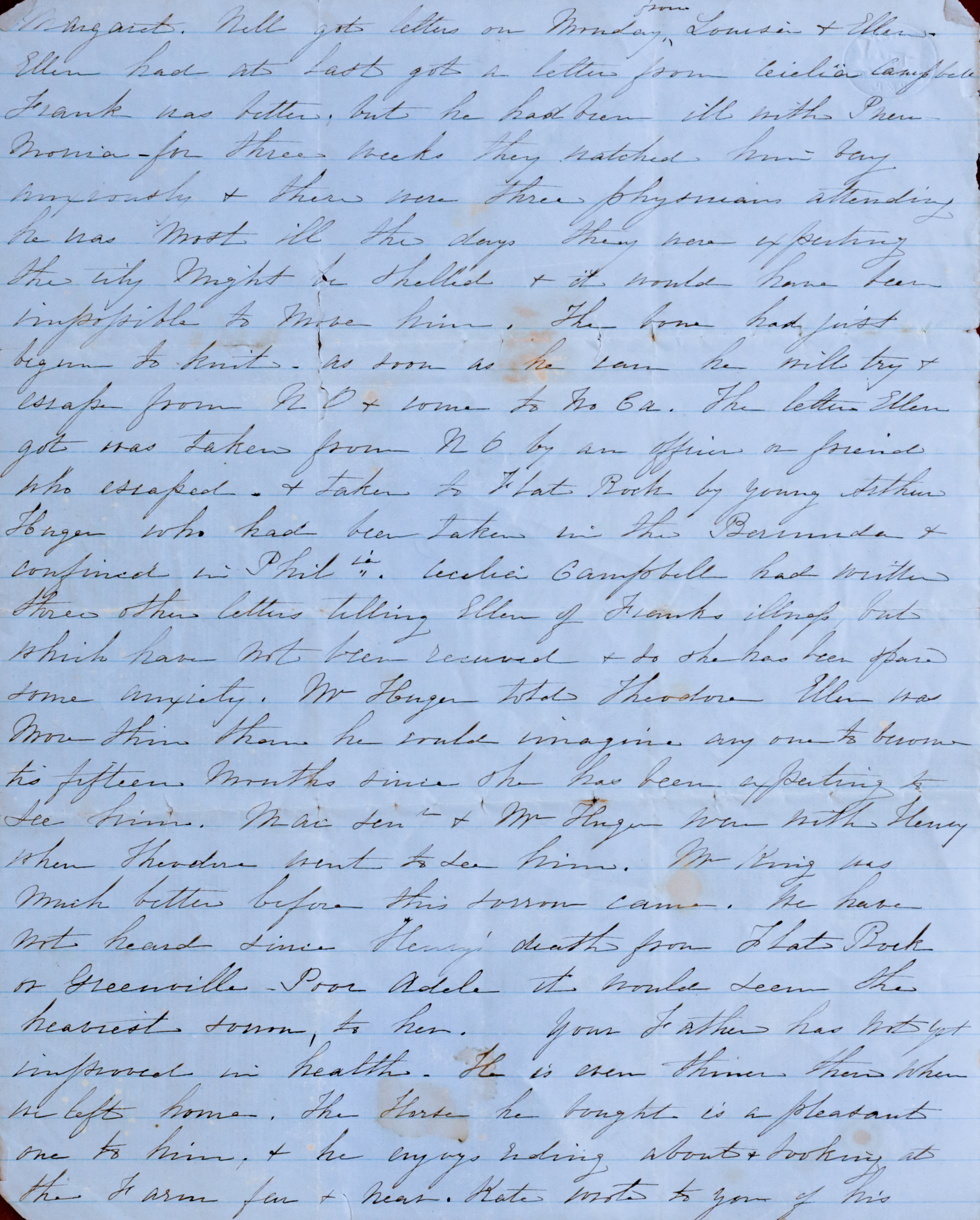
A handwritten letter page in brown ink, continuation from prior pages. Same hand and ink throughout.
[the same?] subject. Will got letters on Monday from [New Orleans]. Ellen had at last got a letter. Frank was better, but he had been ill with the Brain fever for three weeks. They watched him very anxiously & there were three Physicians attending. He was most ill the day they thought the city might be Shelled & it would have been impossible to move him. They had just begun to [Knit?] — as soon as he [saw?] he would try & escape from N. O. & come to No. Ca. The letter Ellen got was taken from N. O. by an Officer or friend who escaped — & taken to Flat Rock by young Arthur Huger, who had been taken in the [Peninsula?] & confined in Phila. Cecelia Campbell had written three other letters telling Ellen of Frank’s illness, which have not been received — & she has had some anxiety. Mr. Huger told Theodore — Ellen was Mrs. Henry [illegible] — them, he would imagine, anyone to know his fifteen months since she has seen him. Mai[?] sent [illegible] & Mr. Huger was with Henry when Theodore went to see him. Mr. King was much better before this sorrow came. He has not heard since Henry’s death from Flat Rock or Greenville. Poor Adele the invalid seems her heaviest sorrow to her. Your [Pa?] I think has not yet improved in health. He is even thinner than when he left home. The [Visit?] he thought is a pleasant one to him, & he enjoys riding about & looking at the Farm far & near. Kate wrote to you of his
AI Notes
Continuation page in brown ink. Will received letters Monday from New Orleans; Frank had been ill three weeks with brain fever, attended by three physicians; the city expected to be shelled. Arthur Huger escaped N.O. carrying Ellen’s letter to Flat Rock; Cecelia Campbell’s three other letters never arrived. Mr. Huger had visited Theodore; Mrs. King is much better. Adele the invalid is her heaviest sorrow. Letter continues.
The letter’s geography traces a wartime communication network: a Confederate officer captured in the Peninsula Campaign and held in Philadelphia carrying a New Orleans letter overland to Flat Rock, NC — the Henderson County village known as the “Little Charleston of the Mountains” and a principal refuge for Lowcountry families during the Civil War. “Brain fever” was a period catch-all for high fevers with delirium, often typhus, typhoid, or meningitis.
Letter continues on next page.