Letter from Charleston, Sept. 27, 1857, continued (verso)
Book 1, Page 65 ·1857
Transcription
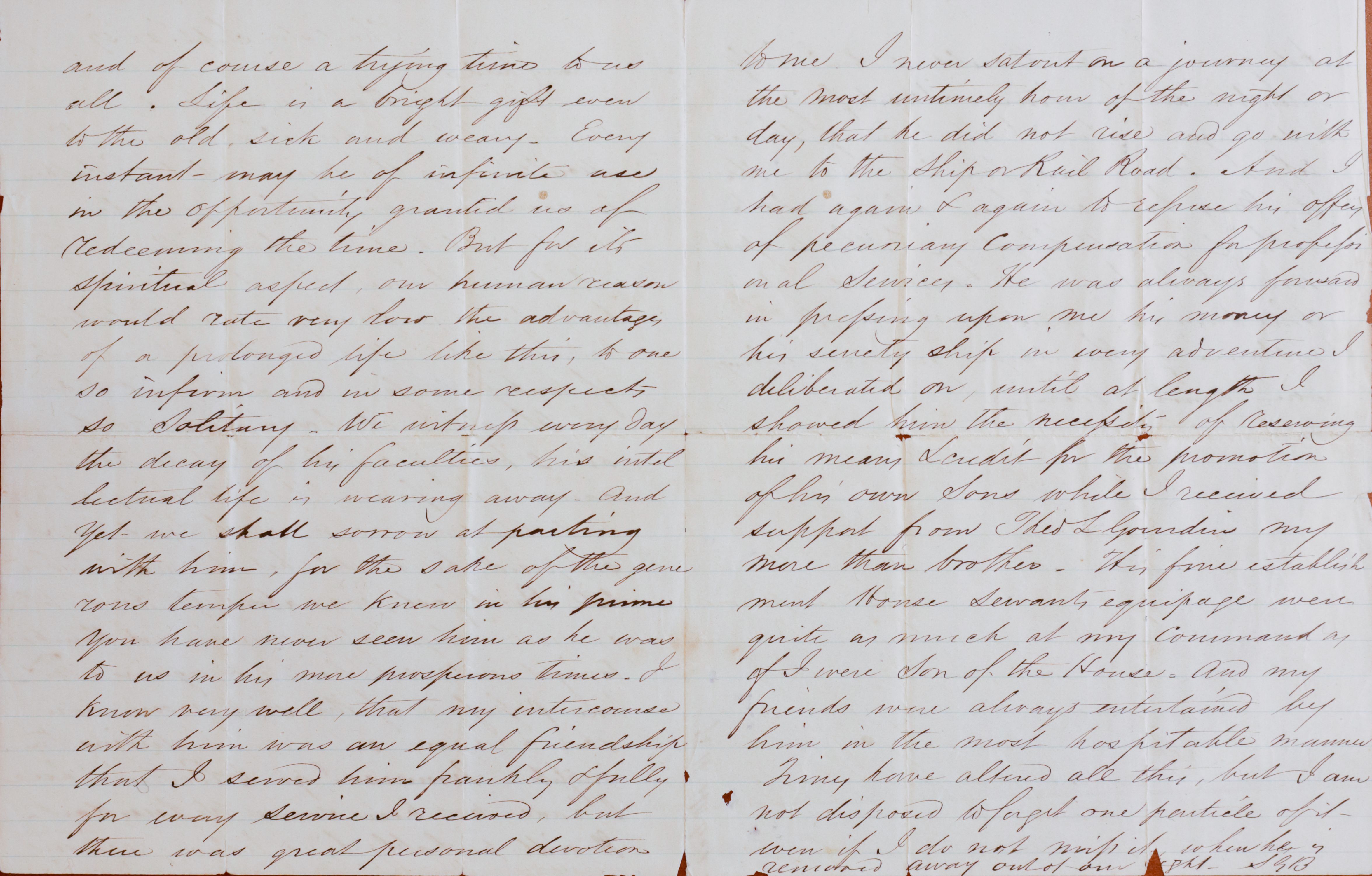
The verso of the bifolium begun on page 064. Two columns of cursive in brown ink, continuing the letter of September 27, 1857.
Left column
and of course a trying time to us all. Life is a bright gift even to the old, sick and weary. Every instant may be of infinite use in the opportunity granted us of Redeeming the time. But for its spiritual aspect, our human reason would rate very low the advantage of a prolonged life like this. To one so infirm and in some respects so Solitary, we witness every day the decay of his faculties, his intellectual life is wearing away. And yet we shall sorrow at parting with him, for the sake of the generous temper we knew in his prime. You have never seen him as he was to us in his more prosperous times. I know very well that my intercourse with him was an equal friendship — that I served him frankly & fully for every Service I received, but there was great personal devotion —
Right column
to me. I never set out on a journey at the most untimely hour of the night, or day, that he did not rise and go with me to the Ship or Rail Road. And I had again & again to refuse his offer of pecuniary Compensation for professional Services. He was always foremost in pressing upon me his money or his security ship in every adventure I deliberated on, until at length I showed him the necessity of Reserving his means & credit for the promotion of his own Sons, while I received support from Theo. L. Gourdin my more than brother. His fine establishment House Servants equipage were quite as much at my command as if I were Son of the House. And my friends were always entertained by him in the most hospitable manner. Times have altered all this, but I am not disposed to forget one particle of it, even if I do not insist on its wholly [being] rendered away out of our [illegible] —
AI Notes
Verso of the bifolium begun on page 064 — continuation of the September 27, 1857 letter from Charleston. The writer reflects on a dying old man’s diminishing intellectual life, then turns to his own debt of gratitude toward Theodore L. Gourdin, whom he calls ‘my more than brother,’ recalling Gourdin’s habitual generosity — pressing money, security, hospitality, and his establishment’s services on the writer ‘as if I were Son of the House.’ Likely part of the 1857–58 Milliken/Barker letter cluster.
Theodore Lazarus Gourdin (1790–1866) was a major Lowcountry planter with holdings in Berkeley, Charleston, Georgetown, and Williamsburg counties — son of Theodore Gourdin (1764–1826), the SC merchant-congressman, and Elizabeth Gaillard, placing him in the writer’s extended kin network through the Gaillard line. Samuel G. Barker’s reflection here registers an unusually deep patron-client friendship in antebellum Charleston’s mercantile-planter world; his own counting-house and credit were under strain by 1857, and Gourdin had stepped in repeatedly with money, hospitality, and personal escort.
Letter continues on the next scan.