Letter on Christian charity and almsgiving (page 4 of 4) — self-denial, the living temple, and signature 'Your Aff't father Sam'l Barker'
Book 1, Page 60
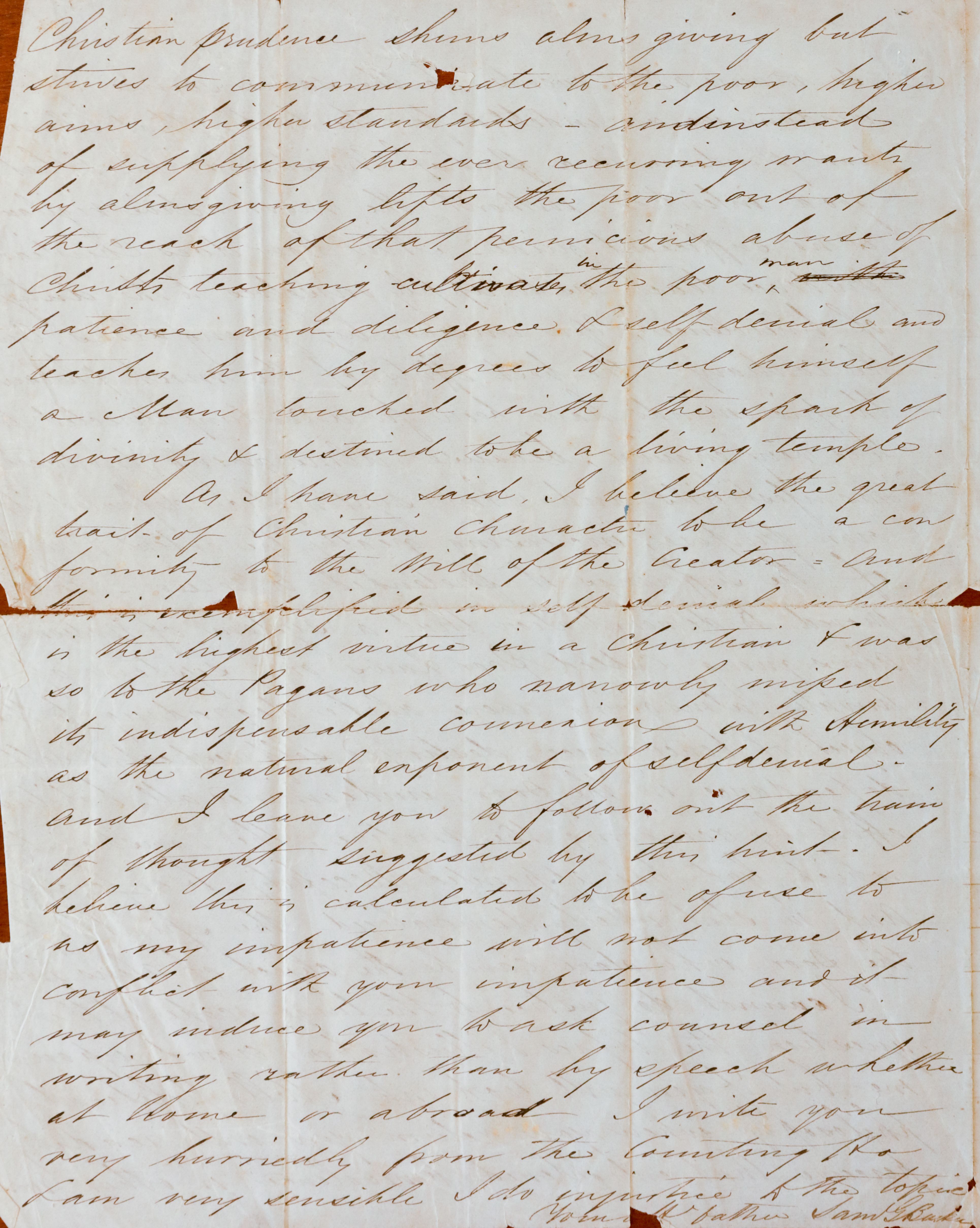
Transcription
Continuation of the letter on Christian almsgiving begun on the previous page. Same hand, same brown ink, on the second leaf of the folded sheet.
Christian Prudence shuns alms giving but strives to communicate to the poor, higher aims, higher standards — and instead of supplying his ever recurring wants by almsgiving lifts the poor out of the reach of that pernicious abuse of Christ’s teaching, [struck: cultivates] the poor [struck: man] patience and diligence, & self denial and teaches him by degrees to feel himself a Man touched with the spark of divinity & destined to be a living temple.
As I have said, I believe the great basis of Christian character to be a conformity to the Will of the Creator. And this is exemplified in self denial which is the highest virtue in a Christian & was so to the Pagans who narrowly missed its indispensable connexion with humility as the natural exponent of self denial.
And I leave you to follow out the train of thought suggested by this hint. I believe this is calculated to be of use to me, my impatience will not come into conflict with your impatience and it may induce you to ask counsel in writing rather than by speech whether at home or abroad. I write you very hurriedly, from the Counting Ho[use], I am very sensible I do injustice to the topic.
Your Aff[ec]t. father Sam’l Barker
AI Notes
Conclusion of the philosophical letter on Christian almsgiving begun on page 058 and continued through pages 059–060. The closing signature reads ‘Your Aff[ec]t. father Sam’l Barker’ (written ‘from the Counting Ho[use]’), with the surname partly masked by an ink blot. Given the recipient cluster (Susan Milliken Barker’s family) and the merchant context, the writer is Samuel Gaillard Barker (1799–1863), Susan’s father, writing to one of his children (probably his daughter Susan, addressed in the letter as ‘you’ returning home with ‘your impatience’). The letter recommends John Stuart Mill’s Principles of Political Economy (1848); together with Sam’l Barker’s death in 1863, this places the letter between 1848 and 1863. Self-correction in the text: writer first wrote ‘cultivates’ then crossed it through and wrote ‘man’ — i.e., ‘lifts the poor… cultivates the poor… [no — strike] …[the poor] man [a] living temple.’
The signature closes a four-page letter (pages 057–060) from Samuel Gaillard Barker, written from his Charleston counting house, to one of his daughters — most likely Susan Milliken Barker, who would later marry into the FitzSimons family and become the compiler’s paternal grandmother. Barker is the compiler’s paternal great-grandfather; an annotation in Amy’s hand on the address panel of a separate 1850s letter (page 082) identifies him as “my great gra[nd]father.”