Letter on Christian charity and almsgiving (page 3 of 4) — Christian Prudence; the evils of systematic alms giving
Book 1, Page 59
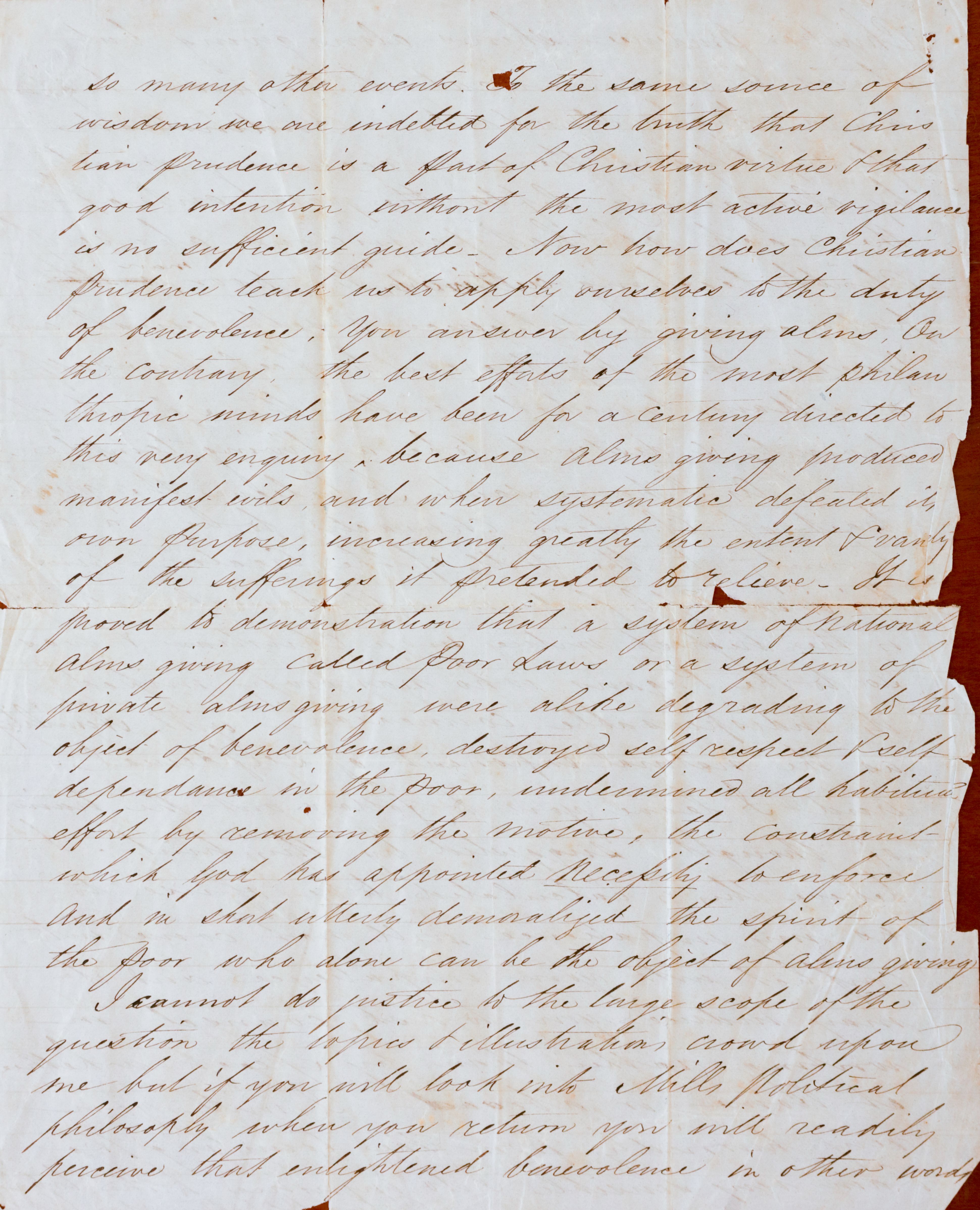
Transcription
A handwritten letter on faded laid paper, written in brown ink in a small, sloping cursive. The page is heavily creased from folding. The text begins mid-sentence at the top of the sheet.
so many other events. To the same source of wisdom we are indebted for the truth, that Christian prudence is a part of Christian virtue & that good intention without the most active vigilance is no sufficient guide. Now how does Christian Prudence teach us to apply ourselves to the duty of benevolence? You answer by giving alms. On the contrary, the best efforts of the most philanthropic minds have been for a century directed to this very enquiry, because alms giving produces manifest evils, and where systematic, defeats its own purposes, increasing greatly the extent & vanity of the sufferings it pretended to relieve. It is proved to demonstration that a system of National alms giving called Poor Laws or a system of private almsgiving were alike degrading to the object of benevolence, destroyed self respect & self dependence in the Poor, undermined all habitual effort by removing the motive, the Constraint which God has appointed Necessity, to enforce And in short utterly demoralized the spirit of the Poor who alone can be the object of alms giving.
I cannot do justice to the large scope of the question, the topics & illustrations crowd upon me, but if you will look into Mill’s Political philosophy, when you return you will readily perceive that enlightened benevolence in other words
AI Notes
Third sheet of the philosophical letter on Christian almsgiving. The writer argues that Christian Prudence is a part of Christian virtue and that almsgiving — whether as a national system (Poor Laws) or private practice — degrades the object of benevolence and demoralizes the Poor by removing the constraint of necessity God has appointed. He refers the reader to Mill’s Political philosophy (i.e., John Stuart Mill’s Principles of Political Economy, 1848) for fuller treatment. The letter continues onto page 060 (signed Sam’l Barker — Susan Milliken Barker’s father).
The reference to “Mill’s Political philosophy” is to John Stuart Mill’s Principles of Political Economy (1848), then the dominant English-language treatment of poor relief; Mill’s mixed verdict on the 1834 Poor Law Amendment Act framed the period’s debate over whether organized almsgiving did more harm than good. The writer’s argument that systematic charity “demoralizes” the poor by removing necessity as a spur to effort is squarely within that Victorian liberal tradition.
Letter continues on next page.