Manuscript copy of 'All Quiet Along the Potomac' (page 2)
Book 1, Page 56
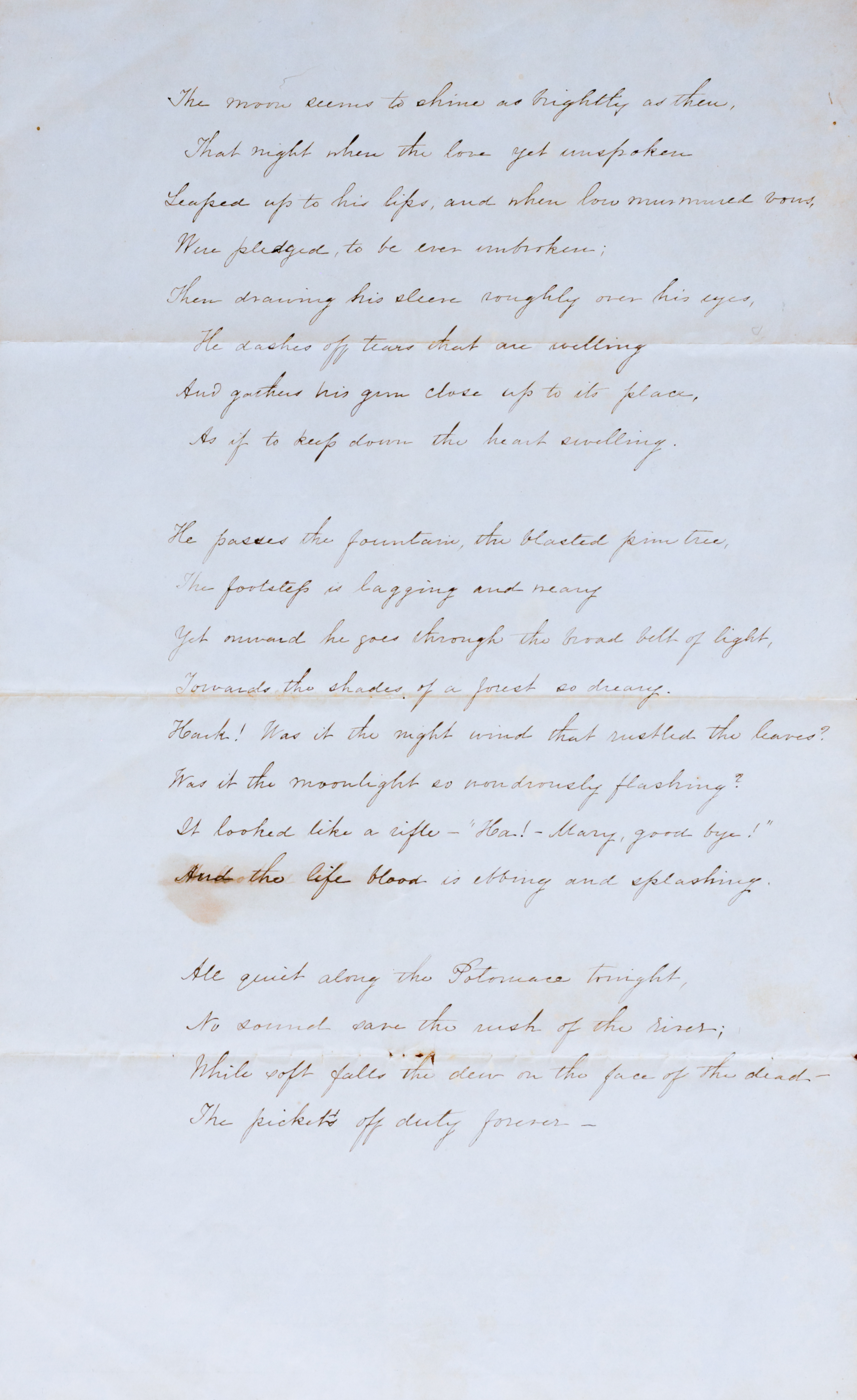
Transcription
The continuation and conclusion of the poem from the previous page.
The moon seems to shine as brightly as then,
That night when the love yet unspoken
Leaped up to his lips, and when low murmured vows,
Were pledged, to be ever unbroken;
Then drawing his sleeve roughly over his eyes,
He dashes off tears that are welling
And gathers his gun close up to its place,
As if to keep down the heart swelling.
He passes the fountain, the blasted pine tree,
The footstep is lagging and weary
Yet onward he goes through the broad belt of light,
Towards the shades of a forest so dreary.
Hark! Was it the night wind that rustled the leaves?
Was it the moonlight so wondrously flashing?
It looked like a rifle — “Ha! — Mary, good bye!”
And thelife blood is ebbing and splashing.All quiet along the Potomac tonight,
No sound save the rush of the river;
While soft falls the dew on the face of the dead —
The picket’s off duty forever —
AI Notes
Second and concluding page of the handwritten poem begun on page 055. Cursive in dark ink on the verso of the folded sheet. The final stanza closes the poem with the picket’s death. The penultimate line shows a struck-through ‘And the’ before ‘life blood is ebbing and splashing.’ Margins examined at full resolution — no annotations or perpendicular text.
The poem is “The Picket Guard,” better known as “All Quiet Along the Potomac Tonight,” written by American poet Ethel Lynn Beers and first published in Harper’s Weekly on 30 November 1861. Beers wrote it in response to a newspaper item noting that a lone sentry had been shot dead on a night reported officially as “all quiet”; set to music by John Hill Hewitt in 1863, it became one of the most widely circulated poems of the Civil War.