Manuscript copy of 'All Quiet Along the Potomac' (page 1)
Book 1, Page 55
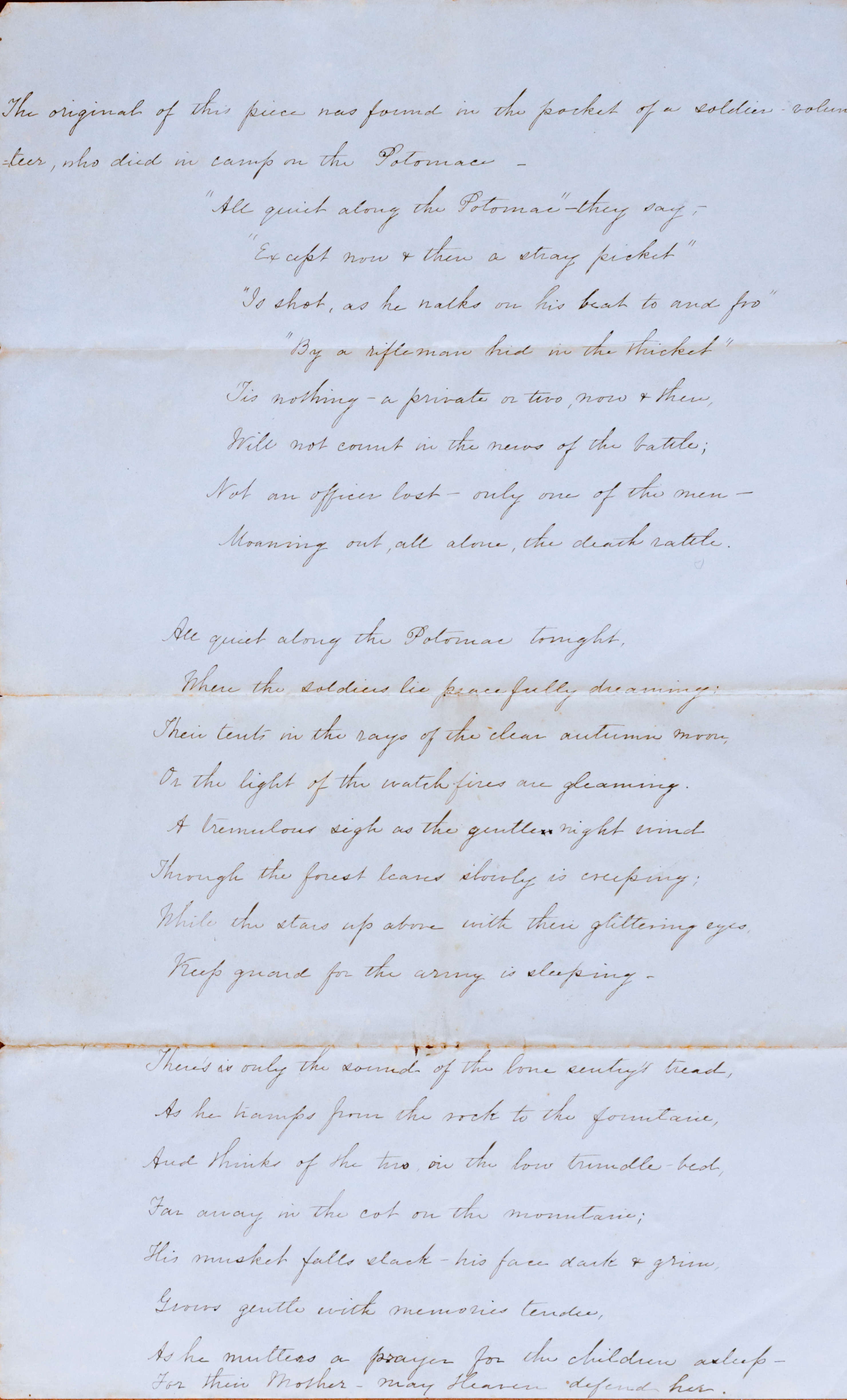
Transcription
A handwritten manuscript poem on a folded sheet, in cursive ink. A brief prose preface introduces the verses, which are arranged as three stanzas on this page.
The original of this piece was found in the pocket of a soldier-volun- teer, who died in camp on the Potomac —
“All quiet along the Potomac” — they say —
“Except now & then a stray picket”
“Is shot, as he walks on his beat to and fro”
“By a rifleman hid in the thicket”
'Tis nothing — a private or two, now & then,
Will not count in the news of the battle;
Not an officer lost — only one of the men —
Moaning out, all alone, the death rattle.
All quiet along the Potomac tonight,
Where the soldiers lie peacefully dreaming;
Their tents in the rays of the clear autumn moon,
Or the light of the watch fires are gleaming.
A tremulous sigh as the gentle night wind
Through the forest leaves slowly is creeping;
While the stars up above with their glittering eyes,
Keep guard for the army is sleeping —
There is only the sound of the lone sentry’s tread,
As he tramps from the rock to the fountain,
And thinks of the two on the low trundle-bed,
Far away in the cot on the mountain;
His musket falls slack — his face dark & grim,
Grows gentle with memories tender,
As he mutters a prayer for the children asleep —
For their Mother — may Heaven defend her.
AI Notes
First page of a handwritten copy of a Civil War-era poem, with a prefatory note that the original was found on a soldier-volunteer who died in camp on the Potomac. Cursive in dark ink on a folded sheet, with deep horizontal fold creases. The poem continues onto the next page. Margins examined at full resolution — no annotations or perpendicular text.
The poem is “All Quiet Along the Potomac Tonight” (originally “The Picket Guard”), written by Ethel Lynn Beers and first published in Harper’s Weekly on 30 November 1861. The prefatory note here — that the lines were “found in the pocket of a soldier-volunteer, who died in camp on the Potomac” — reflects one of several apocryphal origin stories that circulated during the war; the poem’s authorship was widely disputed and falsely claimed, including by the Confederate private Lamar Fontaine, before Beers was credited definitively in 1863. Poem continues on next page.