Letter fragment — wartime news from Vicksburg, with reference to Lee and Johnston
Book 1, Page 35 ·1863
Transcription
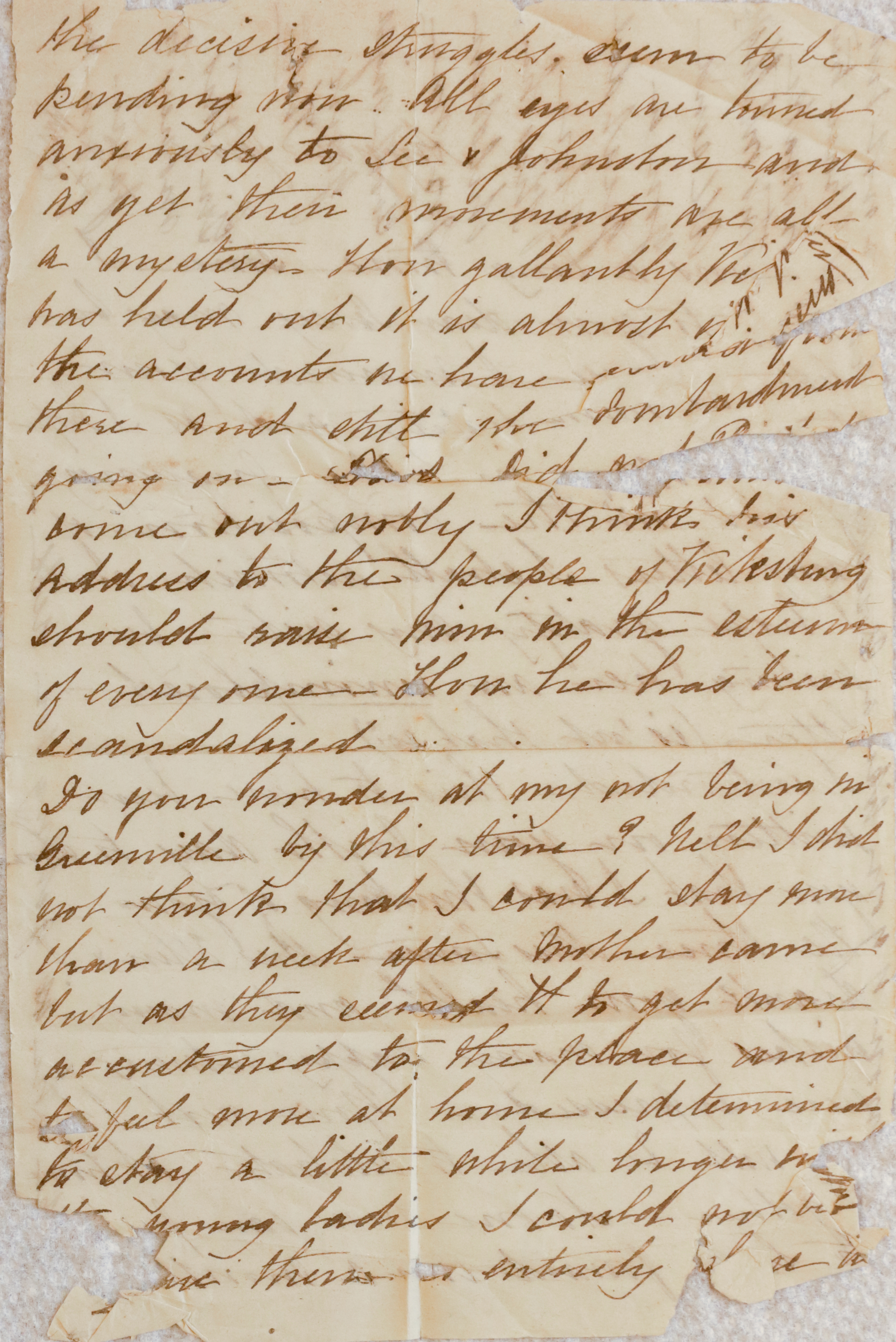
A page of a handwritten letter in faded brown ink on aged paper, with a horizontal crease across the middle that obliterates a short span of text. The page begins and ends mid-sentence; no salutation, signature, or date is visible.
[…] the decisive struggles seem to be pending now. All eyes are turned anxiously to Lee & Johnston and as yet their movements are all a mystery. How gallantly V.b. has held out — it is almost [illegible — word lost to crease] the accounts we have [illegible] from there and still the bombardment going on — [illegible — crease damage] bid [illegible] come out nobly. I think his address to the people of Vicksburg should raise him in the esteem of every one. How he has been scandalized.
Do you wonder at my not being in Greenville by this time? Well I did not think that I could stay more than a week after Mother came but as they [uncertain — “seemed it”?] to get more accustomed to the place and to feel more at home I determined to stay a little while longer to see young ladies I could not bear to see them so entirely […]
AI Notes
A page of a longer handwritten letter in brown/sepia ink on aged paper, with a horizontal crease across the middle. No salutation, signature, or date is visible. The writer comments on the bombardment of Vicksburg (which she abbreviates ‘V.b.’), the suspense of waiting for news of Lee and Johnston, and a published address to the people of Vicksburg — almost certainly Gen. John C. Pemberton’s. The writer then explains why she has not yet returned to Greenville: she stayed longer to be with her mother and to see the young ladies of the place. Internal evidence dates the letter to the siege of Vicksburg, May–early July 1863.
Letter continues on a page not present in this scan sequence. “V.b.” is the writer’s abbreviation for Vicksburg; “his address” refers, by context, to Gen. John C. Pemberton, who commanded the Confederate forces at Vicksburg during the May–July 1863 siege.