Letter from Ellen Porcher, Charleston, May 7, 1898, to Aunt Ellen FitzSimons (opening pages)
Book 1, Page 30 ·1898
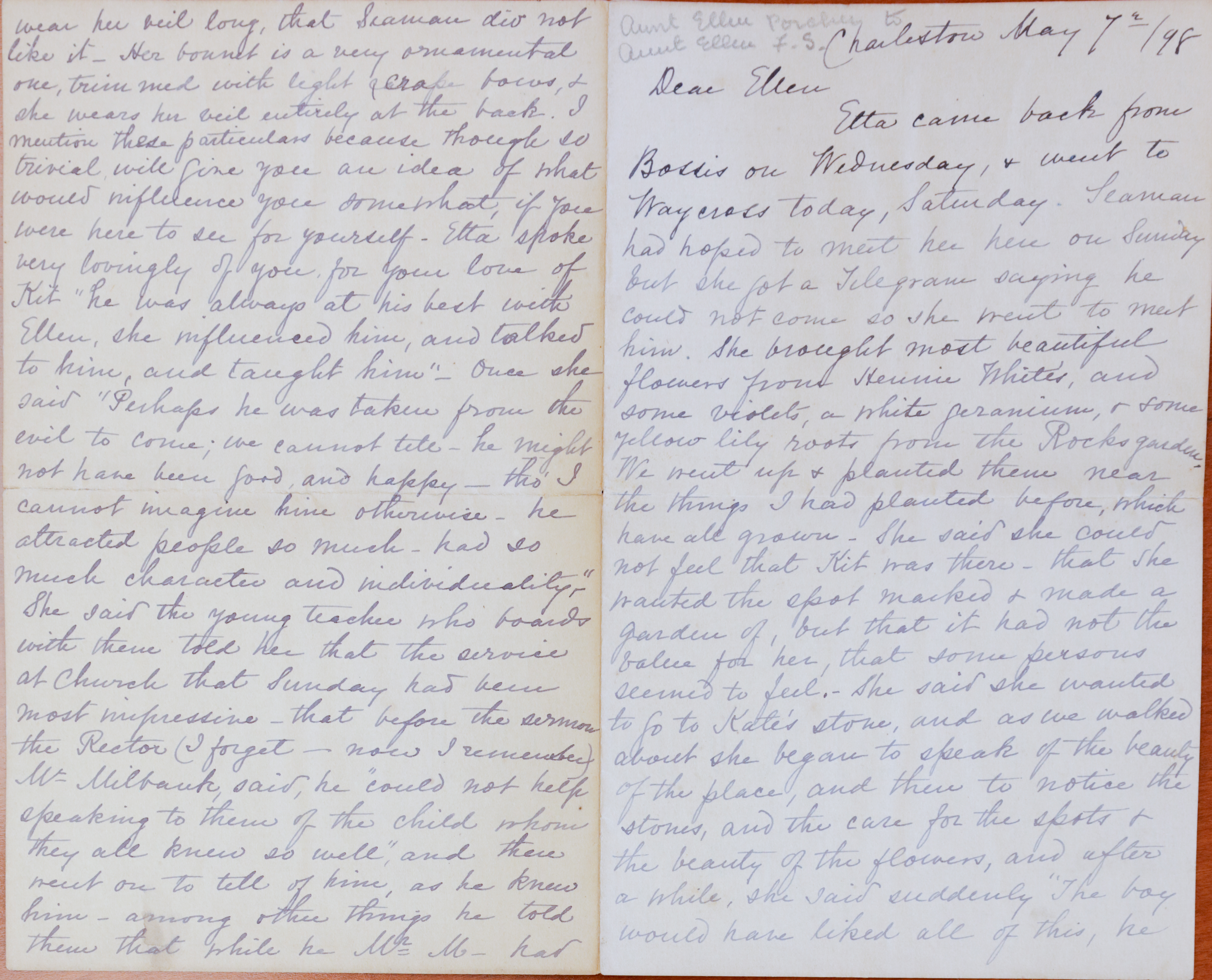
Transcription
A two-page spread of a handwritten letter in blue/purple ink in cursive. A pencilled archival annotation in a later (20th-century) hand runs across the top of both halves of the spread.
[Pencilled annotation, repeated across both halves]: Aunt Ellen Porcher to Aunt Ellen F.S.
Right half — opening of letter
Charleston May 7th/'98
Dear Ellen
Etta came back from Bollis on Wednesday, & went to Waycross today, Saturday. Seaman had hoped to meet her here on Sunday, but she got a Telegram saying he could not come, so she went to meet him. She brought most beautiful flowers from Hennie White’s, and some violets, a white geranium, & some yellow lily roots from the Rock garden. We went up & planted them near the things I had planted before, which have all grown. She said she could not feel that Kit was there — that she wanted the spot marked & made a garden of, but that it had not the value for her, that some persons seemed to feel. — She said she wanted to go to Kit’s stone, and as we walked about she began to speak of the beauty of the place, and then to notice the stones, and the care for the spot, & the beauty of the flowers, and after a while, she said suddenly “The boy would have liked all of this” — he
Left half — continuation
wear her veil long, that Seaman did not like it. — Her bonnet is a very ornamental one, trimmed with light crape bows, & she wears her veil entirely at the back. I mention these particulars because though so trivial will give you an idea of what would influence you somewhat, if you were here to see for yourself. — Etta spoke very lovingly of you, for your love of Kit — “he was always at his best with Ellen, she influenced him, and talked to him, and taught him” — Once she said “Perhaps he was taken from the evil to come; we cannot tell — he might not have been good and happy. — tho’ I cannot imagine him otherwise. — he attracted people so much — had so much character and individuality.” She said the young teacher who boards with them told her that the services at Church that Sunday had been most impressive — that before the sermon the Rector (I forget — now I remember Mr. Milbank) said he could not help speaking to them of the child, whom they all knew so well, and then went on to tell of him, as he knew him — among other things he told them that while he, Mr. M—, had
AI Notes
A two-page spread of a handwritten letter dated Charleston, May 7, 1898, addressed “Dear Ellen”. The right half holds the opening of the letter; the left half holds a continuation. A pencilled archival note in a later hand sits at the top of both halves identifying writer and recipient. The letter continues onto pages 031 and 032.
pencilled annotation across the top fully resolved as “Aunt Ellen Porcher to Aunt Ellen F.S.” — i.e. the letter was written by Ellen Milliken Barker Porcher (“Aunt Ellen Porcher”, Susan Milliken Barker’s sister, m. Thomas Porcher) to her niece-in-law / sister-in-law Ellen Milliken FitzSimons (“Aunt Ellen F.S.”). “Sennie White’s”→ “Hennie White’s”; “boillere”→“value”; “bouret”→“bonnet”; “trimmed with light crepe [uncertain], because”→“trimmed with light crape bows, &” — i.e. mourning crape (the subject is wearing a mourning bonnet for the death of Kit). “she means no veil entirely at the back”→“she wears her veil entirely at the back”. “We rust up & planted”→“We went up & planted”. “Owen she said”→“Once she said”. “Kate’s stone”/“Kit’s stone” confirmed as Kit’s. The deceased “Kit” is Christopher FitzSimons (son of Seaman Sinkler FitzSimons and Henrietta Gaillard), who had died at Waycross, Georgia, on 27 March 1898 in his 11th year; Etta is his mother visiting his grave. “Mr. Milbank” confirmed as the rector who preached the funeral.
Letter continues on next scan.
The grief that pervades this letter is for Kit — a 10-year-old Christopher FitzSimons, son of Seaman Sinkler FitzSimons (one of the seven children of Dr. Christopher 3rd + Susan Milliken Barker) and Henrietta (“Etta”) Gaillard, who had died at Waycross, Georgia on 27 March 1898. “Aunt Ellen Porcher” (the writer) was Susan Milliken Barker’s sister; she is writing to her niece-in-law Aunt Ellen FitzSimons at the Charleston Library Society — two of the album’s several Ellens.