Newspaper clipping: 'Wade Hampton Ended Rule Of Carpetbaggers' by Anthony Harrigan
Book 1, Page 29 ·1876–1878
Transcription
A newspaper clipping pasted to the page, with a portrait of Wade Hampton at upper right. A pencilled annotation in cursive runs across the very top of the clipping, partly obscured.
[Pencilled annotation across top of clipping]: No mention in any history of the bayonets [illegible]
Men Of Principle
Wade Hampton Ended Rule Of Carpetbaggers
Editor’s Note: This is the second of a series of articles on three South Carolina defenders of states rights, John C. Calhoun, Wade Hampton and Strom Thurmond. The presidential campaign will be a time of decision for South Carolinians. They may find useful guidance in the careers of these three states’ righters.
By Anthony Harrigan
“I appeal to you all, white and colored, as South Carolinians, to use every effort to keep down violence or turbulence. . . . We trust to the law and the Constitution, and we have perfect faith in the justice of our cause. I have been elected your governor, and, so help me God, I will take my seat.”
Thus spoke Wade Hampton, governor-elect of South Carolina from the State house portico at the end of the fiercely fought campaign to end carpetbagger government in this State.
The 5,000 angry South Carolinians gathered [illegible] and lawns around the State house in Columbia turned and moved away. Only one man could have prevented an outbreak of violence. The huge man on steps above the crowd, Wade Hampton who 31 days earlier, on November 7, 1876 had been elected governor of South Carolina.
With his calming words, Wade Hampton demonstrated his remarkable hold over the people of South Carolina. They trusted him. Whether they would be a free people again or whether they would continue as victims of the corruption, military dictatorship and occupations they had suffered for a decade was up to the ex-Confederate general who led them.
How well did he lead his people? It is history. On April 3, less than five months later, President Hayes’ Cabinet met and agreed to withdraw federal troops from South Carolina. On April 11, Hampton entered the State house and carpetbagger rule came to an end in the Palmetto State.
Never has calm resolution, patience, and determination not to be maneuvered into a rash deed borne such fruit in the history of the American Republic. A Hampton’s methods and philosophy are lessons for any State whose rights are being usurped at any time.
The South Carolina to which Hampton struggled in 1876 was a prostrate state. The ignorant were installed on high state posts. Men who could do no more than write their names were State senators. School commissioners were grossly incompetent. The following was written by a successful aspirant to a school board:
“The folier ring name person are Rickermended to be the Boarde (a list of names was presented for the Hower (Howard?) Schoole Haveing Given fool sat es fact Shon in the Las Last years.”
There was financial ruin. The State debt in two years of carpetbagger rule increased from $5 million to $14 million.
There was federal terror. The right of habeas corpus was suspended. Squads of cavalry made nighttime arrests. There were no warrants. The prisoners were taken to jail, there to wait the pleasure of the government.
There were frauds and unbridled spending. In the session of 1870-71 the black legislature spent $281,514 for “sundries, wines, liquors, cigars, groceries, etc.” Among the items ordered by the legislators were 800 clocks, sponge mattresses, 88 cuspidores, “finest Havana cigars,” champagne, 600 mirrors. In one day there was delivered for the use of the House wines and liquors amounting to $2,088.
By 1876 the good people of South Carolina had taken all they could stomach. They were determined to do all that was necessary to restore decency in their state, no matter what the cost.
The man South Carolinians nominated to lead their fight was 58-years-old — a big, powerful, athletic man, he was described as, with dark blue eyes, self confident, a fighter, with all the vigor of the days when he led J. E. B. Stuart’s cavalry in Virginia.
His stand was perfectly clear. “Should I be nominated,” he told the nominating convention, “my sole effort shall be to restore our State government to decency, to honesty, to economy, and to integrity. I shall be the Governor of the whole people, knowing no party.”
All that summer and early fall Hampton stumped the state. Again and again he stated his platform: “Reconciliation, retrenchment and reform.” He urged good feeling between the races.
But ever present was violence and threats of violence. Negro henchmen of the Radicals persecuted Negroes who supported Hampton. They armed themselves with guns and clubs and bullied the Negro Democrats.
The whites met threatened violence with organization. Semi-military groups of men who wore red shirts as a distinctive mark were banded together for action. The red shirt units began to parade throughout the state.
On November 7 the people of South Carolina went to the polls. The next day Hampton was declared the winner by a majority of approximately 1,000.
Then came the second phase of the struggle. The carpetbaggers refused to accept the return. President U. S. Grant, in the last months of his administration, recognized the carpetbagger governor the official governor and gave him direction of federal troops in the state.
Hampton, moving slowly and patiently, organized the legislature and won over Negro converts from the carpetbagger camp. He turned-down overtures of compromise, and on December 14 was inaugurated.
Hampton’s dignified conduct and unwillingness to allow violence to erupt that would result in a return of federal troops in mass strengthened his position in the state. His calm leadership also won press support in the North.
Other noble measures were used to assure the position of the Democrats. South Carolina merchants were induced to declare Hampton governor and the Democratic legislature the real government of the state. They announced they would pay taxes to the Hampton administration and ignore the carpetbagger tax men.
Hampton’s administration set out to inform all carpetbagger trial justices in the state that they had been removed and replaced.
A Hampton pardon of a convict at the State prison saw used as a test case in determining his authority. His action was upheld in the State supreme court.
The South Carolina presidential elector vote went to Hayes, and so did a letter from Hampton requesting withdrawal of federal troops from South Carolina. The tide had turned in the North. The Northern press was ready to accept control of South Carolina by South Carolinians; the carpetbagger pretender to the governorship was advised by Hayes aides to withdraw. Hampton himself was invited to Washington to meet the new president.
On April 2 President Hayes’ cabinet made the decision to withdraw federal troops from the state. South Carolina had rewon its independence.
Hampton had demonstrated that patience, diplomacy and organization also serve in preserving States Rights.
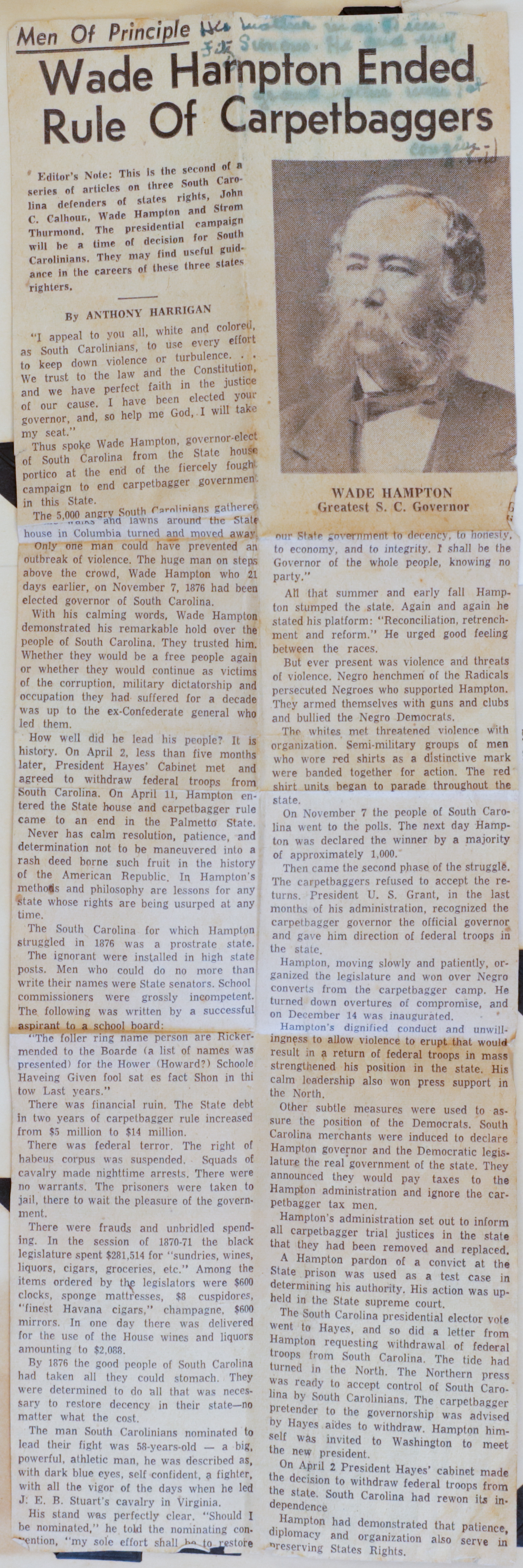
A photograph of Wade Hampton sits at upper right of the clipping, captioned:
WADE HAMPTON
Greatest S. C. Governor
AI Notes
A long newspaper clipping mounted on the page, headlined ‘Wade Hampton Ended Rule Of Carpetbaggers’ by Anthony Harrigan, second in a ‘Men Of Principle’ series on Southern defenders of states rights (Calhoun, Hampton, Thurmond). Includes a portrait of Hampton captioned ‘Greatest S. C. Governor.’ A pencilled annotation in cursive runs across the very top of the clipping.
The “Men Of Principle” series pairs Hampton with John C. Calhoun and Strom Thurmond (a sitting U.S. Senator from 1954), placing the clipping in the late 1950s or 1960s. Wade Hampton III (1818–1902) was the eldest son of Ann FitzSimons + Wade Hampton II — the compiler’s first cousin twice removed and the family’s most famous kinsman. The 1876 campaign was waged in significant part by the Red Shirt paramilitary units the article mentions in passing — armed Democratic clubs that intimidated and in several documented cases killed Republican voters in the months before the election.